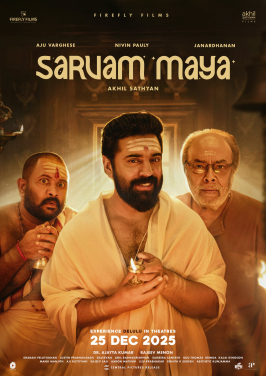
My wife and I watched Sarvam Maya on JioHotstar, together on a day when the kids were away at school. They joined us during the second sitting of the movie.
It has been a long time since we saw something this light hearted and comic while addressing many things we see in our society around us. It covers how we think about ghosts, how we think about Gen Z (and their ghostly behaviour), atheism, shades of the drug issue in Kerala, and our shallow beliefs in our religious practice.
The ending flummoxed me. Even such a light hearted movie required so much work as a viewer. There are deleted scenes on the Director’s and Producer’s YouTube channels. There is a podcast by the Director and actors from the movie, again on their YouTube channel. I finally had to also watch a Pirate Explains video on YouTube.
The deleted scenes and the podcast are in the playlist below.
There is a lot of content online from the actors of the movie. I finally stopped watching content from them.
I spent the hours leading up to the New Year’s watching eko which dropped on Netflix. We watched together as a family. I really enjoyed watching this finale of the Animal trilogy.
The story telling with a twist in the tale reminiscent of Jeffrey Archer who wrote a book of short stories with that name. Doing that with three stories on television/theatre is difficult.
Eko serves as the third and final instalment of Bahul Ramesh’s Animal Trilogy, following Kishkindha Kaandam (2024) and Kerala Crime Files 2 (2025).
I recently needed to read about movies to understand the story better after just one viewing. I didn’t have the energy to watch them again to discover these hidden layers. I even overlooked some details when reading about them. That’s when I found the explanations on The Pirate Explains YouTube channel helpful.
The first video from the channel is about the questions you may have had you watched the movie only once. I would warn you against watching this video unless you have watched the movie at least once.
The same channel had another video that fixes the timeline in the movie for you, but I didn’t think that was that much of a value add.
Sometimes protection and restriction, both look the same. This is the thought with which Bahul Ramesh wrote eko. I enjoyed learning about his intuitive writing of the first draft in this interview with Baradwaj Rangan.
He has a really unique storywriting process. Dialogue, Screenplay, and Story.
But, eventually, this means that I can’t post a review immediately after watching it.
We watched this movie in the morning of the first day of the new year. We were looking for something light-hearted. I had not read any of the reviews and things got pretty serious very fast.
We watched Bheemante Vazhi on New Year’s eve on December 31, 2021. The film portrays the efforts of a people in a poor neighborhood on the side of the railway tracks trying to get an accessible road to their houses.
Theatrical Release Poster of Bheemante Vazhi
The movie highlights the plight of any person who undertakes public tasks in a community in Kerala. The film highlights these in a light hearted way.
Kunchako Boban’s character Sanju aka Bheeman’s love stories in the movie seem interesting choices. Be it the one-way or the love-to-get-your-work-done with the Railway Engineer or the girl who seemed to be waiting for him to make a proposal. Does the presence of martial arts in this movie and in Minnal Murali point to something?
I enjoyed the climax fight scene involving not your usual suspects. I did not understand the animation for the intro scene of the movie. I guess like other Malayalam movies of the day, I would need to read reviews to understand these nuances.
The music from this movie introduced me to Agam, Thaikkudam Bridge and Masala Coffee. It was this music that made me curious about the movie. I had seen bits of it before but when I saw the movie was on Netflix, I thought that it was good use if any of my month long subscription.
I saw the Tamil version of Solo. It stars Dulquer Salman. It constitutes four parts – the elements of Earth, Air, Fire and Water. It looks at the four forms of Shiva. I loved the art and the filming style.
There are many gaps in the story that I was curious about. I like open ended stories. I like non-reveals. I loved this movie.
The Minimalists are a duo who blogged about minimalism alongside others in the late noughties (2000’s). In 2015, they made a move called Minimalism, about the movement. The movie was a conversation that the Minimalists had with many prominent participants and bloggers of the movement.
Many of the bloggers who participated in that movement have now changed their focus away from Minimalism and moved on to other things. I, myself feel drawn more to the idea that Greg McKeown presented in Essentialism. Minimalism is a movement that forms an ideal foundation for many more pragmatic movements and ideas.
The Minimalists are back in 2021 with a follow-up documentary called Less is Now. In this documentary, they talk about their own story. It features a few experts who talk about the financial, economic and environmental burden cost by “stuff”. The story is interlaced with stories of many ordinary individuals who followed the principles laid down by the movement.
The film is directed by Matt D’Avella, whose YouTube channel I follow. I love to watch the videos that Matt directs and that’s possibly the only reason I wanted to watch this documentary.
I subscribed to a month of Netflix again just to watch this 50 minute documentary. I think just watching Matt’s film making was worth watching this.
A spacey afterlife, I had tweeted after I first saw the trailer of Cargo on YouTube.
Netflix trailer for Cargo
I have had a love affair with space since I was a teenager. But, I wasn’t the brave type of fellow who would enjoy being strapped to a rocket. So, I had settled for dreams of being an engineer on Earth who sent people out into space. If forced to leave Earth, I would definitely not be in the first few flights off Earth.
The only way for me to access space in those teenage years through the pages of a science fiction book. I have recently started reading Indian science fiction again by reading Gautam Bhatia’s The Wall. I thought this was a movie I could watch as part of that project.
Going to space after death! People seem to be going to and from the spacecraft without rockets. But, I wonder if the fear of sitting on a rocket will play a role after you die.
Death is a great segue to spirituality, my other interest. Hinduism views death as the first step in the reincarnation process. One dies. Then, one is re-born. The idea is to break this cycle of life, death and re-birth. My personal reading in spirituality has been centered around the Upanishads. I see them as a mental model to answer some of the difficult questions I have till science gives us more concrete answers.
Cargo combines space and death in a very innovative way.
References
As I watched the movie, I was looking up the movie on Wikipedia and Google to understand more of the space and spirituality references the movie uses. What follows are the ones that I found.
The connection to bulls as the mount used by Yama, the Hindu god of death is the logo for the Post Death Transition Services. It is well branded on the coffee mug that the protagonist uses.
The spaceship where they ‘transition’ human beings from one life to the next are called Pushpak. Pushpak is the first reference to a vimana in Hindu texts. This is a chariot built by Vishwakarma for Brahma, the Hindu god of creation. This is the vehicle that Ravana later stole from Kubera, the Hindu god of wealth who got it from Brahma. Vishwakarma is the divine architect and god of architects and engineers. Look at how technical and step-by-step the ‘transition’ is. Doff of the hat to Vishwakarma?
The lead is named Prahasta. Prahasta is the General of the Lankan army and Ravana’s maternal uncle. In the war with Rama, Prahasta is the general of the army leading the first wave. So, Prahasta in the movie, is one of the first six rakshasa-astronauts who fly the first Pushpak?
Prahasta’s science guy at Ground control is named Raman sir. Doff of the hat to C V Raman?
My take
Many of the Upanishads take the question-answer mode between two or multiple people to tackle deep philosophical questions. Many of them have a guru-disciple setting. I think the movie sets the spacecraft as a back drop to have a few question-answer mode between Yuvishka as the student and Prahasta as a guru.
I would consider everything else being nothing more than setting up the scene for this conversation.
I am not sure if the human-rakshasa agreement where humans agree to be led by rakshasas is a commentary on the present political climate?
I think there are more references and hooks that are present in the film that I may not get as I am not a full time movie goer.
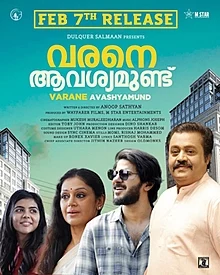
I got my wife a Netflix subscription for a month and the first thing we got to seeing is the Malayalam movie, Varane Avashyamundu (transl. Groom wanted). We had missed watching this in the theatres in February. The story starring Shobhana, Suresh Gopi, Dulquer Salman and Kalyani Priyadarshan and marks the directorial debut of Sathyan Anthikad’s son, Anoop Sathyan.
The movie begins with a single mother – daughter duo looking for groom for the daughter and ends with the daughter selecting a groom for her single mother. But, intertwined in this simple narrative are various societal issues. These include broken marriages, single mothers, adoption, Army men who return from Service but unable to survive in Society and many more. These were issues that Sathyan Anthikad also covered in his movies in the 1980s and 1990s. That Anoop Sathyan covers some of the same issues in 2020 is quite telling.
Shobhana is a single mother who has escaped from a broken marriage. Lalu Alex plays a supportive brother who helps her escape and supports her as she is living life. Her daughter, learning from her mother’s experience thinks a love marriage is destined for failure and attempts to find a groom for herself. She uses matrimonial websites to find her match.
Suresh Gopi plays a troubled military officer who has done great things while in the Armed Forces but struggles to fit in into Society. He says he finds it easier to face the enemy than to tell a woman that he loves her. He undergoes psychological treatment from a Doctor as he tries to fit into Society.
Dulquer Salman is an orphan who has been “adopted” by a TV series star grandmother. He has his own love life collapse during the movie with his colleague who flies away to the US to pursue her career. He then finds love again, with Shobhana’s daughter.
I think the movie tries to throw light on several societal issues that no longer get too much coverage in Malayalam movies that once were it’s mainstay. I think some of the questions that the movie raises are still not fully answered in our Society today. I enjoyed the performances of all the main protagonists – Shobhana, Dulquer Salman, Kalyani Priyadarshan and Suresh Gopi.
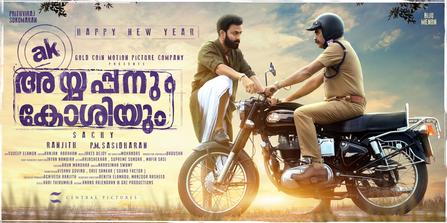
When AK released in theaters, our daughter and financial priorities meant that we decided to wait for the movie to release on an OTT platform. AK came out on Amazon Prime this Friday (March 13, 2020). We decided to watch the movie at home. We streamed it on our television set using Chromecast.
The COVID-19 virus had hit Pune with 9 positive cases. People were being wary of visiting malls and theaters. So, we decided not to catch any of the new movies in the theater over the weekend.
I had watched YouTube interviews (one and two) of the cast which included Biju Menon and Prithviraj before watching the movie.
Ayyappan Nair is a Sub-Inspector in a tribal area of Attappadi in Palakkad. Koshy is a retired havildar with an ego of having served in the Indian Army. The Police and Customs joint team arrest Koshy with liquor in a no-liquor zone. Upon arrest, Koshy makes his contacts known and the police are worried about the influence. Ayyappan Nair comforts Koshy with tactful words and seeks to appraise Koshy about the seriousness of his offence. Koshy now sobered by the realisation that he might have to spend time in jail, appeals to Ayyappan Nair’s humanity and the fact that he has a bedridden mother and two children at home, near Christmas time. Ayyappan Nair says he cannot help in the situation since it is a joint operation. Koshy acts as if he won’t be able to control himself if he can’t have a glass of alcohol. Ayyappan Nair commits a faux pas with encouragement from his superior of offering a glass of alcohol to Koshy who captures this on video in his phone.
This is the premise from which the whole movie starts. What follows are complications because of Koshy’s ego and Ayyappan Nair’s sense of justice that a person with influence can get away with so much in our society while the poor who have little or no-influence are made to suffer. Nair and his subordinate are suspended despite 27 years of unblemished Police service. Ayyappan Nair’s dismissal from police service returns him to his old ways – his wild animal self unleashed by knowledge of what a person with influence is able to accomplish. His wife is branded a Maoist and sought to be arrested. Ayyappan Nair’s good faith and trust built in his community, knowledge of the law and some good snooping skills are probably what saves him.
I find it hard to believe that Ayyappan Nair lets his guard down as Koshy films him at the beginning of the movie. He mistakes it for the fact that Koshy is looking for a contact on his phone. There wouldn’t be a movie if this didn’t happen.
As Koshy’s character develops, that his actions are not only ego-driven but are also a reflection of his relationship with his father. He seeks to gain his father’s approval which seems to drive his machismo. He soon learns of this, reprimands his wife for not having acted earlier despite living in fear and decides to teach his father a lesson.
Koshy also tries to teach Ayyappan Nair a lesson but interference by his father complicates a simple issue that the two men could deal with. Koshy admits defeat and claims that Police uniform is the only thing that would tame Ayyappan Nair’s wild animal reaction.
Ayyapan Nair’s tribal wife is one of those confident female characters who shatters Koshy’s machismo. It probably begins Koshy’s journey of self-realization and moderation. Ayyappan Nair’s journey back to moderation begins at the end of the movie.
The best way to end this review is to quote from another review:
This is a movie of two men and their egos. If you need an adrenaline rush and enjoy larger than life images venting out animalistic urges, go for this. It is a good watch for this day and age.


 Parallel Spirals
