I spent most time this week with work. I ended up not doing anything I expected to be able to do this week.
For the coming week, my in-laws are coming, I am going to Mumbai to get a passport, and I want to take a look at all the things I missed in the last few weeks of engaging with work.
Watched
I believe the title is misleading, but don’t let that stop you from watching this video. My main point is to view the world as a stack of layers. This is what he refers to as wrappers (in a 3D sense). I have unfurled these wrappers into layers to make it easy for you to see.
The biggest risk is taken by business people who connect a product or service with customers. As you move away from the customer, the risk (risk is the wrong word, but no synonym fits better) decreases. We can see this with the changes AI is introducing at this layer. Similarly, the best earning potential is often found at this level, but it also comes with the highest potential for loss.
This made me reflect on which layer I prefer to work in. I’ve found that I might excel in support roles more than main roles. Even when I watch something, I’m more interested in the support character’s work than the main character, who often gets all the attention.
I studied mechanical engineering, which plays an important role at many basic layers. You can’t ship without a ship. However, this doesn’t always create the most value (or money) for the customer. If you are in this layer you feel like you are being exploited. Without it, businesses would struggle. But, without a good or service being sold to a customer at the highest layer, you would struggle.
Money flows down. When you’re squeezed by a layer above, it’s hard to earn more than the person in the layer above you. To earn more, you have to provide more value to the layer above you. The closer you are to the customer, the higher you earn for the value you provide.
Many things can push you to choose a layer to work at. Your circumstances, your attitude, or what you learnt. If you want to earn more, you must learn to be of service in the layer above you.
I did not watch, read or listen to anything besides this. I am hoping to return to a more normal cadence of writing, reading, watching, and listening by the end of the September quarter.
I have been more focussed on work this week. This week was much better for all of us health-wise as all of us were sick in Week 20.
Writing
I did a lot of writing offline. But, I did not get any online writing done.
Reading
I did not get any reading (listening or reading) done.
The rains have begun in Pune, much earlier than predicted. We got caught up in one such torrential downpour on Monday. Other than that we have mostly been enjoying the rains from home or office.
Most of my online presence has been on Instagram. I had wanted to be on blogs, but I have not got a block of time on which to focus and read a blog post.
We are waiting for our kid’s schools to re-open after the summer vacation.
I am expecting next week also to be work focussed. I expect to continue writing offline and do not expect to write online. I am planning to return to the gym from Monday.
This whole last week has been lazy. I did not write Weekly Notes 15. I did not write poetry to participate in Global Poetry Writing Month. My practice of writing a blog post nearly every day faltered. And I realised this only on Wednesday.
This was a lost in deep thought lazy. So, this Weekly Note is going to be really long. It will cover the ground for Week 15 and Week 16. This is 7 April to 18 April 2025.
I mentioned in Weekly Notes 9/2025, that I had got rid of social media apps on my phone. This week I have been consuming content off the social internet, mostly reading on my RSS feed. I have also been clicking on the links to see how the page reads on people’s own websites.
Reading
Roam Research had sent out a newsletter post on 6 April 2025, after a long hiatus. I was happy to read it. Hence, when I went on X, I looked for any posts from Conor White-Sullivan, it’s co-founder and found this post from 19 March 2025. These are quotes from that post:
If your AI won’t help you break the law, it doesn’t belong to you, it belongs to those who make its laws.
I read this wonderful essay, Where We are Headed? by Dean W Ball, whom I subscribed to but has now gone and joined the US Government. Some interesting points from that post:
It had a nice introduction of what are agents:
Agents will be LLMs configured in such a way that they can plan, reason, and execute intellectual labor. They will be able to use, modify, and build software tools, obtain information from the internet, and communicate with both humans (using email, messaging apps, and chatbot interfaces) and with other agents.
And some very frightening scenarios:
Imagine you hired a bright junior employee who was willing to work for you for, say, $10,000 per month. But next year, he’ll do it for $1,000, and the year after that, $100. These are the economics of this industry.
There was an important insight as to how to know if your task can be taken over by an agentic AI:
As you go about your day, occasionally stop and think to yourself, “would it be easy to cheaply verify that I am doing this task correctly?” The answers vary, but I suspect you’ll find that the answer is often “yes.” This has implications for what the near-term economic consequences of agents are likely to be.
danah boyd wrote about five attitudes to climate change that talks about the breaking up of the worldview from two opposing ones to at least five complicated ones. The world is certainly more complicated than simple.
I think one of the reasons why I gave pause to writing on the blog was a feeling of being alone in thinking that we need to write blog posts again. Many things I read this week surrounded that theme.
Jay’s post had a lot of thought on this on the occasion of sixteen years of blogging. Here are some that resonated with me:
2015 was a major inflection point. In my memory, it’s the last gasp of the old web that everyone is now nostalgic for. Blogs lived alongside social media platforms. People still clicked links. You could drive traffic to what you were building off platform.
I have struggled to differentiate the blog from other media that look similar but you really know they are not (like Substack). I think Jay has some good writing about what a blog is in 2025.
It’s understandable. Platforms offer built-in audiences, easier monetisation, and the dopamine hit of instant feedback. But there’s a trade-off: you’re building a presence on rented land. You’re publishing into someone else’s box.
A blog in 2025 should be a destination.
I really loved these two lines:
They don’t just distribute—they accumulate. They hold time, build presence and concretise thought.
Each post sits within a web of references, tags, dates, and links—forming a layered geography of thought over time.
Blogs are also enshittification-proof:
The only person responsible for enshittifying this website is me.
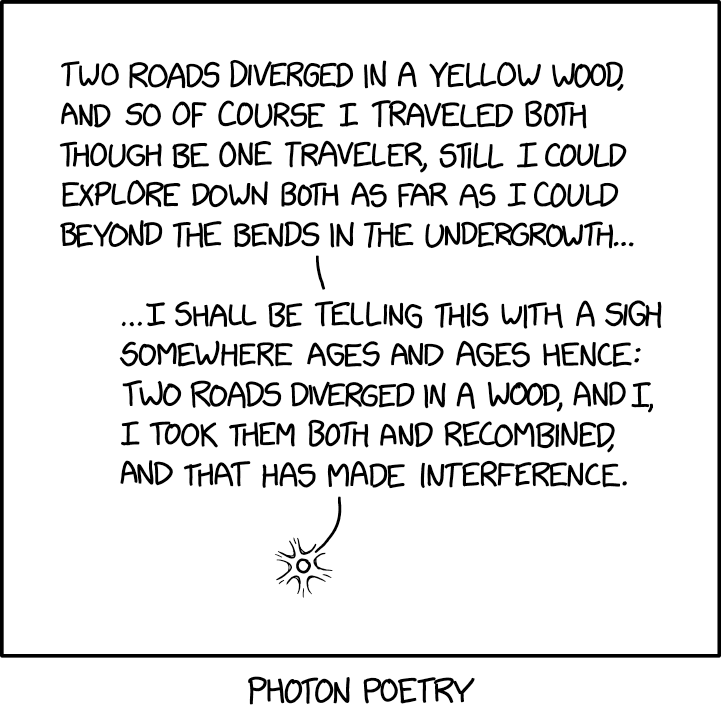
With XKCD 3076 (Roads Both Taken), I felt like Randall Munroe also participated in the Global or National Poetry Writing Month.
I also liked his summary that appears in the RSS feed but not on the website:
When you worry that you’re missing out on something by not making both choices simultaneously by quantum superposition, that’s called phomo.
These <big box> stores come into towns, destroy their local businesses, move out when profits start to dip, and the residents are left without a supermarket, grocer, or pharmacy.
Is a similar phenomenon happening in India? I think we are seeing waves of big box retail, quick commerce, etc. happening simultaneously that we don’t have the time to even think about the impact they have.
You can be a creator anywhere on the internet these days, but there’s only a small handful of places where you actually own your own content. Your own website is one of them.
This is a blog post summarizing many of her talks that she gave around this idea.
I loved reading Tom Johnson’s notes and questions about Johnathan Warner’s book More than Words. I particularly liked this insight:
Much of this type of writing (professional writing) is ripe for AI automation.
I am seeing this happening in my workplace and in my work flow.
Jay (mentioned above) has a blog post that looks at various physical AI tools. He thinks that these type of AI tools must have a definite end date. He calls it the Tamaguchi Imperative:
“I’m going to call this The Tamagotchi Imperative: We must design for the end of the relationship.
That means:
Communicating Lifespans: Be clear about how long the model or service will run.
Narrative Endings: Give the agent an arc. Let it conclude.
Gradual Fade-out: Let responsiveness or features decline over time, gently, so the user reboots the model themselves without coercion.
Memory Archiving: Let users export their interaction history.
Succession Planning: Help users move to new models and new personalities with continuity.”
Search engines — the window into the web for many people — top their results with pages containing thousands of words of auto-generated nothingness, perfectly optimized for search engine prominence and to pull in money via ads and affiliate links while simultaneously devoid of any useful information.
Social networks have become “the web” for many people who rarely venture outside of their tall and increasingly reinforced walls. As Tom Eastman once put it, the web has rotted into “five giant websites, each filled with screenshots of the other four”.
Watching
I finished watching The Good Wife. I am now watching the spin-off The Good Fight. I have reached Season 3, Episode 9.
I am watching Bosch Legacy‘s Season 3 as and when it releases.
This book and the sci-fi book this is inspired by are on my to be read list. This tsundoku is now becoming truly unmanageable.
Another book that I have added in my to be read list. Only issue is that I can’t find this list.
This week began with thinking about our New Year, Vishu, about returning to working in hybrid mode again after surgery, my note-making and to-do lists, writing poetry and companion blog posts, and some home reorganization projects.
I hope to return to working from office in a hybrid mode from tomorrow. In preparation, I tried to drive the car under conditions similar to me going to office. I did much better in worse road conditions than what I face when I go to office. I got the green signal from the doctor.
After I wrote here about the great progress I was making on this blog, I basically made no progress in the note making process. I made no notes. I fixed this by ordering a new Neorah A5 notebook for my Bullet Journal practice.
I read about Meishi on Arun’s blog and have shared his design to get about 100 cards printed. I want to try it out as a to-do list and note taking system.
I wrote a poem on each day for Global Poetry Writing month on thinkdeli. I, then, wrote companion blog posts on the blog here. Not, for all of them but ones that I thought I should write about – which was most of them. You can read them here.
I missed an important milestone, two days ago. I wrote my first blog post on Blogger on 1 April 2006. It has now been 18 years since I started this blog.
Year
Number of Posts
2025
40
2024
12
2023
63
2022
41
2021
25
2020
74
2019
53
2018
9
2017
22
2016
33
2015
25
2014
28
2013
38
2012
20
2011
74
2010
39
2009
30
2008
53
2007
95
2006
38
I love how writing here is spurning me to action. After making no progress on my note making process in the last 3 months, I have already set up parts of the note making system. I think having the system will help implement the workflow.
I kept following that thread the rest of the week. I started selecting to View Source again. When listening to Craig Mod on The Tim Ferriss Show, I went to his website. I loved some of his in-line comments in the source code.
I guess this is what Code is Poetry meant which used to be written in the top of WordPress admin page.
This was what browsing the web was about, in my opinion. That is how I want to browse the web again.
The World of Wikipedia Userpages
There is also a hidden world of Wikipedia user pages that is not widely known. Other than to Wikipedia editors or contributors. I used to consistently contribute to Wikipedia a decade and a half back and I used to love visiting these user pages.
I used to love reading L Shyamal’s ornithological investigations on his blog, Catching Flies. I have still subscribed to his blog on RSS feeds. When I got some of his recent updates, I visited his Wikipedia userpage. I loved reading this, there, about the reason for his contributions to Wikipedia:
The Western Ghats of Karnataka. Blink and this area may have already been destroyed, with ever-widening roads, street-lighting, power-lines, dams, and habitations following well-established and misguided notions of development that are entrenched in the minds of most people. These are the wild spaces that inspire much of my contribution to Wikipedia, a land that supports life and hosts enough wonders to engage everyone, physically and mentally, now and in the future. Incidentally, within this view live floral and faunal elements that represent more than a million potential Wikipedia entries. Converted (or “developed”) into a boring human settlement, it would not produce a single notable person.
Personal Updates
My post-surgery recovery is coming along well. The guy who dresses my wounds thinks it would take another 2 weeks for the wound to heal completely. That would put it at a date around the Malayalam New Year of Vishu, around 14 April.
Many of my family members’ doctors visits were on hold because of my recovery. Those were covered in the last few days.
How AI has changed the way children do homework. Even ones supported by their parents. It is getting to a place where we first get the answer from AI. There is no effort to search. But, as the blog post says, the reward is for the output and not the effort.
Scale above all else is the philosophy that both buries us in endless genAI slop and locks customers in to enshittified platforms… and taste is in tension with scale.
This is something that Craig Mod talks about in his twin interviews with Tim Ferriss.
It is not just that people making AI slop are spamming the internet, it’s that the intended “audience” of AI slop is social media and search algorithms, not human beings.
I am trying to write using Emacs over the next month or so. I am not that into programming – that’s the reason I use WordPress and Blot and not hosting it on a static website (like I tried to with Hugo).
I was wondering during lunch about how I can improve my note making workflow. This thought arose because I have also been thinking about improving my task capturing workflow at work.
I was introduced to the difference between note taking and note making in a post by Anne-Laure Le Cunff. Note taking is about integrating the knowledge in your matrix and hopefully improving your life.
I have focussed on note taking so far because I had a hard time getting that under control. My approach changed when I read Cal Newport’s Slow Productivity. The first principle in Slow Productivity is Do Fewer Things. Accordingly, I reduced the amount of content that I read.
I wrote here earlier about how I wanted to reduce this consumption by considering how I consume social media posts. I wrote here about how I reduced that even further to the blogs that I read. I wanted to slowly repair my damaged attention span that allowed me to take a lot of notes but not make many notes.
Late last year, I purchased the same pocket notebook that Hiran suggests in how he uses a bullet journal and using his idea of numbering the bullet instead of the pages and using an index. I was able to take more notes in the pocket notebook.
But, I also like keeping the A5 sized Bullet Journal since I like to write a lot by hand. I started spending more time copying things over from the pocket notebook to the Bullet Journal.
I did this because my 7 y.o. daughter would raid my empty notebook stack to repurpose it for her own use. The casualty rate of the empty notebooks was quite high.
At the other end my 2 y.o would pick up the pocket notebook I would be using and treat it as he liked. He would tear it, rip it apart, or colour in it, depending on his mood.
I found myself repeating the same things when I looked at my notes. I seem to be going through the same stuff or reading authors who seem to be saying the same thing.
This the process I am now considering as a result of asking the question (refer to the sketchnote at the bottom right for the question), How can I improve workflows for capturing?[An earlier version of this read as, “This is the process I am now considering:”, updated 27 March 2025, 2308 hrs]
Write down the note in the physical A5 Bullet Journal or Pocket Notebook.
This includes some highlights from books, blog posts, or articles that I read on Readwise’s Reader.
This includes some screenshots or notes I take on Google Keep. This is usually when I listen to videos, podcasts or audiobooks.
I am thinking of writing these notes at a certain frequency to Roam Research. The highlights from Readwise’s Reader sync with Roam Research.
I am thinking of then exporting these notes to my laptop where I am considering the option between Emacs or Obsidian.
Since these are text notes, mostly, I hope to back them up to offline storage.
This is not the end of the story. It has already been 3 months. So, the idea behind this post is to help you catch up with what’s happened so far.
The next part will drop when I finish thinking and implement the system outlined here.
Update 1: 31 Mar 2025
Saurabh hopped on a call with me. He suggested using the Eisenhower matrix to determine importance of the notes and then blocking out time on the calendar to grapple with the note.
I have had a lot of time on my hands since I’ve stayed away from social media websites this week. Most of that time has been spent writing for work.
I did not do much other reading or writing. I have nothing more to report for this Weekly Notes.
Take 2: I am writing this at 2240 hrs on 24 March 2025.
I read the post I wrote above and was not very proud of it. It does a poor job of reflecting how my last week was. I only thought it prudent to fix it, for the historical record.
Goals have been demonized. They have been confused with or are replaced by resolutions, systems, processes, intentions etc. I returned to goal setting again this week. I set goals with my wife for this quarter.
Read/Listened/Watched
Some interesting ideas from this video –
India thinks inputs based. China thinks outputs based.
Work life balance happens when you have a sense of control over your time.
Every January, ask yourself, if you were to be laid off this year, what will you do?
Important to channelise your anger in the correct direction when you are laid off.
Burnout happens when you lack control or when you are not aware of what role your contribution plays in the bigger picture.
Some of the lessons learned from this video (these are his final suggestions):
Find a sleep schedule that fits your life. Get enough sleep.
Move your body every week.
Keeps you active.
Increases your heart rate
Find a productivity system that works and actually stick with it.
Practice embracing the flinch.
Delete social media from your phone and laptop for 30 days.
watch closely how your behavior changes
Learn your Baseline caloric intake.
Know your macronutrient breakdown
He suggested using the myfitnesspal app.
Be more intentional with how you spend your time, the things you bring into your life and people you surround yourself with.
Stop choosing the default path. Build a life that is uniquely yours.
Treat life as one big experiment.
Learn about who you are
Learn more about the person you want to become.
Truth be Told has a good post about the two modes of functioning of the brain and the six modes of rest.
Utsav Mamoria has a great long read about how to live an intellectual life. He uses fantasy as a great storytelling tool to illustrate his point.
I realized that I love going and visiting websites in their url. Here are two websites that I enjoyed visiting:

 Parallel Spirals