Category: Space

  • India’s Roadmap to Space 2047 – Spacecraft Innovation and Exploration

    I wrote about India’s Roadmap to Space 2047 in an earlier blog post. I wanted to share it without any comments at first, but then I decided to add my thoughts.

    The term “flexible COMSAT” refers to a type of satellite that can change its coverage, bandwidth, and frequency. This technology is being developed by ISRO, as mentioned in a PTI story published on the NDTV website.

    The term “full EPS satellite” is a reference to a type of satellite that uses only electric propulsion systems (EPS). The EPS system was first flown on the South Asia Satellite or GSAT-9, launched in 2017. The note says that this would reduce the mass of satellite from approximately 6 ton to 4 ton for the same capability.

    Quantum and Optical COMSATs are in various stages of development. Urbasi Sinha and her team in QuIC lab, Raman Research Institute, Bengaluru and an ISRO team at the Space Applications Center (SAC) are working on the building blocks of quantum satellites. The first optical communication payload was carried on the GSAT-29 mission.

    The Indian Space Station based R&D and economic activity is at least a decade into the future. Vellon Space, an Indian startup has been talking about space-age medicine and pharmaceutical manufacturing in space.

    Inter-planetary networks hold immense potential for the future of humanity! Imagine a world where communication seamlessly spans across celestial bodies, connecting Earth with other planets. The vision of becoming a multi-planet species becomes more tangible as these networks evolve. It all starts with the Earth-Moon system, but the possibilities for expansion are limitless. With initiatives like Artemis and the International Lunar Research Station, we are paving the way for a future where inter-planetary communication becomes a reality!

    ISRO may not focus as much on Earth observation satellites because there are many Indian space companies (Pixxel, SatSure, Dhruva etc.) working on remote sensing capabilities. They may continue with Earth observation missions until the startups can offer similar levels of data. On the other hand, there are fewer startups in the field of communications satellites technologies. The only one that comes to mind is Astrome among the NewSpace companies.

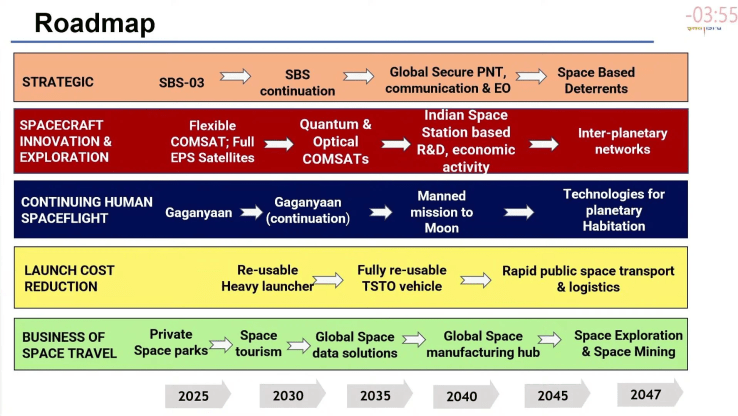
  • India’s Space Road Map up to 2047

    Reddit user u/Blazing_Phoenix_100 shared this screenshot of India’s space road map shared at the G20 summit. I plan on using this chart not to point out times where ISRO has fell behind this timeline. They have done that plenty of times but to understand the general direction they are headed in.

    In the absence of an official roadmap on the ISRO website, this becomes an important indicator of priorities until an official roadmap appears.

  • The Last Debris from Mission Shakti

    Update: The actual re-entry date is 14 June 2022.

    Someone had a question about what happened to the debris related to India’s ASAT test, Mission Shakti in 2019.

    Joseph Remis is the person I look to for this information.

    Tweet from Joseph Remis: Another consequence of the electromagnetic storm is to bring the fall of the last remaining debris of the Indian ASAT closer.

    If you open the image on the tweet, you would see the decay date is 11 May 2022. When I opened the quote tweets on this post, I saw this post from Astro_Neel.

    Tweet from Astro_Neel: This piece was otherwise predicted to come down by Aug 2028 (six years later)

    Astro_Neel makes the point that the piece of debris was likely to re-enter only in August 2028 (quoting Joseph Remis again). An electromagnetic storm that hit Earth in February 2022, that knocked out 38 Starlink satellites of SpaceX.

    The geomagnetic storm also led to reducing the time needed to decay the last piece of debris related to the Mission Shakti from August 2028 to June 2022.

    Update

    I was remis to not check the r/ISRO sub-Reddit before writing here. When I shared the blog post on the Fediverse, Ohsin pointed to the thread on Microsat-R where he had also been tracking the debris.

    @pradx Last tracked piece from Microsat-R debris decayed in 14 June 2022. I was also keeping track of it in PSLV-C44/Microsat-R launch thread over at reddit!

    Ohsin on the Fediverse

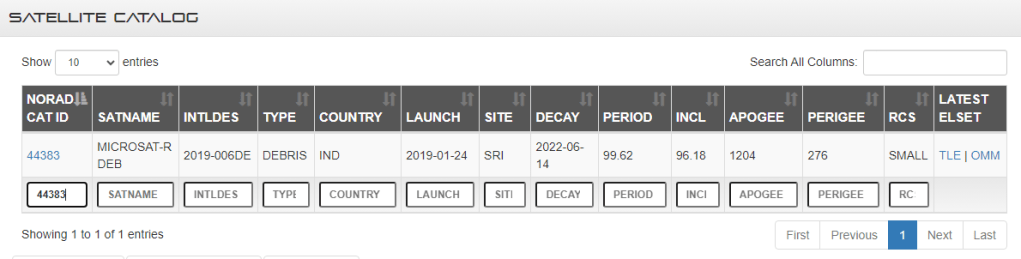
    He also shared this image with the final decay date indicated.

    Final update from the Satellite Catalog. Image from Ohsin.

  • What India must talk to France about Space?

    Suhasini Haidar, writing for The Hindu, talks about the upcoming visit of Indian Prime Minister Narendra Modi to France. A key paragraph to highlight in the article:

    India and France are also hoping to strengthen ties over collaboration in space that dates back to the 1960s. Apart from collaborations in launching satellites, the two sides are also looking at training astronauts and partnerships in space industrial engineering, it is learnt.

    Haidar, Suhasini. “Co-Development Rather than Co-Production Will Be Focus of India-France Ties, Sources Say.” The Hindu, 6 July 2023

    France provided inputs on solid fuel technology to ISRO with the Centaures rocket in the 1970s. Working together on the Viking liquid engine, under an arrangement with the European Society for Propulsion (SEP), provided valuable inputs to develop India’s workhorse Vikas engine in the 1980s. The French helped in setting up the Liquid Propulsion Systems Center (LPSC) at Mahendragiri, Tamil Nadu.

    Arianespace has provided launch service for various Indian communication satellites, as India struggled with mastering cryogenic technology. ISRO and CNES has worked together on two satellites related to climate studies, Megha-Tropiques and SARAL. A future collaborative mission, Trishna, is slated for launch in 2024.

    India and France can play an important role in space science. I would love to see a continuation of co-operation of Earth observation satellites that are built to study Earth’s climatic systems. I believe that collaboration with France particularly with the mission to Venus would be a shot in the arm for the Indian Venus Mission, called Shukrayaan. France has experience with working on the Vega missions with the Soviet Union.

    The study of Mars is a rosy colonization dream today. The study of Venus provides an understanding of where the Earth could be headed because of global warming and climate change. I think there must be as many if not more missions to Venus as there are missions to Mars today.

    France is also a signatory of the Artemis Accords, and along with Australia is trying to look for an international arrangements to govern access to and resources on the Moon. This is an essential middle path that India must try to support. Global supply chains are important to keep mission costs low.

    India must try to book cheaper slots on the Ariane 6. There is a 6 ton and higher category of satellites that Indian launch vehicles can currently not support. India must also try to get more French companies to try to fly on Indian launch vehicles. There could be an opportunity coming up during the period of transition between Ariane V and Ariane 6.

    At the industry level, I believe there are opportunities to collaborate in data sharing and data analysis. Indian space startups could try to provide satellite, satellite sub-systems, and propulsion systems to French startups.

  • Role of ISRO in the future?

    Fortune India did an interview with Chairman, ISRO Dr. S. Somanath. This was one of the exchanges in the interview.

    Commercial human space travel is something which private players in some countries are offering. Can ISRO do this?

    We can, but it is not our job. It is the job of the industry. ISRO is a national agency. ISRO can develop the technology. But the practice of government funding ISRO to develop technology is going to stop. If a technology is needed, it will be developed by ISRO and industry through government-industry funding. So, now, the industry will have to put money into technology development. They have to do some R&D and develop technology.

    This is an interesting comment and perhaps provides an insight into how ISRO thinks of its evolving role in the new space policy regime in India post-2019.

    NSIL, the Department of Space’s commercial arm signaled the intention to move to a demand-driven model in the space sector. As an example, GSAT-24 was India’s first demand-driven satellite that NSIL/ISRO built for Tata Play (DTH service provider).

    If you read through the whole interview, you can see the lengths to which Somanath goes to protect ISRO’s role while trying to push the idea that industry must lead in the future. This is a new tension for ISRO to hold. I don’t think there is enough clarity on how this will happen for him to communicate the message well.

  • Conjunction of Venus and Jupiter

    Zoomed in and edited using Snapseed. Image taken using Realme GT Master. Image Credit: Pradeep Mohandas

    The question my wife had was how do the planets that are on either side of the Earth are seen together in the night sky.

    A drawing to explain how Venus and Jupiter whose orbit is on either side of Earth can be seen together in the night sky. Drawing: Pradeep Mohandas

    When we see from Earth, Jupiter must be on the other side of the Sun. Whereas, Venus could be between the Sun and Earth or between the Sun and Jupiter.

    This is the first time that I tried to capture a celestial event with a mobile phone camera and edited it.

  • Star Party

    It was the sight of the launch of the Hubble Space Telescope by the Space Shuttle Discovery on Discovery Channel that shifted my interest from archaeology to astronomy. After the lift-off the Discovery Channel proceeded to show some of the fascinating images that the Hubble captured. I was in awe.

    This anecdote also holds the confusion I held for the longest time. I did not know if I wanted to do astronomy or build rockets that would launch people and telescopes into orbit. I am not sure if I still have an answer to this question. The move towards engineering was pragmatic and not based on interest.

    After marriage, my wife was interested in the bright objects in the night sky and did not mind me watching rocket launches because Indian rocket launches were few and far between. They were not as frequent as the SpaceX launches of today of almost one a week.

    When our daughter was born in 2017, I told my wife that I will introduce our daughter to the night sky but wouldn’t try to push my hobbies on her. Keeping my promise, I had only introduced my 5 year-old daughter to the Moon, Venus, Jupiter, Saturn and Mars. Of these, my daughter only has trouble distinguishing between Jupiter and Saturn when they are both present in the night sky.

    When the astronomy club in Pune, Jyotirvidya Parisanstha (JVP) organized a star party for the public, I forgot this promise to my wife and registered both of us (our daughter and myself) for the same. My wife could not travel as she had just given birth to our son last December.

    I decided against going by car as I was not familiar with the location. We decided to travel in the bus provided by JVP.

    We landed up around 4 pm at Shalimar Furniture at Swar Gate in Pune. We arrived there travelling in an Uber. My daughter was already impatient with the slow progress of our journey to the location of the Star Party.

    I had told my daughter that we were going for a star party. The only other party she had attended thus far were three to four hour long birthday parties of her friends who all stayed in our neighborhood, which she reached in 20 minutes at the most. She would spend time at the birthday party playing with her friends or having samosas and snacks. She was excited nonetheless.

    This Star Party was not her kind of party.

    We travelled in a Tata Motors bus to a village in the outskirts of Pune called Naigaon. This was on the Pune – Bangalore Highway a little beyond the gate of Khed Shivpur about an hour from Swar Gate. The Star Party was held at Manali Agro Farm.

    First up, it lived up to it’s name. It was probably colder than it was in Manali. My daughter had to wear her thermals, t-shirt, sweater and a blanket before she could shiver and speak. I only had an athleisure t-shirt and a sweater protecting me. JVP had warned in their email invitation and the programme that it would be very cold. The name also should have given ample warning and we should have probably prepared with winter wear we might have carried had we travelled to Manali.

    As the team at JVP was setting up their telescopes (2 Cassegarian, 2 Newtonians and a Dobsonian), we spotted a few fast moving satellites in their orbit. They were most likely Earth observation satellites taking pictures of Earth from their perch in space. I also spotted the planet Venus with my daughter.

    Venus was the first planet that the telescopes pointed to as people formed lines in front of them. We missed seeing the planet through the telescope. As the planet set in the western sky, we had the opportunity to see Jupiter and three of its moons through the telescope. I was not sure my daughter would be able to see the moons through the telescope but was happy when she could spot them easily.

    Sarang then showed the constellations in the night sky with a pointer. We saw the body of Pegasus the Winged Horse, Cetus the Sea Monster, and spoke to us about Raashis and Nakshatras. I had heard these terms and now knew their significance and meaning.

    He later shared stories from Indian and Greek mythologies. He had immense energy that comes from knowledge and passion. He spoke endlessly through the evening and then later in the night. He flawlessly mixed sharing the science of the night sky, the art of storytelling, and a healthy skepticism.

    My daughter and I were able to see the Moon through the telescope. She described it as seeming like cheese. I told her about craters without delving too much into its violent history. She saw both the Moon and Jupiter through one of the Cassegarins. The other Cassegarin of the pair was having a hard time tracking in the beginning though the volunteers were able to fix it later in the night.

    She did not eat any food at night. I ate the delicious Marathi dinner at the farm. There were a few slides and swings in the park but they were too cold to even sit on. She was immensely disappointed and spent the rest of the night sleeping on my lap. I did not feel confident about laying the mat on the floor and letting her sleep there ergo many people did.

    I missed seeing the Pleiades (Rohini) and the Orion nebula through the telescope they had set out at night.

    We reached in time as one of the JVP team members talked about imaging the comet C/2022 E3 (ZTF) and how he stacked images one on top of the other and used software to get an image of the comet. The comet’s tail had grown faint in the image and it’s core also seemed to have broken. It was great to see a comet but were disappointed that we missed seeing it in all its glory.

    A little past four in the morning, I wasn’t sure our cold protection systems could keep us protected from the cold any longer. So, I headed to the bus with a few of the other parents and caught up on some sleep. Although I was awake most of the night, I am not sure if I could stay awake most of the night.

    Some of the other people missed Sarang’s story sessions and caught some well deserved sleep and spent the early morning watching the sky. We missed that part but I was happy that I could brush up on both my astronomy and mythological knowledge.

    The star party was over at 7 in the morning and we headed back to Swar Gate around 7:30 am.

  • Regulation in the Space Sector

    The space sector is compliance heavy. It needs to comply with various national and international laws. In the absence of national laws, compliance requirements are a la carte right now.

    India’s private sector space regulator gave a few green signals this year. It authorised the launch of Skyroot’s sounding rocket from the Sounding Rocket Complex. It authorised the launch of satellites from Pixxel and Dhruva Space on the PSLV.

    Right now, the regulator regulates only the private sector. It does not seem to regulate launches from NSIL. This is like the RBI not regulating public sector banks. This comparison does not stand up much because NSIL provides much better service and because the private sector is in its infancy.

    The question to ask is how is the regulator, IN-SPACe building capacity to do its job? When there is a proliferation of startups in a sector that the Government has just opened up, how does a regulator provide adequate regulation?

  • India’s Space Policy – Sowing Now to Reap Later

    Note from the Author: I wrote this piece in March 2022. I did not get around to publishing it anywhere. Hence, posting it here. Some of the information mentioned here is outdated.

    Introduction

    India has pursued a space program since the 1960s with the intention of benefitting its people for the past sixty years. For this period, the program was dominated by a single government player with an innovative production capability nurtured through these years. But, the Indian government now wants private players to play a bigger role – to design products, develop them, and market them to the world. Against this backdrop, the Indian Government opened up the space sector in 2020. This led to the need to make policies and institutions that would help India tap into this hidden potential.

    Opening up India’s Space Sector

    The Union Finance Minister, Nirmala Sitharaman announced the opening of eight sectors in May 2020 as part of the INR 20 lakh crore (USD 300 billion) Atmanirbhar Bharat Abhiyan (Self-reliant India Campaign). Space was one of the sectors that opened up as part of these reforms.

    The Government said that it wanted the private sector to be a player in the space sector. She said that the Government would provide a level playing field for the non-governmental private entities to build satellites, launch vehicles, and provide space-based services. She promised that future planetary exploration and human outer space travel opportunities would be open to non-governmental private entities. Towards this, she promised access to facilities of India’s space agency, the Indian Space Research Organisation (ISRO), and a liberal geospatial policy.

    India identified that space held a huge commercial potential for growth. It wanted non-governmental private entities (NGPEs) to be part of this growth. When the Government says NGPEs it is referring to academic institutions, start-ups, and industry. 

    As a part of opening up the space sector, NewSpace India Ltd (NSIL), which was set up in the previous year, was repurposed to drive a move from a supply-driven to a demand-driven model. NSIL would act as an aggregator of demands from the market. It would then supply the services provided earlier by ISRO. For this, it would take over ownership of ISRO’s operational launch vehicle and satellite fleet. It would commercialize the production of the launch vehicle fleet by handing it over to a private consortium. 

    The opening up also involved setting up a regulator, Indian National Space Promotion and Authorisation Centre (IN-SPACe). IN-SPACe would provide a one-stop shop for all space-related activities in India. ISRO would then concern itself with the research and development of various space technologies and applications.

    IN-SPACe would “promote, hand hold, permit, monitor and supervise space activities by NGPEs and accord necessary permissions as per the regulatory provisions, exemptions and statutory guidelines”.

    Developments since the Announcement

    A draft Space Activities Bill, 2017 had been floated for comments from stakeholders and the public. This bill was to provide an overall legal framework for the space sector. As of February 2022, the bill has completed public and legal consultations and has been sent to the various Ministries for their approval.

    IN-SPACe was established. Pawan Goenka, a former Managing Director of the Indian automobile major, Mahindra & Mahindra, was made Chairman of IN-SPACe. It was reported in February 2022 that ISRO facilities and expertise were extended to the NGPEs. ISRO facilities are being shared with these private entities at no or reasonable cost basis.

    NSIL undertook its first fully commercial launch for Brazil’s Amazonia 1 and fourteen ride-share satellites in February 2021, on the Polar Satellite Launch Vehicle’s (PSLV) PSLV-C51 mission. It is also undertaking the first demand-driven communication satellite [PDF] launch. It will launch the GSAT-24 communications satellite to fulfill the demand of Direct-to-Home company, Tata Sky (now Tata Play). The launch is expected to take place on board the European Ariane V in the first half of this year.

    The Department of Space had provided various draft policies on its website for comments. These include draft policies on Space Communications, Remote Sensing, Technology Transfer, Navigation, Space Transportation, Space exploration and Space Situational Awareness, and Human Spaceflight through 2020 and 2021. India, at present, has, only Space Communications and Remote Sensing policies. 

    Although space startups have been present in India since 2011, there was a real acceleration in the number of startups that started following the opening up of the space sector. As per statistics shared by the Indian Government in February 2022, there are more than 50 space startups presently in India. These work in areas such as building satellites, launch vehicles, satellite subsystems like electric propulsion systems, as well as various space-based applications in remote sensing, agriculture, fisheries, economic growth forecasting, etc. The Indian Government hopes to attract foreign direct investment (FDI) in the space sector.

    Obstacles in the Way

    As with any reform, there is a feeling that the reforms are not being implemented fast enough. It is not known when the draft Space Activities bill would be cleared by the Union Government and tabled in Parliament. The Space Communications policy is expected to be finalized by April 2022. The status of the other policy drafts is currently not known.

    In the interim, ISRO is tasked with clearing the backlog of remote sensing, communication, navigation, scientific, and interplanetary missions of national importance which have been delayed as a result of the COVID-19 pandemic. India has only had 5 launches from India since 2020. One of them was a failure. There are limits on the number of launches ISRO is able to do in a financial year (March to April). This period of transition would be a difficult one to manage at ISRO, as it would have to fulfill launches for NSIL as well. 

    NSIL floated tenders for the commercialization of the PSLV in 2019. It has still not been announced as to who the tender is awarded to. There are two other operational launch vehicles, the Geosynchronous Satellite Launch Vehicle (GSLV) and the Geosynchronous Satellite Launch Vehicle Mark III (GSLV Mk-III) that also need to be similarly commercialized. 

    All these delays then make the regulator, In-SPACe ineffective to do much other than provide access to DoS facilities until there is regulatory clarity with the publication of draft policies and the passage of the draft Space Activities Bill in Parliament.

    Hopeful Future?

    While it is expected that the infrastructure put in place after the announcement of the space reforms, would take anywhere from half a decade to a decade, the future remains hopeful. 

    In the decade, India expects to launch interplanetary missions to the Moon, Mars, and Venus. It also expects to operationalize its human spaceflight program in the first half of this decade. In addition, it expects to launch missions for communications, remote sensing, navigation, and scientific applications.

    It is expected that these reforms would bear fruit in the future decades. India hopes to participate and play a bigger role in the global space economy. It hopes that its start-ups today will provide goods and services not only for India but also for the world. 
  • Feedback on ThePrint opinion by Carnegie fellows

    ThePrint published an opinion piece by Carnegie India’s Konark Bhandari and Tejas Bharadwaj on 7 November 2022. I am writing this piece to point out certain mistakes in the arguments that they make.

    The Indian Space Research Organisation, or ISRO, launched 36 satellites of OneWeb last week. OneWeb, a joint venture between the UK government and India’s Bharti Enterprises, had been scampering to secure a launch of its satellites after its original partner, the Russian space agency, Roscosmos, backed out following the war in Ukraine. There seemed to be no backup available for OneWeb, with analysts citing SpaceX as the only possible option.

    Roscosmos was the launch provider. Arianespace was the launch partner. OneWeb backed out on the back of unreasonable demands from Roscosmos. The link they provided in “backed out” in the link clarifies this.

    This launch by ISRO, therefore, is seminal. It has defied market expectations. It has done the launch in record time.

    The record-time launch defying market expectations was done by postponing the Chandrayaan 3 mission for which the launch vehicle was slated to be used. When SpaceX is able to do a launch a week, making such a claim makes no sense. SpaceX did not launch as fast as India did because it simply prioritized its missions better than India did.

    It was also the first mission that did not use India’s traditional workhorse vehicle, the PSLV, but instead opted for the more sophisticated GSLV-Mk III. And it has further catapulted ISRO, and by extension India, as a promising and emerging player in the commercial launch market. To be sure, India did undertake commercial launches for other customers earlier as well, but the speed with which ISRO launched OneWeb’s satellites, and their overall significance, was truly a noteworthy milestone.

    ISRO has traditionally flown commercial missions on the workhorse PSLV mission. This is the first time ISRO flew a commercial mission on the GSLV Mk-III. OneWeb’s 36 satellites weighed more than 5,000 kg. PSLV could not deliver that payload to the intended orbit. GSLVMk-III was the only Indian launch vehicle capable of doing the job.

    ISRO was able to deliver the launch at this speed because it postponed the launch of Chandrayaan. This would have been “a noteworthy milestone” if ISRO had built a new GSLV Mk-III at this time and fulfilled the demand.

    Given India’s increased capability and an enhanced appetite to undertake launches for overseas customers, is it possible to expand the scope of these activities? Could India not just launch small satellite constellations but also build them? Could it do this not just for private enterprises but also countries as well? India should use its capabilities in space infrastructure to undertake deft space diplomacy, with a focus on small satellites. This may fulfil a variety of objectives.

    Because of the point above, there has been no increased capability. They are working on increasing the capacity.

    Therefore, India can and should think about entering this domain that enables smaller and less “space-capable” states to build their defensive capabilities for peaceful purposes. While SpaceX currently provides access to its Starlink terminals only to its customers, and has cited “cost” as a factor in possibly pulling such access from Ukraine, India should consider providing an entire vertical stack to other countries, including capacity building related to imparting technical “know-how”. This could be done by building, launching and providing access to small satellites to nations that wish to utilise the benefits arising from such services. Besides using them for defence purposes, these benefits accrue in the domains of precision farming, disaster management, and climate change impact measurement.

    There are significant obstacles that stop India from providing countries entire spacecraft stacks or even launch services. Many originate from US’s ITAR norms.

    Logistically speaking, even for countries that may possess such satellite building capability, launching them in a timely and cost-effective manner is often a challenge. Many small satellites have to often operate as secondary payload on most rocket launches. The more thrust a rocket has, the more payload it can carry. Accordingly, since there are various payloads on a rocket, small satellites usually have to take a back seat and essentially “rideshare” with other payloads whose readiness determines the overall launch schedule. India, with its newly built SSLV, has demonstrated that it can address this logjam too. In fact, ISRO had developed the SSLV keeping in mind lighter payloads weighing less than 500 kg, which are usually used to provide Internet access in remote areas.

    Small satellites fly as rideshare when launch vehicles have additional payload-carrying capacity after carrying a primary satellite. This is one of the ways that smaller satellites can launch faster rather than wait for a dedicated launch vehicle to launch them. Rideshare is one of the solutions to the problem that is described above.

    Each satellite in a constellation of satellites that provide internet access in remote areas may weigh less than 500 kg. But, to provide continuous internet access, more than one of these sub-500 kg satellites is needed. SSLV would take a long time to launch satellite constellations. GSLV Mk-III is better suited for this role.

    We are also waiting for the first successful flight of the SSLV. So, we are awaiting the demonstration of the launch vehicle that can address the logjam.

    As luck would have it, India’s domestic policy matrix as well as the international regulatory scenario are currently aligned with these geopolitical aims. India’s freshly proposed telecommunication bill might just make it easier for satellite spectrum to be cheaper – which could help with the adoption of satellite terminals and then help drive use of satellite broadband. A larger satellite broadband user base may effectively drive down the cost per terminal and help ISRO, which itself entered the market for providing satellite broadband last month, to cross-subsidise other countries’ adoption of such satellites.

    ISRO has not entered the market for providing satellite broadband. Two of ISRO satellites – the GSAT-11 and GSAT-29 – will be used by a consortium of Hughes Telecommunications India and Bharti Airtel to provide satellite internet services to enterprises (like Jio and SBI) in India and hopefully, also to remote parts of India like Jammu and Kashmir, Ladakh, and Himachal Pradesh.

    In addition to this, with the new US FCC rules mandating deorbiting going into effect (and with FCC being the de-facto global space regulator), de-orbiting may become a more common phenomenon, thereby providing opportunities for Indian companies that specialise in deorbiting satellites which have completed their missions. Given the increasing frequency of small satellite launches and the need for their replacement/deorbiting every now and then, this is eminently feasible. At the same time, there is a valid fear that this may lead to congestion in outer space over time, but India is currently chairing the Working Group on UNCOPUOS LTS Guidelines that is promoting the implementation of existing guidelines as well as discussing the possibilities of developing new guidelines to address the sustainability issues of small satellites, including satellite constellations.

    There may be Indian companies working on deorbiting satellites but there are none with such demonstrated capability. It can increase its order book size but I am not sure how much they can deliver until they demonstrate capability.

    It would be interesting to see India’s response in the Working Group as the partly Indian-owned company OneWeb may be one of the affected parties of these rules.

    However, challenges remain. India would need to ensure that the benefits provided by its small satellites are unique and not in conflict with any existing space programmes of partner/beneficiary nations. Furthermore, the gap between promise and performance must also be addressed since there is a perception that India’s other bilateral infrastructure projects have been afflicted by delays, whatever the cause may be. In the end, India has an opportunity to share the manifold benefits of its prowess in space with other countries. It must do so actively as a form of space diplomacy. Space has always been characterised as a part of the global commons. India can now validate this axiom to the advantage of the comity of nations. 

    Space is presently an opportunity for collaboration and data-sharing. As a part of space diplomacy, it must share data from its small but aging fleet of remote-sensing satellites. It must provide the services it already does for disaster management and search and rescue operations.

    ISRO must first work on the gap between promise and performance for its own fleet of satellites (remote-sensing, communications, and navigation) and missions like Chandrayaan 3.

    My prescriptions

    Space was characterized as a part of the global commons, but it is falling apart today. I think India must try to make sure that outer space becomes part of a global commons, parts of which (like the Moon and Mars) are opened up for competition and commercial exploitation after all countries are consulted through mechanisms like UN-COPUOS.

    On the question asked in the sub-heading of the article, on whether India must now build small satellites and forge global partnerships? I do not know.