Category: Space

  • Feedback on ThePrint opinion by Carnegie fellows

    ThePrint published an opinion piece by Carnegie India’s Konark Bhandari and Tejas Bharadwaj on 7 November 2022. I am writing this piece to point out certain mistakes in the arguments that they make.

    The Indian Space Research Organisation, or ISRO, launched 36 satellites of OneWeb last week. OneWeb, a joint venture between the UK government and India’s Bharti Enterprises, had been scampering to secure a launch of its satellites after its original partner, the Russian space agency, Roscosmos, backed out following the war in Ukraine. There seemed to be no backup available for OneWeb, with analysts citing SpaceX as the only possible option.

    Roscosmos was the launch provider. Arianespace was the launch partner. OneWeb backed out on the back of unreasonable demands from Roscosmos. The link they provided in “backed out” in the link clarifies this.

    This launch by ISRO, therefore, is seminal. It has defied market expectations. It has done the launch in record time.

    The record-time launch defying market expectations was done by postponing the Chandrayaan 3 mission for which the launch vehicle was slated to be used. When SpaceX is able to do a launch a week, making such a claim makes no sense. SpaceX did not launch as fast as India did because it simply prioritized its missions better than India did.

    It was also the first mission that did not use India’s traditional workhorse vehicle, the PSLV, but instead opted for the more sophisticated GSLV-Mk III. And it has further catapulted ISRO, and by extension India, as a promising and emerging player in the commercial launch market. To be sure, India did undertake commercial launches for other customers earlier as well, but the speed with which ISRO launched OneWeb’s satellites, and their overall significance, was truly a noteworthy milestone.

    ISRO has traditionally flown commercial missions on the workhorse PSLV mission. This is the first time ISRO flew a commercial mission on the GSLV Mk-III. OneWeb’s 36 satellites weighed more than 5,000 kg. PSLV could not deliver that payload to the intended orbit. GSLVMk-III was the only Indian launch vehicle capable of doing the job.

    ISRO was able to deliver the launch at this speed because it postponed the launch of Chandrayaan. This would have been “a noteworthy milestone” if ISRO had built a new GSLV Mk-III at this time and fulfilled the demand.

    Given India’s increased capability and an enhanced appetite to undertake launches for overseas customers, is it possible to expand the scope of these activities? Could India not just launch small satellite constellations but also build them? Could it do this not just for private enterprises but also countries as well? India should use its capabilities in space infrastructure to undertake deft space diplomacy, with a focus on small satellites. This may fulfil a variety of objectives.

    Because of the point above, there has been no increased capability. They are working on increasing the capacity.

    Therefore, India can and should think about entering this domain that enables smaller and less “space-capable” states to build their defensive capabilities for peaceful purposes. While SpaceX currently provides access to its Starlink terminals only to its customers, and has cited “cost” as a factor in possibly pulling such access from Ukraine, India should consider providing an entire vertical stack to other countries, including capacity building related to imparting technical “know-how”. This could be done by building, launching and providing access to small satellites to nations that wish to utilise the benefits arising from such services. Besides using them for defence purposes, these benefits accrue in the domains of precision farming, disaster management, and climate change impact measurement.

    There are significant obstacles that stop India from providing countries entire spacecraft stacks or even launch services. Many originate from US’s ITAR norms.

    Logistically speaking, even for countries that may possess such satellite building capability, launching them in a timely and cost-effective manner is often a challenge. Many small satellites have to often operate as secondary payload on most rocket launches. The more thrust a rocket has, the more payload it can carry. Accordingly, since there are various payloads on a rocket, small satellites usually have to take a back seat and essentially “rideshare” with other payloads whose readiness determines the overall launch schedule. India, with its newly built SSLV, has demonstrated that it can address this logjam too. In fact, ISRO had developed the SSLV keeping in mind lighter payloads weighing less than 500 kg, which are usually used to provide Internet access in remote areas.

    Small satellites fly as rideshare when launch vehicles have additional payload-carrying capacity after carrying a primary satellite. This is one of the ways that smaller satellites can launch faster rather than wait for a dedicated launch vehicle to launch them. Rideshare is one of the solutions to the problem that is described above.

    Each satellite in a constellation of satellites that provide internet access in remote areas may weigh less than 500 kg. But, to provide continuous internet access, more than one of these sub-500 kg satellites is needed. SSLV would take a long time to launch satellite constellations. GSLV Mk-III is better suited for this role.

    We are also waiting for the first successful flight of the SSLV. So, we are awaiting the demonstration of the launch vehicle that can address the logjam.

    As luck would have it, India’s domestic policy matrix as well as the international regulatory scenario are currently aligned with these geopolitical aims. India’s freshly proposed telecommunication bill might just make it easier for satellite spectrum to be cheaper – which could help with the adoption of satellite terminals and then help drive use of satellite broadband. A larger satellite broadband user base may effectively drive down the cost per terminal and help ISRO, which itself entered the market for providing satellite broadband last month, to cross-subsidise other countries’ adoption of such satellites.

    ISRO has not entered the market for providing satellite broadband. Two of ISRO satellites – the GSAT-11 and GSAT-29 – will be used by a consortium of Hughes Telecommunications India and Bharti Airtel to provide satellite internet services to enterprises (like Jio and SBI) in India and hopefully, also to remote parts of India like Jammu and Kashmir, Ladakh, and Himachal Pradesh.

    In addition to this, with the new US FCC rules mandating deorbiting going into effect (and with FCC being the de-facto global space regulator), de-orbiting may become a more common phenomenon, thereby providing opportunities for Indian companies that specialise in deorbiting satellites which have completed their missions. Given the increasing frequency of small satellite launches and the need for their replacement/deorbiting every now and then, this is eminently feasible. At the same time, there is a valid fear that this may lead to congestion in outer space over time, but India is currently chairing the Working Group on UNCOPUOS LTS Guidelines that is promoting the implementation of existing guidelines as well as discussing the possibilities of developing new guidelines to address the sustainability issues of small satellites, including satellite constellations.

    There may be Indian companies working on deorbiting satellites but there are none with such demonstrated capability. It can increase its order book size but I am not sure how much they can deliver until they demonstrate capability.

    It would be interesting to see India’s response in the Working Group as the partly Indian-owned company OneWeb may be one of the affected parties of these rules.

    However, challenges remain. India would need to ensure that the benefits provided by its small satellites are unique and not in conflict with any existing space programmes of partner/beneficiary nations. Furthermore, the gap between promise and performance must also be addressed since there is a perception that India’s other bilateral infrastructure projects have been afflicted by delays, whatever the cause may be. In the end, India has an opportunity to share the manifold benefits of its prowess in space with other countries. It must do so actively as a form of space diplomacy. Space has always been characterised as a part of the global commons. India can now validate this axiom to the advantage of the comity of nations. 

    Space is presently an opportunity for collaboration and data-sharing. As a part of space diplomacy, it must share data from its small but aging fleet of remote-sensing satellites. It must provide the services it already does for disaster management and search and rescue operations.

    ISRO must first work on the gap between promise and performance for its own fleet of satellites (remote-sensing, communications, and navigation) and missions like Chandrayaan 3.

    My prescriptions

    Space was characterized as a part of the global commons, but it is falling apart today. I think India must try to make sure that outer space becomes part of a global commons, parts of which (like the Moon and Mars) are opened up for competition and commercial exploitation after all countries are consulted through mechanisms like UN-COPUOS.

    On the question asked in the sub-heading of the article, on whether India must now build small satellites and forge global partnerships? I do not know.

  • Replace satellites before they die

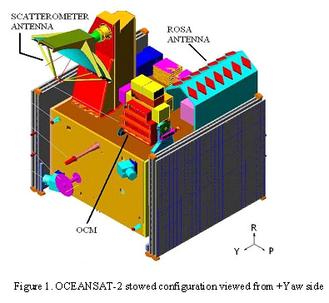
    Image of Oceansat-2 from ISRO. Source: Wikimedia Commons

    There was news recently that an issue with the attitude control system caused the end of life of the Megha-Tropiques mission. The satellite had completed more than ten years in orbit. This reminded me of a comment we had submitted to the Parliamentary Standing Committee.

    One of the comments I had written as part of The Takshashila Institution’s comments to the Parliamentary Standing Committee on Science and Technology, Environment, Forests, and Climate Change addressed said:

    The Department of Space must aim to put in orbit replacements for operational satellites before they reach end-of-mission life and not of end-of-design life.

    pg 7, Comments to the Parliamentary Standing Committee on Science and Technology, Environment, Forests and Climate Change on Demand for Grants (DFGs) in the Union Budget for FY 2022-23

    With reference to Megha-Tropiques, which had a mission life of three years, I meant that we seek to replace them before the end of three years and not the ten years it eventually served because its parts were designed to last this long.

    Perhaps, replacing Megha-Tropiques was not top of mind at ISRO or CNES, the French space agency. But, consider a satellite that we plan to launch in the near future, Oceansat-3.

    Oceansat-1 was launched in 1999 and had a mission life of 5 years. Oceansat-2, the replacement for Oceansat-1, was launched in September 2009, six months after 10 years of Oceansat-1’s launch anniversary. Oceansat-1 survived for 11 years.

    Oceansat-2 had a mission life of 5 years. The scanning scatterometer (SCAT) on board the Oceansat-2 failed after 4.5 years. In 2016, India launched a satellite, SCATSat-1, to replace the functionality. Oceansat-2 has now been functional for 12.5 years. Oceansat-3 has been plagued with delays. The new launch date for Oceansat-3 is now August-September 2022.

    The pandemic played a role in the delay. If Oceansat-2 had failed after 11 years like it’s predecessor, we would not have a Oceansat. What would that mean? The Wikipedia page says:

    Oceansat satellites facilitate a range of applications including documenting chlorophyll concentration, phytoplankton blooms, atmospheric aerosols and particulate matter as well as marine weather forecast to predict cyclones.

    Oceansat Wikipedia page

    Forget if the others don’t make sense to you but imagine not being able to predict cyclones with accuracy. Remember the claims of being able to predict cyclones much earlier and hence being able to save more lives? What happens if that function goes kaput?

    It was that functionality that was lost and was replaced by SCATSat-1 in 2016. That instrument has now been running for 5.5 years. It has crossed six months since end of it’s five year mission life. Maybe it will survive eleven years like other satellites in the series. Maybe not. Hence, replace satellites before they die.

    Update on April 10 @ 2126 hrs IST: @zingaroo on Twitter had an update on SCATSat-1:

    Many other things could also go wrong. This is why redundancy is good. But, there are constraints. There are budgetary and people constraints. I think that is why we must work towards replacing the satellite as close as possible to the end of mission life.

    This is not the first time I am making this point. I had written an article for The Wire Science in 2019 where this was one of the issues that I had raised. In the article, I applauded ISRO because it was doing much better at replacing satellites of the CARTOSAT series compared to other remote sensing satellites just after mission life.

    I thought of putting the suggestion again in the comments to the Parliamentary Committee because I thought the pandemic reinforced the lesson. In case of an unforeseen incident because of which we are not able to replace a satellite before mission life, we have some tolerance before if we launch it before end of design life. But, it we launch it close to end of design life, there is a possibility that there may be a loss of the satellite before we can launch the replacement.

  • A First Step to better Space Situational Awareness

    It was three years after the Kargil war in 1998. It was more than a month after the deadly attacks of September 11. A Polar Satellite Launch Vehicle (PSLV) carrying a satellite with possible military applications was launched from India’s space port, Sriharikota.

    Cover of the Jan-Mar 2003 edition of Space India. Source: ISRO.

    The armed forces wanted a way to watch the border with Pakistan. The satellite launched on-board the PSLV-C3 mission had a capability to see vehicles on the ground (1 m resolution) and could hence help spot infiltration bids by military or terrorists from across the border from Pakistan.

    This was the Technology Experiment Satellite (TES). The launch took place without much fanfare.

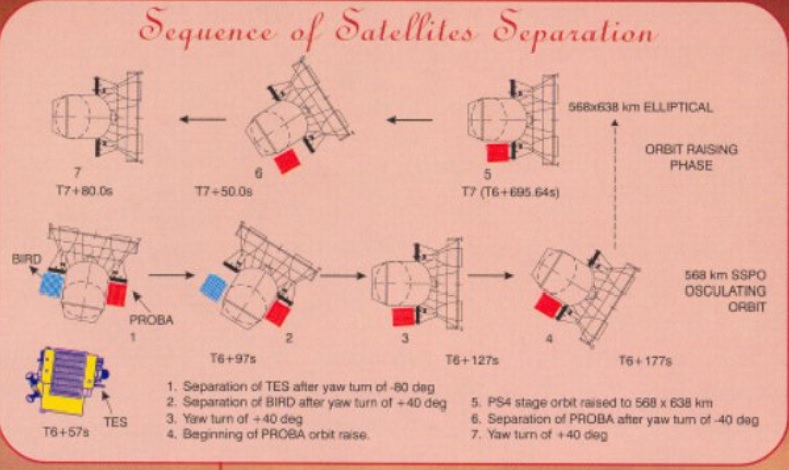
    But, this mission had a more lasting impact than just this important near-term national security mission. Flying with TES, were the Belgian PROBA and the German BIRD satellites. The PSLV after placing TES and BIRD in circular orbits, moved using its yaw RCS thrusters to place PROBA in an elliptical orbit. Each of these customers paid India $1 million for the mission. This was a big deal then, being just the second commercial mission that India was flying.

    PSLV-C3 sequence of satellite separation. Illustration in the Space India edition Oct-Dec 2001.

    This demonstrated PSLV capability to place multiple satellites in multiple orbits. So, the primary satellite could be placed in one orbit while the ride-share satellites could fly to the same or other orbits.

    Within a couple of months of the launch, the fourth stage of the satellite broke-up on 19 December, 2002. A paper written for the 34th Committee on Space Research (COSPAR) Scientific Assembly held in Houston, USA, by P Bandopadhyay, R Sharma and V Adimurthy identified the cause as explosion. They predicted that 75% of the debris would decay in the Earth’s atmosphere by end-2002.

    In the Space Situational Assessment 2021 that ISRO released yesterday, they shared that 76 (almost 20%) of the 386 debris pieces from the PSLV-C3 fourth stage explosion still remain in orbit.

    Although ISRO knew that passivation was important, this mission seems to have prompted active ISRO efforts towards passivation of upper stages of launch vehicles and spacecrafts of ISRO. This 2019 paper by Santosh Kosambe throws light on these efforts to reduce the contribution of space debris because of ISRO launches.

    A K Ganeshan, then with the Flight Dynamics Center at ISRO Satellite Center (now, U R Rao Satellite Center) wrote a piece about space debris in the January to the March 2003 edition. This, seems to be one of the first public write-ups on the issue published by ISRO.

    Ganeshan and Adimurthy (from the 2002 COSPAR paper above) wrote a paper together in Acta Astronautica in February 2006. This seems to be a seminal paper in the active efforts ISRO took in reducing space debris.

    The Space Situational Assessment shares important information about Indian assets (spacecraft and Indian space debris) in orbit broadly. It shares the methods by which ISRO tracks these objects (optical telescopes and radar). It also shares the debris avoidance maneuvers it has performed to protect Indian space assets (satellites and even the Chandrayaan-II orbiter).

    Sharing this important information publicly is an important first step. Transparently sharing this information with data (two-line elements) would be the logical next step.

    ISRO has been building this capability with a series of optical telescopes and radars to be installed for monitoring. This would be the basic institutional infrastructure required since India is responsible, as per international law, for accidents in space caused due to Indian space assets (spacecraft and debris).

    My former colleague at Takshashila, Aditya Pareek and I had written a piece in The Wire Science asking for more involvement from the open-source intelligence community. ISRO must encourage the growth of this talent in India. The sharing of the data with two-line elements will help the development and growth of an Indian community.

    India has also begun the process of opening up the space sector for private companies. As private companies build spacecraft and launch vehicles, there would be an increase in the number of space assets to be monitored. While ISRO built infrastructure can monitor these, Indian companies should also become part of the solution. Companies like LeoLabs show how private companies can help solve this problem.

    As the number of Indian assets in space grows, it will become increasingly important to work with other space-faring nations which may endanger Indian assets or vice-versa.

    In short, we will need institutional capability, amateur enthusiasts, private companies and collaboration with other space-faring nations to keep Indian assets in space safe and to reduce Indian liability in case of any space accidents.

  • Interview with Dr. S Unnikrishnan Nair, Director, HSFC and VSSC in Malayalam

    This is a Malaylam language interview on Asianet News with Dr. S Unnikrishnan Nair. He is the Director of Vikram Sarabhai Space Center (this is where Indian rockets and launch vehicles are built) and Human Spaceflight Center (this is where India’s human spaceflight programme is being developed with astronaut training etc.).

    Link to the Malayalam article that accompanies this interview.

    The interviewer is Arun Raj K M. You can follow him here on Twitter. Below was his announcement for the interview posted on Twitter. He erroneously says 2020 in the tweet but he means 2022.

    I do not have a cable connection at home, so I watched it on YouTube. The video was originally shared on Gareeb Scientist’s Discord (link to his YouTube channel, his Discord is for members only). At least two people on Twitter asked me for the English translation of this interview. Hence, I decided to create the English notes of the interview to help me share it with others.

    There may be mistakes in my notes. Please refer to the original in Malayalam if you understand the language. Please help me with corrections in the comments section of this blog post.

    • Congratulations on the PSLV-C52 launch.
    • ISRO thinking about how to clear backlog and return to launch after COVID-19.
    • Next launch will be PSLV C-53.
      • within 2-3 months.
      • exact date will be known later.
    • Small Satellite Launch Vehicle
      • designed to launch 500 kg payload to Low Earth Orbit.
      • Has a lot of commercial possibilities.
      • Three solid stage with a liquid velocity trimming module for fourth stage.
      • All important tests are done. Vehicle being integrated right now.
      • Launch from Satish Dhawan Space Center, Sriharikota.
    • Gaganyaan – India’s human space flight programme
      • Working on how Orbital module can be separated in flight.
      • It is not necessary to use GSLV Mk-III for these tests.
      • So, a Test Vehicle (TV) was developed using a single stage Vikas engine. This engine is derived from second stage of the PSLV (PS-2) and the liquid strap-ons used on the GSLV (L-40).
      • This vehicle will be used to create the conditions of flight to test the abort of the Orbital Module.
      • 1-2 flights of the Orbital Module will be undertaken this year. This gives us confidence to make sure that the Crew can escape in case of any issues in-flight.
      • TV is also being developed as a multi-purpose test platform.
      • TV will be used to test air-breathing propulsion system.
      • TV will also be used to create flight conditions for the Reusable Launch Vehicle (RLV-TD) for various tests like straight-line flights of the RLV.
    • Human Spaceflight Launch Vehicle
      • GSLV Mk III is converted into a human-rated launch vehicle.
      • Satellite and payload fairing used on GSLV Mk III is replaced with an Orbital Module and Crew Escape System.
      • Vehicle design has changed. Hence, vehicle undergoing tests like wind tunnel tests etc. Many of the hardware used for the vehicle is being realized at Vikram Sarabhai Space Center (India’s rocketry hub).
      • Each stage needs to be analyzed separately and together to identify points at which failure is possible. Then, need to provide redundancy to avoid failure.
      • Health parameters of the launch vehicle needs to be monitored constantly. If needed, flight should be aborted under appropriate conditions. Vehicle Health Monitoring System is being developed for this purpose.
    • Second Launch Pad
      • Second Launch pad is being modified to support human spaceflight.
      • Second Launch Pad will be able to launch both GSLV Mk III and human-rated GSLV Mk III.
      • Escape chutes are being developed on the Pad.
      • Testing facilities and other accessories needed for human spaceflight being added to Second Launch Pad.
    • Astronaut Training
      • 4 astronauts in Bengaluru at Human Space Flight Center.
      • Training provided in Russia was generic in nature.
      • The Indian training round involves familiarizing astronauts with the human rated launch vehicle and the Orbital Module.
      • It also involves theory, practical, mental fitness, physical fitness etc.
      • Training likely to take 1.5 years. (I am assuming this is the Indian training round and not the total training time.)
      • Understand which areas are accessible in the Orbital Module.
      • Astronauts will also undergo simulator training. Simulators are getting ready at a temporary facility being developed in Bengaluru. This will be inaugurated soon.
    • Collaborating with Glavkosmos, other collaborations? (This was the question asked, but Unnikrishnan replied about Indian contribution. I think the interviewer intended to ask about any other foreign collaboration.)
      • This is a truly national programme.
      • We are tying up with industries, academia and other national laboratories where the technology is already available.
        • DRDO lab in Agra provided us with the parachutes.
        • Defence Food Research Laboratory in Mysore is providing the astronauts with food.
        • We have signed 12 MoUs with various national laboratories.
    • Technology Transfer to the public in the future. (Again, I think the interviewer asked about generally but Unnikrishnan is answering from PoV of human spaceflight).
      • Life support system in capsule could help in living in high altitudes. (possibly, in locations like Siachen for the Indian Army)
      • Inflatable Habitat
      • Portable Life Support System
      • Flight Suits
      • There are also many other things that we cannot foresee today.
    • Private Ecosystem
      • Space was a largely the domain of the government in the 1950s and 1960s. Private companies are playing a bigger role in space across the world.
      • Especially in America, where today they are also involved in human spaceflight and dreams of travelling to Mars.
      • We need to increase private sector participation in the Indian space programme.
      • Mechanisms like IN-SPACe (India’s regulator for the space sector) help.
      • Incubators, access to ISRO faciliteis will help.
    • Do you see private companies like Skyroot etc. as competitors?
      • No.
      • We have to encourage private ecosystem in the space sector to lower cost, to foster technological innovations etc.
      • We need to handhold them today to help them achieve these tomorrow.
      • We help them in reviews, provide test facilities, identify research areas etc.
      • By doing this, we want to increase India’s share in the space economy.
      • ISRO will do science missions.
    • Chandrayaan-3 , India’s third lunar mission
      • It will happen this year.
      • VSSC’s responsibility is for the launch vehicle, the GSLV Mk III.
      • We will make sure that VSSC delivers the same on time.
    • Heavy-Lift Launch Vehicle
      • Studies on this are on-going. They are not yet in project stage.
      • These are revealed to the public when a proposal is sent to the Government after study.
      • This will be based on capabilities of ISRO, Indian industrial capability etc.
    • GSLV (what was earlier called the GSLV Mk II)
      • The cause of the failure of the GSLV-F10 has been isolated.
      • We are working on fixing this issue. Fix implementation is in progress.
      • NAVIC’s Indian Regional Navigational Satellite System (IRNSS-1J) will be launched on the GSLV after the fixing the issue.
    • NASA-ISRO Synthetic Aperture Radar (NISAR)
      • Joint collaboration between ISRO and NASA. Work in progress.
      • Main responsibility of VSSC is the GSLV. Work in progress to make sure that the launch vehicle is ready to launch on time.
    • Satish Dhawan Space Center, Sriharikota (India’s space port)
      • We are developing the capability to launch multiple rockets and launch vehicle. These are in the final stages of implementation.
      • We are also building the capability to increase the number of PSLV launches. These are also in the final stages of development.
      • We are building the capability to assemble and integrate GSLV Mk III in two locations, brought to the launch pad and launched.
    • Science Missions
      • Aditya-L1 (Mission to study the Sun) – to be launched in the second half of this year.
      • Launch vehicle preparations are in progress in VSSC.
    • The change in naming conventions (from OceanSat, EduSAT to EOS and CMS etc.) is for better monitoring of the missions.
    • Semi-cryogenic engine
      • These are being built to uprate the capability of the GSLV Mk III (to help it carry more mass to orbit).
      • LPSC, Mahendragiri is working on developing this stage and associated testing facilities.
    • Vyom-mitra (a humanoid robot developed by ISRO)
      • It will fly on the first uncrewed mission of Gaganyaan.
      • It is now undergoing testing and qualification for space conditions for launch.
      • Robotics is an important area. We see these robots as co-travelers with humans to the Moon and Mars (for interplanetary missions).
      • Hence, we are testing and developing our capability in robotics.
  • Evo-Devo Universe

    I had written about the Evo-Devo universe on January 3, 2021. I got many questions from readers for more details about the Evo-Devo universe. I am still in the process of learning more about it myself.

    Photo by Snapwire on Pexels.com

    Evo-Devo is a model of predicting the future of the universe. The model was developed by futurist John Smart and philosopher, Clement Vidal. It is a possible theoretical explanation for the Universe. The authors propose a model that mixes two other existing models – evolutionary and developmental model.

    However, scientists, presently think that the universe is fully evolutionary.

    Evolutionary in the Evo-Devo is the bottom-up process of evolution. This is what we see in biology and shown by Charles Darwin. The authors call this part of the process “chaotic, variety-producing, locally adaptive, and unpredictable”.

    Developmental in the Evo-Devo is the top-down process of development by planning. The authors call this part of the process “stabilizing, convergently unifying, globally adaptive and predictable”.

    The authors think that the mixture is in the Pareto ratio (80:20). This ratio could be 90:10, 95:5, 98:2 or could move in either direction as more data becomes available.

    In his essay, The Goodness of the Universe, John Smart applies the above theory to show that the Universe becomes increasingly good as it evolves and develops into networks. As these networks miniaturize and becomes dense, it becomes more likely that humans will stay on Earth than go out into the cosmos.

  • What they talk about when they talk about the GSLV?

    The GSLV-F10/EOS-03 mission failed on August 12, 2021. The vehicle faced an issue in it’s third cryogenic stage.

    What does ISRO mean when they say GSLV? There is a lot of confusion between the GSLV Mk I and the GSLV Mk II. The YouTuber Gareeb Scientist raised this question in a video he posted on August 8, 2021. He provides the reasons for this confusion.

    I believed the first version of the story shared in Gareeb Scientist’s video. I believed that the Mk I was a reference to the GSLVs which flew with the Russian cryogenic engine, KVD-1. And, thought that the Mk II referred to the GSLV which flew with the Indian cryogenic engine, CE-7.5.

    This version was shared by ISRO in the brochure of the GSLV-D3 which flew on April 15, 2010. ISRO has removed this brochure from it’s website. But, there is an archived version online as well as on the VSSC website [PDF]. Page two of this brochure carries this explanation.

    The Wikipedia page for GSLV still references this explanation and describes variants in this manner. I think that this has contributed to this confusion.

    ISRO seems to have changed this version of the story in 2015 in an e-book published on its website, Fishing Hamlet to Red Planet. You need an epub reader to read the book. In an essay by R V Perumal titled, Evolution of the Geosynchronous Satellite Launch Vehicle, he mentions that the GSLV Mk I was actually a modified version of the PSLV with a cryogenic upper stage. However, since the Cryogenic Stage did not work out for the PSLV, hence the idea of the GSLV Mk I was dropped. Perumal was the Project Director for the PSLV and GSLV and later the Director, Liquid Propulsion Systems Center (LPSC). I think I would trust this version.

    Since there is no Mk I and all the flights of the GSLV are what ISRO called the Mk II project, it seems ISRO just dropped the Mk II and began calling the launch vehicle GSLV in 2017. This change is also seen on the ISRO website on the GSLV page from 2017.

    The GSLV Mk III is a totally different project. I think the GSLV tag got attached to it only because it primarily delivers its payload to a geostationary transfer orbit.


    Addendum – August 17, 2021

    In response to this blog post @zingaroo replied on Twitter stating that ISRO had always called the GSLVs with the Russian cryogenic engines as the Mk-I and the ones with the Indian cryogenic engines as the Mk-II. He provided two examples of the same from the past.

    He presents evidence from the magazine, SPACE-India April-June 2003, Page 11. Also from Gopal Raj’s book Reach for the Stars published in 2000.

    It seems ISRO is also re-writing history in a way. It seems that the project started somewhere after 2010.

  • Does ISRO have any plans?

    India’s space programme seems to be stuck in a rut.

    India has three broad tracks in it’s space programme – satellites and launch vehicles programme for remote sensing, communications and navigation, planetary exploration and human spaceflight. We are trying to outsource the first to a private industry that is not prepared to handle the responsibility yet. The second is moving in slow motion. The third seems to be pushing really hard to achieve the unachievable. In the recently held, Global Space Exploration Conference 2021, Chairman, ISRO had this to say:

    This is a statement that the media in India has run several times. Hence, his statement did not get any media coverage in India. ISRO is going through tough times with the spaceport under lockdown because of the large number of COVID-19 cases.

    The United Arab Emirates seems to be having more ambitious planetary exploration plans than India at the moment. They are talking about two lunar missions, they have signed up for the Artemis accords and are planning to send the second astronaut to the ISS soon.

    UAE has grown rich on an important natural resource, oil. This resource is limited on Earth. This has helped the nation learn important lessons in importance of natural resources for the development of the country. Hence, they want to be part of the space faring nations who get to decide how space resources are used just like OPEC controls crude oil prices on Earth.

    India used to announce plans like this before. Before the Chandrayaan 1 launch, we spoke of landing humans on the Moon by 2020. While factors beyond ISRO’s control delayed the realization of these projects by years, it gave everyone a broad idea of where India was headed. Now, there is just silence in this regard.

    Chairman, ISRO in his New Year message had said that the various centers had drawn up decadal plans but so far we have not seen any. When there is no action physically due to valid reasons, this is the right time to think of things. For example, China has been putting out studies about how to get humans to Mars. ISRO has been doing these studies but not publishing them.

    The civilian space programme is not secretive. The idea is to use this programme to raise the morale of the workforce, inject excitement for science and commerce in the country and project India’s rising capability in the sector. This communication is an important task that is assigned to Chairman, ISRO.

  • Pradeep’s Space Newsletter

    I started writing the space newsletter again. Edition #23 was out this Thursday. Future editions will be out every Thursday.

  • Should India sign the Artemis Accords?

    I wrote a piece on The Wire Science with the above title. You can find the article here.

  • A Difficult Task – Splitting ISRO and NSIL

    me: I made an error in understanding this. I leave this here for record. But, I have corrected this on my newsletter.

    I write a weekly newsletter on an Indian perspective to space stuff every Thursday. The edition that I sent out last Thursday (March 11) was a space policy edition.

    I specifically covered a report tabled in the Rajya Sabha by the Department-related Parliamentary Standing Committee on Science & Technology, Environment, Forests & Climate Change.

    Department of Space Organisation Chart. Image: ISRO.

    The Standing Committee asked DoS about the role of India’s space agency, Indian Space Research Organisation (ISRO) with the entrance of NewSpace India Ltd. (NSIL). The Department replied stating that missions such as Gaganyaan, Chandrayaan and advanced technology mission would be carried on by ISRO and the rest would go to NSIL. This answer was presented to Parliament in February 2021. The Standing Committee published the report on 8 March 2021.

    It is based on this answer that I said in the newsletter that:

    This means that ISRO is going through a period of change as it commercializes parts of it’s operations (PSLV, GSLV, SSLV etc.) and focuses on research. This section thus marks a very important turning point in it’s journey. As shared in this PTI story, NSIL also has ambitions of building satellites and payloads. This would mean parts of works done in each center of ISRO will be commercialized and spun-off into NSIL.

    Pradeep’s Space Newsletter #20

    On 12 March 2021, NSIL held a press conference (NSIL press note). Here, they announced that they are planning to take over ISRO’s fleet of communications and remote sensing satellites.

    I must admit I did not see the satellites bit coming. This is no small task. Managing such a fleet of satellites would need the kind of human resources and expertise that is currently only available at ISRO.

    Splitting technical and human resources between ISRO and NSIL will be no small task. This is the turning point that I am referring to in the paragraph above.

    DoS had put out a request for proposals (RFPs) from the industry to see if any single or a consortium of industries could develop PSLV for NSIL. This process, they claimed during the press conference will take 6 to 8 months.

    This leaves the space sector with several players with them not yet knowing what they have to do. There is Indian National Space Promotion and Authorisation Centre (IN-SPACe), Indian Space Research Organisation (ISRO), NewSpace India Ltd. (NSIL), Antrix Corporation, Space Commission and the Department of Space. The Government will have the task of putting them in order to make the sector boom. A difficult task.