Category: Space

  • Tianwen 1 – China’s Maiden journey to Mars

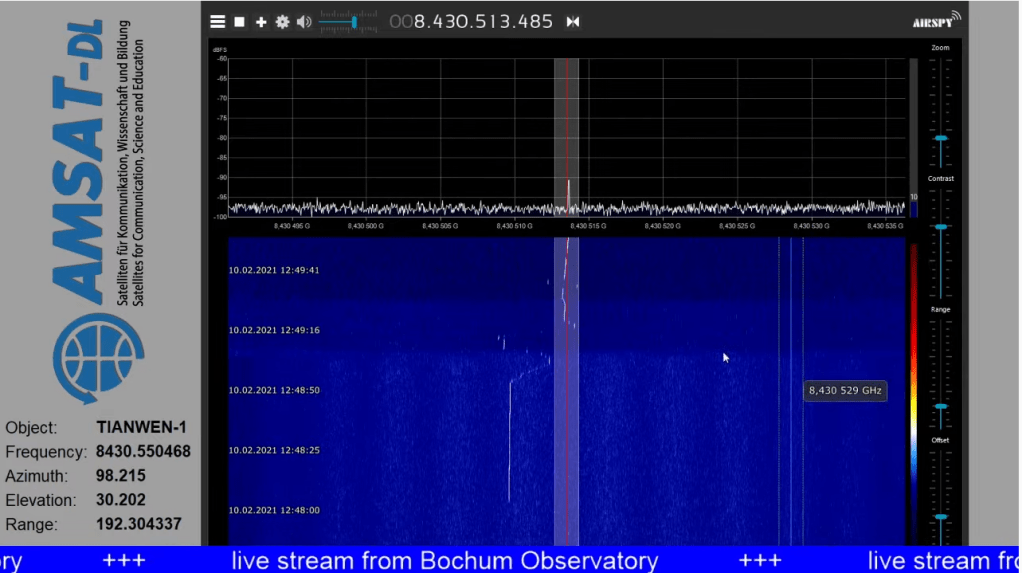
    Tianwen-1 is the Chinese spacecraft that went into orbit around Mars on February 10, 2021. There was not going to be a live coverage of the event. Andrew Jones, a journalist tracking the Chinese space program tweeted that AMSAT-DL is covering the event on radio. This is where I followed the event.

    Radio output from Tianwen-1 after it emerged from behind Mars. Photo is a screenshot of the AMSAT-DL YouTube live feed

    The spacecraft re-emerged from behind Mars. I captured the image above from the live webcast. From the expected time being as expected, it was judged that the spacecraft had reached Mars orbit. Confirmation came from Chinese CCTV4 stating that the orbiter had reached orbit.

    Read more:

  • Hope – UAE’s Maiden journey to Mars

    I had the chance to follow the United Arab Emirate (UAE)’s Hope mission to Mars on YouTube and Twitter. I followed the YouTube stream of Dubai One. On Twitter, I followed the official Twitter account of Hope and Sarwat Nasir, a journalist with The National, a UAE based newspaper.

    The Hope (Al-Amal) was designed, developed and controlled from the Mohammed bin Rashid Space Centre (MBRSC) in Dubai, UAE. It was built by MBRSC with 3 universities in the United States of America (USA), University of Colorado, Boulder, University of California, Berkely and Arizona State University. It was launched on 19 July, 2020 on Japan’s H-IIA launch vehicle. The UAE hopes to setup a human settlement on Mars by 2117.

    The UAE went all in with the promotion of the mission.

    Besides these promotions, they did a good job with a light show on the Burj Khalifa in the run up to the Mars Orbit Insertion. My favourite part of the show was the slice of Mars shown on the Burj. The light show showed the Emirati scientists involved in the program. They spoke to some of the personnel that worked on the mission. News was shared that more than 37% of their personnel were women. The average age of the personnel was 27.

    The first acquisition of signal was at the Deep Space Network at Madrid. As we waited for Hope to emerge from behind Mars, the tension that scientists faced was similar to the tension that would have been faced at any space center anywhere in the world. On display, was a very basic human emotion. Waiting for the results of a mission that one has worked so hard on.

    With the mission success, UAE became the 5th country or country group at Mars along with the United States of America, Europe, Russia and India.

  • ISRO’s plan for the next decade

    Chairman, ISRO and Secretary, Department of Space, K Sivan, shared a new year message.

    It has been a little more than 5 years since ISRO shared it’s Space Vision documents, it usually shares. I think this had something to do with the failure of the GSLVs in the first half of the last decade. With both, GSLV Mk-II and GSLV Mk-III operationalized, I was hoping that ISRO would start the process of planning it’s space missions again. ISRO’s former Chairman, G Madhavan Nair recently criticised ISRO for this shortcoming. Thus, I was happy to read that an institutional level decadal plan has been drawn up and inputs were received from most ISRO centers.

    I particularly like the use of the word ‘resourcefulness’. This has been used to describe ISRO in the past and I think Sivan might have re-discovered the word. I prefer this word to describe ISRO’s innovative use of limited resources. I prefer this word instead of the low-cost and jugaad descriptors that media has been using for ISRO since the Mars Orbiter Mission.

    Space Transportation Systems

    The Vikram Sarabhai Space Center (VSSC) at Thiruvananthapuram is ISRO’s principal space transportation systems center. VSSC has rightly identified heavy lift as an important challenge for India. If India is to plan even slightly more complex lunar missions or even useful Mars mission, it requires more power than what it currently has. The development of a heavy lift vehicle is an important step in building up capability in this aspect. With ISRO’s thrust in this decadal plan being towards human spaceflight, this will be an important requirement for launching space stations in the future.

    Another aspect that VSSC has to focus on is the number of launches it’s launch vehicles can offer. ISRO has set targets of 10 launches per year in the past, a target it has not yet achieved. Being able to reach that target in this decade would be a fundamental confidence booster. With talk of commercialisation of the PSLV stages, there will be hope that the constraint will not rise from the supply side.

    Also, VSSC will have to deliver on important technologies like the scramjet, testing of the reusable launch vehicle and partial reusability made popular now by SpaceX.

    STS needs support from the other centers as well. The Liquid Propulsion Systems Center (LPSC) in Mahendragiri will play a vital role in development of the semi-cryogenic engine required for the Heavy Launch Vehicle. There will be no use developing these systems without the support of the Satish Dhawan Space Center (SDSC) at Shriharikota. SDSC will need to ramp up its infrastructure for a more busy schedule. Adding to it’s manifest this decade will be private launch vehicles other than the one’s from ISRO. Skyroot’s Vikram 1 could be the first privately launched launch vehicle from SDSC as early as December 2021. Also, not to forget, this decade could see Indians launching on an Indian rocket from Indian soil.

    Satellites

    The U R Rao Satellite Center (URSC) in Bengaluru will also have to increase the production of satellites. India currently has one-fourth the number of operational payload of China. Earlier, it’s complaint has been that the satellites it built don’t get to orbit. With those problems sorted and with more options opening up to go into orbit, URSC has the opportunity to build satellite constellations, build innovative space infrastructure like space stations, in-space satellite servicing and maybe even satellites that dock with each other. Besides, new innovations, URSC also has to build and launch satellites that are needed for various applications like remote sensing, meteorology, communications, navigation and geographic information systems.

    Space Applications

    As a country, I think we have not integrated space enough into various parts of the Indian economy. Many of the NewSpace companies are now offering this service directly to customers. Space Applications Center (SAC), Ahmedabad and National Remote Sensing Center (NRSC), Hyderabad must now also be centers where data is exchanged with private players and not only government players. This has to be provided with minimal down time and with high accuracy. Besides building technologies that enable this in space and on Earth, they have a vital role to play to support requirements of the Indian government and NewSpace applications providers.

    Space Situational Awareness

    ISRO Telemetry, Tracking and Command Center (ISTRAC), in Bengaluru has an important role to play in space situational awareness. As we launch more satellites into orbit including those by private companies, space situational awareness becomes more important. There is a real threat from our neighbours who have direct kinetic weapons, co-situated orbital weapons and cyber weapons in their kits. The recent operationalisation of the Space Situational Awareness center is a step in the right direction. Transparency in sharing data and collection of data by the center will improve its capability and hence prove to be an active player in the world in the matter of space situational awareness.

    Science vs Engineering

    While IIST provides the engineers who work at ISRO, an important complaint with ISRO has been the lack of science impact on it’s missions. I hope that in this decade, the Physical Research Laboratory (PRL) at Ahmedabad works closely with other scientific institutions in the country to get more science per kilogram of payload available on ISRO’s satellites and outer space missions. The role of a scientist needs to shift from few to all stages of the mission. The engineers need to understand what the scientists want the satellite to do. The scientists need to understand the limitations of engineering payloads. I think PRL can facilitate this much better than any scientific institution in the country.

    IIST will continue to provide ISRO with the engineers it needs but PRL needs to be made ready to provide the scientists who will provide challenges to engineers for unique space missions.

    Last words…

    ISRO needs to formalize the plans laid down by the Chairman. I think having plans will help ISRO plan and execute better. It will place more stress on time-bound completion of projects. It will make the organization ready for the challenges awaiting it while we compete not only with other nations but large private players. The Chairman talks about a transition to the knowledge economy but I think, in space we have moved from a knowledge economy to an utilization economy.

    A utilization economy is one where space know-how is used for utilization of space-enabled data in the economy of Earth, utilization of space-based resources and possibly one day an economy that spans Earth-Moon and Mars as dreamed by our former President, A P J Abdul Kalam.
  • ISRO’s plan for the next decade

    Chairman, ISRO and Secretary, Department of Space, K Sivan, shared a new year message.

    It has been a little more than 5 years since ISRO shared it’s Space Vision documents, it usually shares. I think this had something to do with the failure of the GSLVs in the first half of the last decade. With both, GSLV Mk-II and GSLV Mk-III operationalized, I was hoping that ISRO would start the process of planning it’s space missions again. ISRO’s former Chairman, G Madhavan Nair recently criticised ISRO for this shortcoming. Thus, I was happy to read that an institutional level decadal plan has been drawn up and inputs were received from most ISRO centers.

    I particularly like the use of the word ‘resourcefulness’. This has been used to describe ISRO in the past and I think Sivan might have re-discovered the word. I prefer this word to describe ISRO’s innovative use of limited resources. I prefer this word instead of the low-cost and jugaad descriptors that media has been using for ISRO since the Mars Orbiter Mission.

    Space Transportation Systems

    The Vikram Sarabhai Space Center (VSSC) at Thiruvananthapuram is ISRO’s principal space transportation systems center. VSSC has rightly identified heavy lift as an important challenge for India. If India is to plan even slightly more complex lunar missions or even useful Mars mission, it requires more power than what it currently has. The development of a heavy lift vehicle is an important step in building up capability in this aspect. With ISRO’s thrust in this decadal plan being towards human spaceflight, this will be an important requirement for launching space stations in the future.

    Another aspect that VSSC has to focus on is the number of launches it’s launch vehicles can offer. ISRO has set targets of 10 launches per year in the past, a target it has not yet achieved. Being able to reach that target in this decade would be a fundamental confidence booster. With talk of commercialisation of the PSLV stages, there will be hope that the constraint will not rise from the supply side.

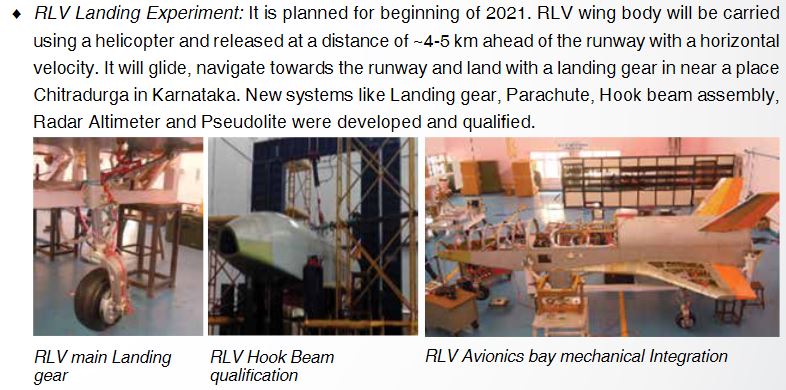
    Also, VSSC will have to deliver on important technologies like the scramjet, testing of the reusable launch vehicle and partial reusability made popular now by SpaceX.

    STS needs support from the other centers as well. The Liquid Propulsion Systems Center (LPSC) in Mahendragiri will play a vital role in development of the semi-cryogenic engine required for the Heavy Launch Vehicle. There will be no use developing these systems without the support of the Satish Dhawan Space Center (SDSC) at Shriharikota. SDSC will need to ramp up its infrastructure for a more busy schedule. Adding to it’s manifest this decade will be private launch vehicles other than the one’s from ISRO. Skyroot’s Vikram 1 could be the first privately launched launch vehicle from SDSC as early as December 2021. Also, not to forget, this decade could see Indians launching on an Indian rocket from Indian soil.

    Satellites

    The U R Rao Satellite Center (URSC) in Bengaluru will also have to increase the production of satellites. India currently has one-fourth the number of operational payload of China. Earlier, it’s complaint has been that the satellites it built don’t get to orbit. With those problems sorted and with more options opening up to go into orbit, URSC has the opportunity to build satellite constellations, build innovative space infrastructure like space stations, in-space satellite servicing and maybe even satellites that dock with each other. Besides, new innovations, URSC also has to build and launch satellites that are needed for various applications like remote sensing, meteorology, communications, navigation and geographic information systems.

    Space Applications

    As a country, I think we have not integrated space enough into various parts of the Indian economy. Many of the NewSpace companies are now offering this service directly to customers. Space Applications Center (SAC), Ahmedabad and National Remote Sensing Center (NRSC), Hyderabad must now also be centers where data is exchanged with private players and not only government players. This has to be provided with minimal down time and with high accuracy. Besides building technologies that enable this in space and on Earth, they have a vital role to play to support requirements of the Indian government and NewSpace applications providers.

    Space Situational Awareness

    ISRO Telemetry, Tracking and Command Center (ISTRAC), in Bengaluru has an important role to play in space situational awareness. As we launch more satellites into orbit including those by private companies, space situational awareness becomes more important. There is a real threat from our neighbours who have direct kinetic weapons, co-situated orbital weapons and cyber weapons in their kits. The recent operationalisation of the Space Situational Awareness center is a step in the right direction. Transparency in sharing data and collection of data by the center will improve its capability and hence prove to be an active player in the world in the matter of space situational awareness.

    Science vs Engineering

    While IIST provides the engineers who work at ISRO, an important complaint with ISRO has been the lack of science impact on it’s missions. I hope that in this decade, the Physical Research Laboratory (PRL) at Ahmedabad works closely with other scientific institutions in the country to get more science per kilogram of payload available on ISRO’s satellites and outer space missions. The role of a scientist needs to shift from few to all stages of the mission. The engineers need to understand what the scientists want the satellite to do. The scientists need to understand the limitations of engineering payloads. I think PRL can facilitate this much better than any scientific institution in the country.

    IIST will continue to provide ISRO with the engineers it needs but PRL needs to be made ready to provide the scientists who will provide challenges to engineers for unique space missions.

    Last words…

    ISRO needs to formalize the plans laid down by the Chairman. I think having plans will help ISRO plan and execute better. It will place more stress on time-bound completion of projects. It will make the organization ready for the challenges awaiting it while we compete not only with other nations but large private players. The Chairman talks about a transition to the knowledge economy but I think, in space we have moved from a knowledge economy to an utilization economy.

    A utilization economy is one where space know-how is used for utilization of space-enabled data in the economy of Earth, utilization of space-based resources and possibly one day an economy that spans Earth-Moon and Mars as dreamed by our former President, A P J Abdul Kalam.
  • Geostationary Junkyard – A Business Opportunity?

    I recently read on Marco Langbroek’s blog about there being a geostationary junkyard at two longitudes 75 E and 105 W.

    These seem to be forming a geostationary ring around our planet formed with non-functional geostationary satellites. Of these 75 E is the longitude on which India is located.

    Is there a business opportunity for an Indian NewSpace company?

  • Space going back to Kerala?

    While listening to Mission ISRO, I realized how the focus of space activities changed from Thumba to Bengaluru in the 1970s when Prof. Satish Dhawan became ISRO Chairman after the death of Vikram Sarabhai, the father of the Indian space program.

    In today’s episode, it was discussed how people in Kerala opposed the move to build Aryabhata, India’s first satellite to Bengaluru. Surendra Pal in his reconstruction says that people blockaded the movement of equipment from Thumba. It seems scientists carried some tools and books as personal luggage from Thumba to Bengaluru.

    In Thiruvananthapuram, a space park was started in 2019. Many space companies have moved there. When listening to this episode today, I wondered if this is a return back to the 1960s.

    While I do not want to indulge in counterfactual of what would have happened if the space program had stayed in Kerala, I think the creation of the space park is another opportunity to unlock that potential.

    Kerala has lost several investment opportunities. It has lost so because of perceived unionism and the political troubles many industries have faced. But, given the slow loss of a remittance economy, there is a slow return of small and medium enterprises in the state. Unfortunately, the state has slowly lost land with no space for large industries.

    The Space Park idea is a great place for space companies to register and operate from. Will it be inviting enough to get companies to move from Bengaluru to Kerala Space Park?

  • Skyroot Aerospace unveils Dhawan 1

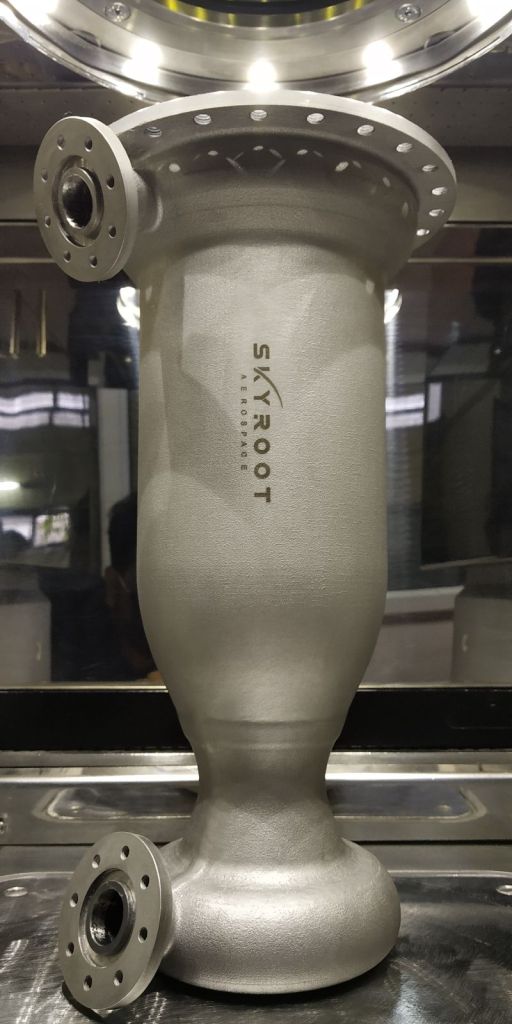
    Skyroot Aerospace unveiled the Dhawan 1 cryogenic engine today.

    Skyroot Aerospace is a commercial launch vehicle service provider company based in Hyderabad. They hope to build a fleet of three small satellite launch vehicles called Vikram 1, Vikram 2 and Vikram 3. They hope to launch Vikram 1 in December 2021.

    Dhawan 1. Image Credit: Skyroot Aerospace

    Dhawan 1 is a cryogenic engine that uses liquefied natural gas (LNG) and liquid oxygen as cryogenic propellants. The company says that their engine is 100% 3D printed in India. This will form the last stage of the Vikram 2 rocket. Vikram 2 is capable of lofting 520 kg to Low Earth Orbit (LEO). Skyroot dedicated the engine to Prof. Satish Dhawan on his birth centenary.

    Today is Prof. Satish Dhawan’s birth centenary. He was a fluid dynamics expert who was director of the Indian Institute of Science (IISc), Bengaluru before becoming Chairman, ISRO after the death of Dr. Vikram Sarabhai, the founder of the Indian space program. He is credited with building up India’s communication and remote sensing satellite systems as well as development of India’s workhorse PSLV.

    India also has had a tough time working with cryogenic engines. It tried to procure cryogenic engines from Russia. This was blocked by the USA. Following this, India began developing an indigenous cryogenic engine in the 1990s. Following many failures atop the GSLV, it finally became successful only in 2014. ISRO has since developed a stable of cryogenic rocket engines. Given this history, Skyroot’s success is appreciable.

    They received a lot of attention in August 2020, when they became the first Indian aerospace company to test their Raman engine. Raman is the upper stage bi-propellant liquid rocket engine used for Vikram 1. Vikram 1 is capable of lofting 315 kg to Low Earth Orbit (LEO). A few days back they also fired the ballistic evaluation model motors of their solid rocket engines. They have shared the videos on their YouTube channel.

    Test firing their Raman rocket engine
    Firing a scaled down version of their solid fuel engine

    I am waiting to watch a static fire test of this cryogenic engine and also the first flight of Vikram 1. Good luck to Skyroot Aerospace.

  • A muted first anniversary for Chandrayaan 2

    Arup Dasgupta writes in The Wire Science about the muted Chandrayaan 2 anniversary. This is quite contrary to the claim of the 95% mission success that ISRO spoke of at the time of the loss of lander and rover.

    I broadly agree with the point Dasgupta makes in the article but have a few reservations to share.

    I think there have been many more publications of results than what Dasgupta claims but they are not centralized at any one place. This has been a pain point with ISRO. I have to depend on r/ISRO for helping me find where ISRO has published this information.

    I summarized the findings from Chandrayaan 2 in Issue #3 of Pradeep’s Space Newsletter under the heading Chandrayaan 2 science papers where other than the Current Science articles Dasgupta mentions, there are papers submitted to the Lunar and Planetary Science Conference (LPSC). There may be more or perhaps COVID-19 intervened.

    ISRO has announced that Chandrayaan 2 data will be released in public in October 2020. Hence the claim about there being no release of data may be premature. An announcement of opportunity may follow.

    Speculation about the lander-rover, is that more news will be available with images from Chandrayaan 2 when they publish a paper about it. But the silence and reaction from ISRO about the failure of the lander-rover part of the mission has been childish.

    Shanmuga Subramanian mentioned in the article above has also been continuing the search for Chandrayaan 2 lander-rover from data obtained from NASA’s Lunar Reconnaisance Orbiter (LRO) from subsequent passes over the crash site. He has also been continuing to search for impact debris of the Moon Impact Probe launched with Chandrayaan 1 in 2008. Talking of Chandrayaan 1, I will be posting here about their finding of rust on the lunar surface.

    To end, I like to share VM’s post about why it’s a pain to try and follow what ISRO does. But, part of the love for our space agency is learning about ISRO using any means necessary.

  • Devleena @ Numer8

    Episode 22 of the NewSpace India podcast had Narayan Prasad (NP) talking to Devleena about her company, Numer8. Numer8 is a Mumbai-based data science company that uses data obtained from Earth observation satellites to solve problems like disaster management, coastal community monitoring, infrastructure monitoring, wildlife, and biodiversity protection.

    The present episode of the podcast talked about fishing and how Numer8’s app Ofish helps in this regard. They provide a mobile application to the fisherman who use the app to determine places to fish and also see what price they can get from the market for their catch. The fishermen use the app using transponders that were fitted on the boats by the respective State governments. Some also rely on mobile networks. At the same time, Numer8 also provides a dashboard to port authorities to protect the coasts and prevent over-fishing.

    The app supports Tamil, Sinhala, English, Marathi and Bengali languages currently. It protects data obtained from satellite by providing limited field of view of about 20 km, with no data provided for fishing beyond 20 nautical miles and also not sharing data to fishermen in other countries.

    The geospatial data is primarily sourced through NASA and Europe’s Sentinel data. Devleena says that timely data from ISRO has been an issue but they hope to use data such as the Ocean Colour Monitor data from OceanSat.

    There were also two other brief discussions that I found interesting and I note them here for my own reference.

    The app is an example of a downstream application of geospatial data. This means data obtained from satellites is provided to a customer in an easy to use format. This has been difficult to do in the Indian situation with not many companies looking at these downstream applications. As much as we need private companies to build space hardware and software we also need companies that can use the products obtained from putting satellites in orbit. Numer8 is one example of such a company.

    In the past, ISRO has sold its fishing data to the Fisheries Department and relies on the Fisheries Department to get the data to the fishermen, who are the end user. This ended up with fishermen having data that they did not understand and spending too much time at sea to obtain their catch. This was the transmission of data from Government agency to another Government Agency which relayed the data to a Customer (G > G > C). The presence of Numer8 inserts a private entity in this supply chain. So, the flow of data becomes (G > P > C). This led to improvement in way by which data was presented to the end user or customer and ensured that the data was used by the same. The Private company studied the end user, found out why existing products were not used and made sure that the data was usable.

    The second point related to Numer8’s contribution to the UN’s Sustainable Development Goals (SDGs). Devleena said that theirs was the only startup that presented to the UN that the oceans could be as much a source of food as land. Numer8 suggested that better data could feed people while ensuring that ocean fish population was not over-fished.

  • Astrobiology in India

    I stayed in Lonar between July 2018 and June 2019. I was aware of the geological interest that the meteorite crater there held for the scientific community. I did not know what interest it held for the astrobiology community. I had the first opportunity to learn more when Jyotirvidya Parisanstha (JVP) hosted a lecture by Prof. Yogesh Shouche of the National Center for Cell Science. The lecture was about how Lonar Lake was a model for extraterrestrial life search! I kicked myself little for missing the lecture. Today’s podcast episode gave me a glimpse of what I probably missed.

    Episode 16 of the NewSpace India podcast has Narayan Prasad (NP) in conversation with Siddharth Pandey, PhD. Siddharth heads the Center of Excellence in Astrobiology at Amity University, Mumbai. Below are the show notes from that episode.

    Siddharth defines Astrobiology as the study of origin, evolution and distribution of life on Earth and the search for it elsewhere. He says Astrobiology formed the basis for some of the older space programs like NASA and Russia’s Roscosmos because it pertains to some of the fundamental questions that have been important to the human species like are we alone in the Universe and the search for life outside our planet. Siddharth wants to begin connecting to a network of people in India who are interested in Astrobiology. He returned to India after stints in America, Europe and Australia.

    Siddharth says that astrobiology related experiments in India began in 2005 with teams led by Dr. Jayant Narlikar based out of IUCAA, Pune and TIFR, Hyderabad among others. This group believed in a theory called Panspermia – which says that life was bought to Earth by an asteroid impact at some point in the Earth’s history. This team conducted balloon experiments out of the field in Hyderabad that led to the discovery of bacteria living in extreme environments in the Earth’s atmosphere.

    Siddharth says that the Methane search instrument (Methane Sensor for Mars – MSM) on board the Mars Orbiter Mission is an astrobiology experiment. He says ISRO had developed an astrobiology experiment knowingly or unknowingly. Methane is considered one of the bio-signatures that indicates the existence of life. Hence, existence of Methane corresponds to existence of life. He hopes we have more experiments flying to search for life in clouds of Venus and the surface of Mars. He hopes that the chance to carry micro-gravity experiments on board the 4th stage of the PSLV, SSLV and the upcoming human spaceflight mission, Gaganyaan increases the number of astrobiology experiment that can be designed and carried on these missions.

    NP asks Siddharth if the lack of a Space Science roadmap is worrying. Siddharth says that he finds the fact that we have no clear Space Science roadmap concerning especially given ISRO’s plans for missions to Mars and Venus in the near future. He says that several meetings on these experiments have been held but the outcomes of these experiments need to be more widely shared. He hopes that in the future, scientists are involved right mission planning and architecture stage of the mission itself to design better payloads.

    Siddharth says that there is a need for a National Committee for Astrobiology that brings together various Government departments like DST, DBT etc to develop a roadmap for Astrobiology and to co-ordinate an astrobiology program. He says that ISRO has been good at developing platforms for astrobiology experiments in space.

    He then talks about analog environments that are present in India. He speaks about Ladakh, Kutch, Lonar in Maharashtra and Antarctica. He says that the low atmospheric pressure, low oxygen, high ultraviolet ray exposed environment which are well preserved for centuries in Ladakh provides conditions that are analogous to an early Mars.

    He says that hypersaline bacteria and jarosite minerals found in Kutch have been studied by PRL, Ahmedabad and papers have been published in scientific journals. He says that being one of the largest continuous salt expanses make it an interesting field of study for it’s similarities to early Mars.

    He says that the impact of a meteorite in basaltic rock, a form of rock formed by melting of volcanic rocks means that it takes longer to weather compared to meteorite impact on other types of rocks.. The site at Lonar, Mahrashtra is one that is most accessible among two other similar sites in the world. He says that Lonar also has a lake formed by a drain of a spring that drains into the crater. This is similar to the landing site for the Mars 2020 which may be going into a dried site where a lake such as the one in Lonar probably existed at some point in Mars’ history. Lonar offers similar basin and depositing mechanisms which scientists can compare and study from.

    Siddharth says India has two sites in Antarctica – Maitri and Bharati. Of these, Bharti station is located on Larsemann Hills. The hill is of interest because it is ice-free. This is because geothermal heat prevents ice formation. This means scientists have access to rocks and access to study bacteria living in rocks which survive in dry and cold regions of Earth. It also has a permafrost where the ice has not melted as it is under the soil. Here the ice is preserved for centuries and hence of interest to scientists.

    NP then asked about how a person interested in astrobiology can pursue it as a career option. Siddharth says that they are in the process of putting together a website with freely available reading material. Siddharth suggests that interested students can pursue Astrobiology at the post-graduate level after pursuing an under-graduate program in Biology, Physics, Chemistry, Engineering etc.

    NP then asks Siddharth about possible citizen science efforts that can be undertaken in astrobiology. Siddharth talks about the development of a Space Citizen Network where citizens can get connected to research groups working in the field. He also suggests that citizens could connect with these groups when they go on field trips. There are plans for a field trip to Kutch in October 2020 and to Lonar in November 2020.

    There are also plans for projects that can be undertaken at home. One of the plans is to distribute marbles and citizens can report back after studying microbial colonies that grow under the marble. Scientists are interested in understanding how microbial colonies grow and attach themselves to rocks. They also want to learn what environments support growth of these microbial colonies. This can be in addition to similar amateur astronomy projects like identifying asteroids etc.

    NP then asks whether there are plans for an independent road-map for Astrobiology of Government efforts for the same. Siddharth says that plans are afoot to formalize a Society of AstroBiology Education and Research (SABER) that could be registered in Maharashtra. He says that the group had already met twice – once in Lucknow and once in Pune. They hope to develop a roadmap for the future growth of the astrobiology community. They might also consider contributing to mission objectives on future missions to Mars and Venus.

    NP asks about raising funding for astrobiology experiments. Siddharth says that there is no single source for funding for astrobiology. Mostly, scientists raise funds from different departments and societies based on either where they are coming from or from organizations that are involved in their area of interest.

    ISRO provides funding through its RESPOND and SNAP. He says that they have previously raised funding from companies like Tata Motors and National Geographic Traveller magazine. He is currently also thinking of reaching out to philanthropy houses in Mumbai to access funding for the future projects that they are thinking of undertaking.

    Siddharth says that Amity is planning to put together a weekend program called Space for Everyone which would generate awareness about space. At the end the people who complete the program can join the Space Citizen Network. He says that astrobiology popularization has been hurt as there is a lack of credible speakers. He hopes that efforts above address these issues. Amity has also launched India’s plant growth space flight experiment called the Amity Space Biology Experiment -1 (ASBE-1).

    On the role of the Media, he says that media should do more than simply cover events. They must provide a forum to discuss, analyze and critique events. He says that it must enable two way discussion between the scientist and the citizens. He says that India must look at reasons for which it is pursuing a scientific program.

    NP says India has a strong Biotechnology and Pharmacy industry. He asks Siddharth about what is the scope for Indian biotech and pharmaceutical companies in participating in Astrobiology. Siddharth responds that astrobiology experiments would give these companies an opportunity to research how the human body behaves in microgravity and experiment with chemicals and drugs. He says that while there are applications in fundamental research, it would largely serve marketing purposes currently. Companies could showcase how their products are used in space programs and how their designs can be used in extreme conditions such as in space.

    NP then asked where Siddharth sees the future of astrobiology in India. Siddharth replies that he hopes that ISRO works on larger support and infrastructural missions with private sector works on supporting low earth commercial missions. For astrobiology in India, he hopes that there is an active scientific society, meeting often to exchange knowledge and builds cross-domain and inter-disciplinary expertise that is needed. He also hopes India undertakes future missions to the moons of Jupiter and Saturn – Europa and Enceladus, that are considered some of the other sites in our solar system which could support life.

    End of show notes.

    This podcast also gave me a stream of ideas. We could Astrobiology Cafes to discuss recent developments in the field. As missions progress in this direction, I also think there will be discussions surrounding ethics and safety that arise. I do not see how these are tackled by the astrobiology community. This conversation excited me a lot, opened my eyes to what astrobiology really is about and agree with NP’s comment in the end that it was a dense knowledge transfer rich episode of the podcast. This reminded me so much of my days from 2009 when I developed a Lunar Analog Research Station.