Category: Space

  • ISRO to launch 5 British satellites as its first commercial launch in 2015

    ISRO will launch 5 British Satellites on behalf of Antrix Corporation (which is ISRO’s commercial arm) on board the PSLV-C28 vehicle on July 10, 2015. This is the PSLV’s 30th mission. ISRO will use the PSLV’s Extended Length (XL) variant to launch 1440 kg payload consisting of 5 British satellites into orbit.

    The 5 satellites are the Surrey Satellite Technology Limited’s (SSTL) DMC3 satellites and CNBT-1 satellites and the Surrey Space Center’s DeOrbitSail spacecraft.

    DMC3 satellites

    The DMC stands for the Disaster Management Constellation of 3 satellites built by the SSTL for it’s wholly owned subsidiary, DMCii (DMC International Imaging Ltd) which is executing this project for a Chinese company, 21AT.

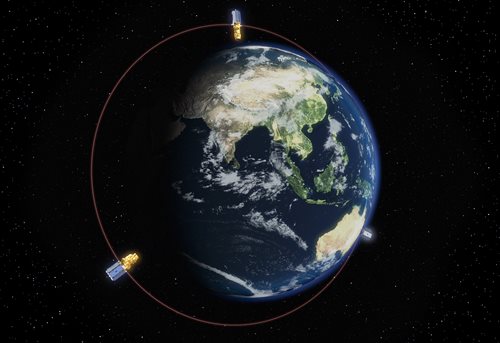
    A visualisation of the orbit and position of each satellite in the DMC constellation. Image Courtesy: SSTL
    A visualisation of the orbit and position of each satellite in the DMC constellation. Image Courtesy: SSTL

    The DMC constellation is a group of 3 small satellites placed in orbit 120 degrees apart, as shown in the image above. The idea is to quickly image areas which have been struck by disaster with high-resolution cameras (1 m resolution) with a capability to provide very fast down link in order to help make the images available quickly in order to assess damage and plan disaster response.

    CBNT-1

    I could not read much about this satellite but it seems that the company that built it, SSTL will share more details after the launch. All that is known for sure right now is that it weighs 91 kg and is a technology demonstrator mission.

    DeOrbitsail

    This is an interesting 7 kg 3U cubesat with dimensions of 10 x 10 x 34 cm. It contains a highly densely packed 4 x 4 meter sail which will be deployed in space in order to increase drag in order to cause the spacecraft to deorbit and return back to Earth. The project is developed by the Surrey Space Center (not the same as SSTL).

    PSLV-C28

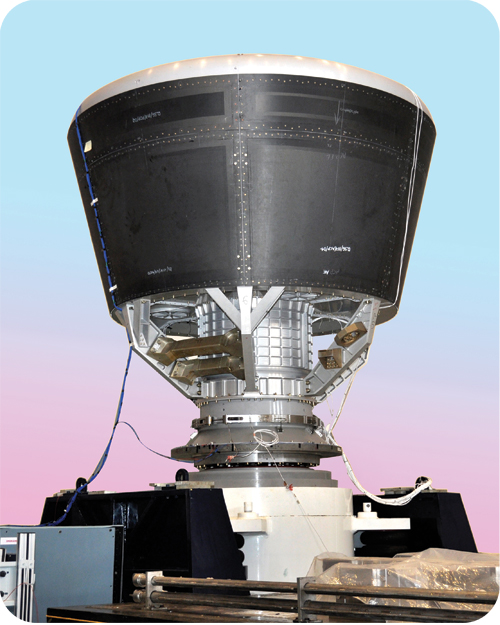
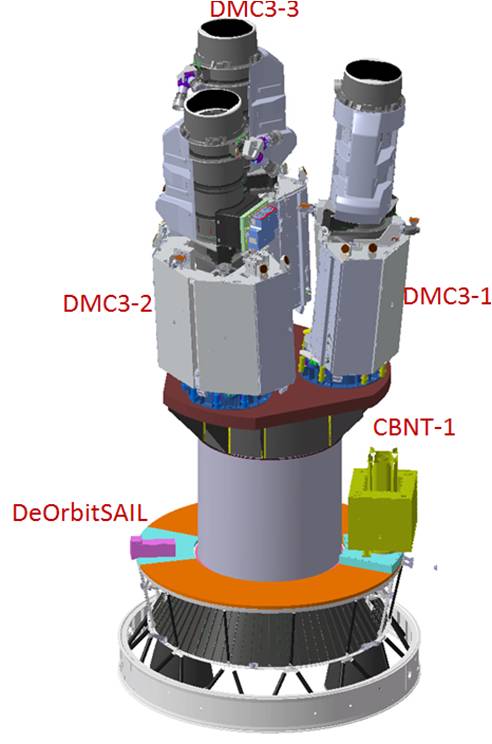
    The Spacecraft mounted on the Launch adapter called the L-adapter. Image Courtesy: ISRO
    The Spacecraft mounted on the Launch adapter called the L-adapter. Image Courtesy: ISRO

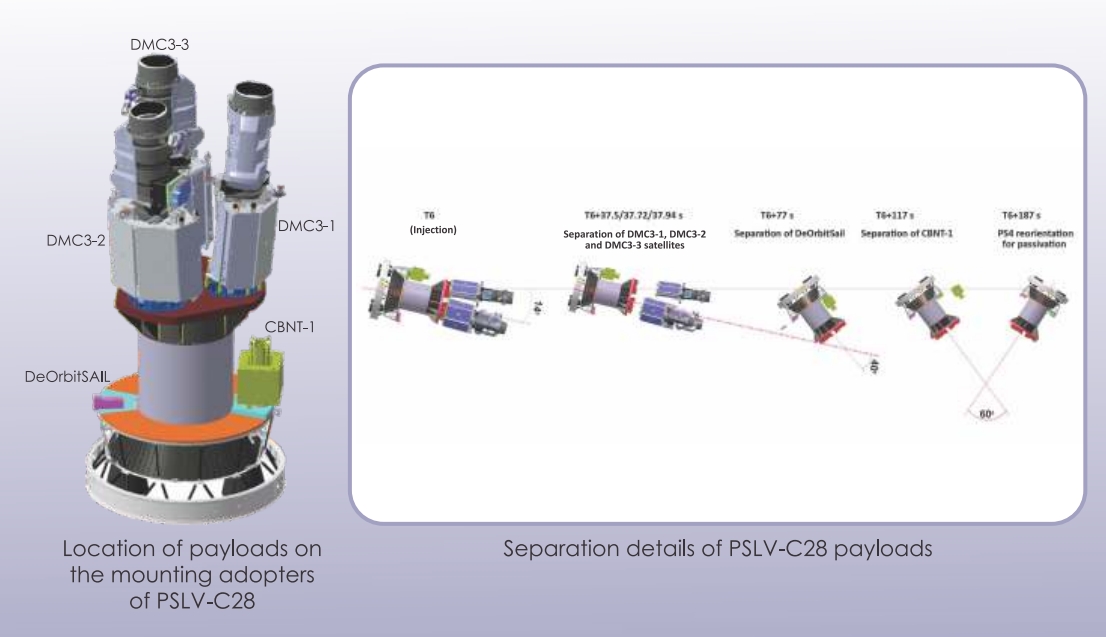
    For ISRO, the challenge begins with the three DMC3 spacecrafts. It had to fit in these 3 satellites each of which has a length of 3 meters into the 3.2 m diameter, 8.9 m long payload fairing of the PSLV-XL. They resolved the issue by changing the launch adapter. A launch adapter is basically a platform on which the satellites are kept and launched from once the last stage of the PSLV reaches the designated orbit and orientation. The vehicle uses a new launch adapter which has a triangular deck and is called the Multiple Satellite Adapter – Version 2 (MSA-V2).

    Illustration of the Multiple Satellite Adapter - Version 2 (MSA-V2) with the satellite mounted and showing the launch of various satellites. Image Courtesy: NasaSpaceflight.com
    Illustration of the Multiple Satellite Adapter – Version 2 (MSA-V2) with the satellite mounted and showing the launch of various satellites. Image Courtesy: NasaSpaceflight.com

    A success now will help cement the PSLV’s record and hopefully bring more business Antrix’s way. This launch shows that even commercial launches can make requirements on a proven launch vehicle that if managed would improve the agility of the variety of satellites that the PSLV is capable of putting into orbit. This agility lowers cost and enables Antrix to reach a wider market to sell launches on the PSLV. Wishing ISRO Godspeed.

  • RC Planes and the Cansat competition

    In 2009, whilst I was involved with SEDS-India, we had initiated a cansat competition at our chapter in Vellore Institute of Technology. The next year on a team at IIIT-Hyderabad won the international cansat competition, a feat they repeated the next year. I have been thinking up ideas of how to make a reasonable cansat competition in India, given the restriction on launch of amateur rockets to expand the popularity of cansats beyond these pockets.

    Given this background, I wanted to attend this introductiory talk to a workshop on aeromodelling and RC Planes given by a member of the Aeromodelling club at VJTI, Mitali Shah.The workshop is slated to run through weekends on Sunday at Maker’s Asylum in One Indiabulls Center from April 4.

    At the time that I was doing engineering, there were several co-working and hackerspaces being developed in Mumbai. The advent of MAKE magazine in the US in 2005 brought on what was being touted as the maker movement. This saw the advent of makerspaces along the same lines as the hackerspaces. Maker’s Asylum is one such makerspace that has been evolving as part of this global maker movement. This is a welcome experiment among a group of models being tried out by people in India to see what works and what does not.

    The talk today consisted of introducing the workshop which begins on April 4. The workshop is to include a day of theory lessons and then nearly 2 days of practical build sessions and flight at Mahalaxmi Race Course (one of the few sites in Mumbai which has permission to fly RC planes). I also heard talk of developing a wind tunnel and how accessibility would be much easier compared to getting hold of wind tunnels in colleges like VJTI and IIT in Mumbai.

    During the talk it struck me that RC planes are good candidates to carry cansats for their drop.

    Let me take you back to what is involved in a cansat competition. An amateur rocket is used to carry and deliver the cansat at a predestined point and left to descent along a parabolic path. At the competition we held in VIT, we launched the cansat from atop a building complex. With amateur rockets being severely restricted and RC planes having a relatively easier access profile than amateur rockets, it would make a great carrier plane for cansats. It would be something akin to the way Virgin Galactic plans to launch its rockets.

    After her talk, I spoke to Mitali and she confirmed that RC planes would be able to carry cansats comfortably.

    A cansat competition in India could thus be done as a part of RC planes competition already being held in the country or independently in collaboration with aeromodelling clubs replacing the amateur rockets. RC planes would carry the payload to a designated height and release it. The cansat would then after a few seconds of free flight would then parachute down where they could meet the data requirements sought in the competition. After touchdown, teams would have to search for cansats by fox hunting, which are currently done by amateur radio enthusiasts in Mumbai.

  • Public Talk by Dr Seetha

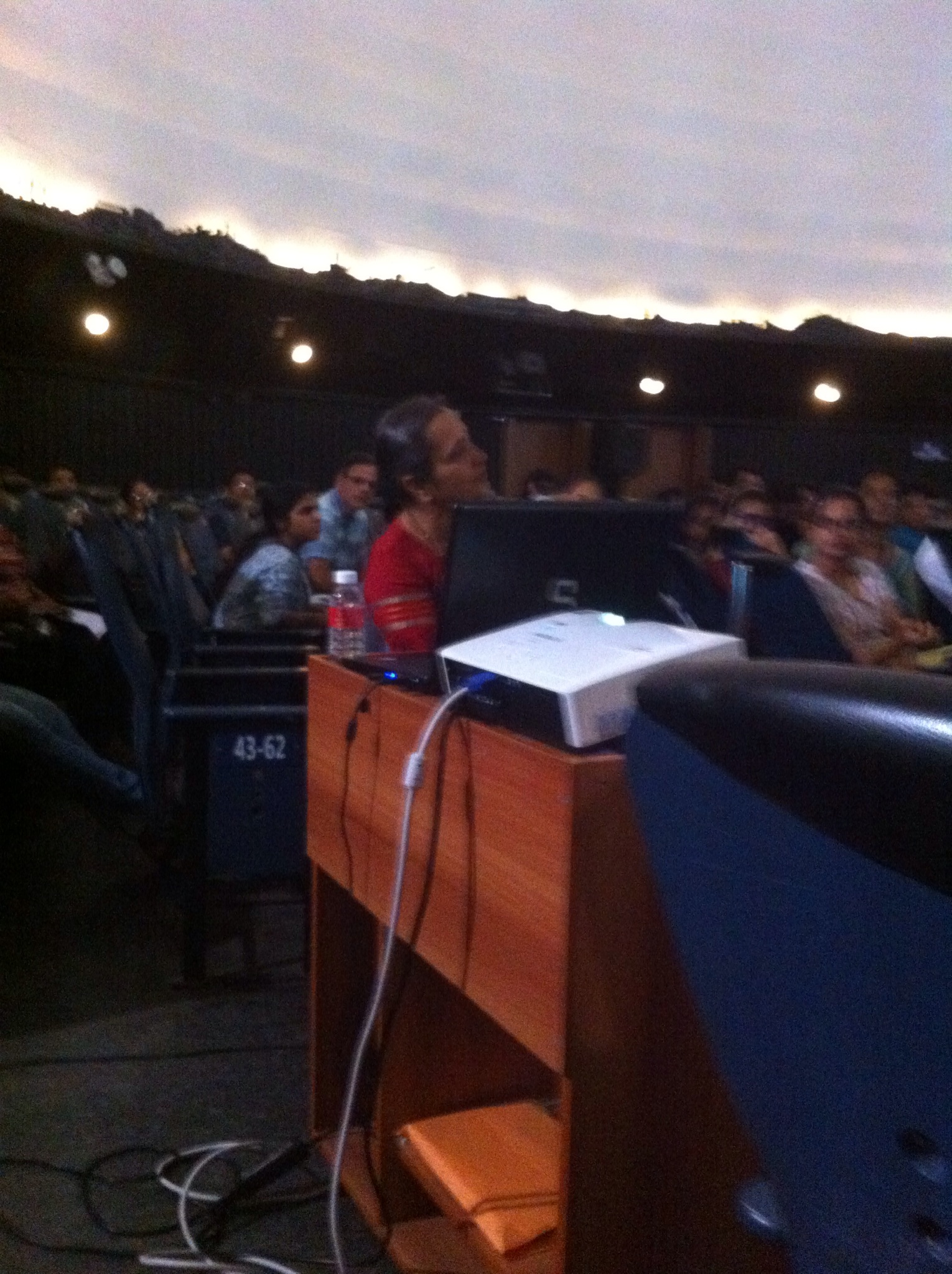
    Last Saturday I was at Nehru Planetarium, Mumbai’s Sky Theatre listening to a talk by ISRO’s Dr Seetha. She was working with the Mars Orbiter Mission and from my understanding on the Mars Colour Camera project. She is also a principal investigator on the Astrosat Project.

    IMG_0686.JPG
    Image: Dr. Seetha giving her talk at Nehru Planetarium, Mumbai. Image Credit: Pradeep Mohandas, released under a CC-BY license.


    Nehru Planetarium director Arvind Paranjpaye introduced Dr. Seetha who comes from a background in astronomy and who was working on the instrumentation of telescopes at the Kavalur Observatory. She moved to ISRO once it began the Planetary Sciences Division at PRL, Ahmedabad. She was among a group of scientists who moved from astronomy to space division within ISRO, a fact that was thus far unbeknownst to me.

    She spoke of some of the challenges faced by the ISRO team whilst putting together the Mars mission – the usual facts about the need for the longer coast phase for the PSLV, the need for additional ocean based terminals provided for by the Shipping Corporation of India, the re-starting of engines and of-course the Mars Orbiter insertion. She spoke of how the once in 26 month opening comes for a mission to Mars works and also answered specific questions on spacecraft instrumentation redundancy and radiation and thermal shielding. There were a few request for apps. She said the spacecraft may have enough fuel now to do a 1 year mission even though though it was designed for a 6 month mission thanks to the inserted orbit. She asked the audience to follow the mission via Facebook and Twitter for more exciting picture releases and perhaps even a few science results from the other instruments.

    I hope ISRO does send more of its scientists to talk to the public in gigs such as this. She said she understood that there was public was restless about the speed at which the pics were getting released via Facebook and Twitter but said that the speed was slow down a bit as the scientists get down to the science. In a private conversation with her, I got a chance to thank her for the better quality of pics that were now being made available. She said that better technology enabled this.

  • The Red Marble

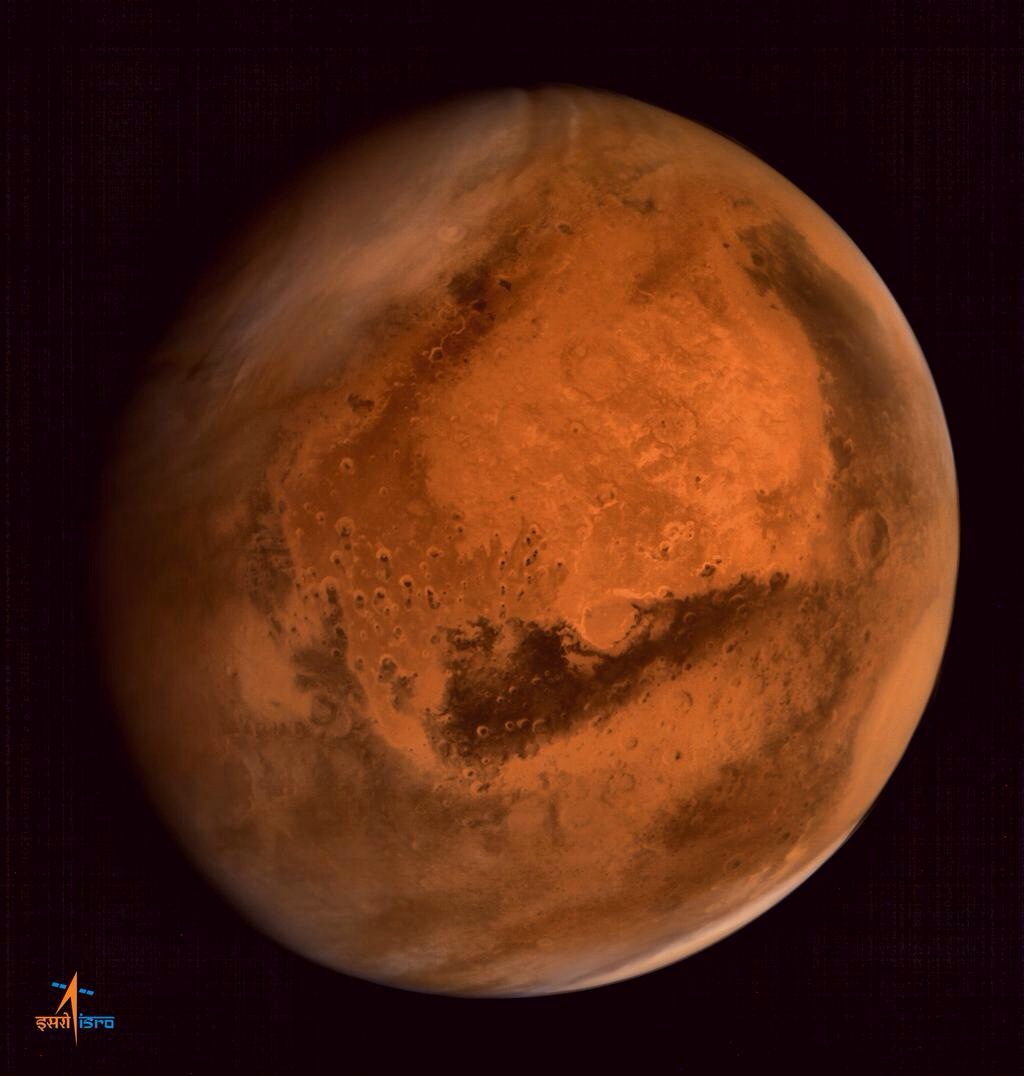
    The Red Marble, this is what I thought we’d call the first global image that would be returned by the Mars Orbiter Mission. The name is inspired by the famous 1972 image known as the Blue Marble. This was made possible by the highly elliptical orbit that the spacecraft was designed to take. Today evening, ISRO put out the first global picture of Mars. It kinda looks more like Mysore Masala Dosa, no?

    IMG_0634.JPG
    Image: Regional dust storm activities captured by the Mars Colour Camera on board the Mars Orbiter Mission. Taken from an altitude of 74,500 km from the surface of Mars. Image Credit: ISRO.

    Emily Lakdawalla explains the importance of this image in this blog post. If you are interested in what specific features this image covers Phil Plait aka The Bad Astronomer covers that on his blog here. Stephen Clark of SpaceflightNow reporting from the International Astronautical Congress 2014 at Toronto, Canada reports that ISRO Chairman Radhakrishnan announced that 4/5 instruments have now been activated at the Space Agency Head’s Panel. All good news!

  • ചോവ്വില നിന്നും ആദ്യത്തെ ചിത്രങ്ങള്‍

    ഐ എസ് ആറ ഒ ചോവ്വ ചിത്രങ്ങള്‍ പുറത്തുവിട്ടു.

    IMG_0624-5.JPG

    IMG_0625-4.JPG

  • India at Mars

    Short version: India’s Mars Orbiter Mission spacecraft successfully fired it’s Liquid Apogee Motor (LAM) today to correct its trajectory and also served as a test for the LAM which had been sleeping for about 298 days now whilst the spacecraft sped in the general direction of where Mars would be. As of 9:30 AM today, MOM is in Mars’ sphere of gravitational influence, it test fired and trajectory corrected at 2:30 PM today. Long version below.

    It was 2:30 PM today when ISRO tweeted that the MOM may currently be firing its LAM to perform a test to check if it’s still working and also execute a very small trajectory correction so that the spacecraft will be set up to park into Mars orbit come the morning of September 24. About 15 minutes after that, ISRO announced to the world that they had fired the engines successfully for nearly 4 seconds.

    ByJG5vxCYAA7xvw


    Image: ISRO flashed this image on Twitter with the caption, “Test Firing of Liquid Engine: Guided by wisdom, Executed by youth”. link to the orignial pic

    I was really sceptical about ISRO’s prospects of doing a Mars mission. They worked really hard and pulled through extra shifts to ensure that a spacecraft would be ready in time for the Mars launch window in 2013. Little news items were strewn around showing progress that ISRO made that showed that ISRO was working towards the goal of launching in 2013 but nothing quite indicated that they were ready to launch. As the launch window approached, they quickly got the spacecraft off Earth on a smaller launch vehicle than one would anticipate being used for a Mars mission anywhere else in the world.

    The modified PSLV, a workhorse adaptable launch vehicle performed excellently delivering the spacecraft to its intended orbit. The spacecraft then performed orbit raising manoeuvres and slowly headed out towards the heliocentric orbit. As the spacecraft pushed off towards Mars, my skepticism slowly waned away.

    For a technology demonstrator mission, the most critical part of the mission is to show that the fundamental building blocks work and can function. With today’s LAM firing, I think that ISRO proved a very crucial component of the mission design. Skepticism kept me away from posting anything here for a very long time. I have to say that I am now very hopeful that we can do this. I seek nothing more than a gentle nudge that puts the spacecraft in an elliptical orbit around Mars.

    Critics of this mission have been plenty and have criticised each component of this mission design. ISRO has answered its critics thus far by action, something I think that many Indians would do well to ape.

  • India, Uranus and its rings

    There are several Indian publications that claim that India discovered the rings of Uranus (Vigyan Prasar, the principal science populariser in India, the Vellore District website, the Indian National Science Academy in its publication and even the Wikipedia page on the Vainu Bappu Observatory). So, when you visit the page on Uranus on Wikipedia, you’re quite surprised to see the credit for the credit has been stolen by the Americans! Being a Wikipedian and from the spirit of reading the Sceptical Patriot, I began researching.

    Rings of Uranus
    Image: A 1998 false-colour near-infrared image of Uranus showing cloud bands, rings and moons obtained by the Hubble Space Telescope’s NICMOS Camera. Image credit: NASA/Hubble Space Telescope. Image Source

    The year is 1977. Astronomers have predicted that a star was going to be occulted by Uranus. Basically, this meant that Uranus would pass in front of a star. The best visibility was to be had from South Asia, East Africa and parts of South East Asia. Two observatories from India participated in this observation, the Vainu Bappu Observatory at Kavallur and the Uttar Pradesh State Observatory at Nainital. Since the US did not get to be part of the action, NASA flew an airborne observatory called the Kuiper Airborne Observatory (KAO). On it flew Eliot, Dunham and Mink who are today credited with the discovery of the rings of Uranus. Having read the above publications whilst growing up, I thought that Wikipedia was showing it’s Global North bias while claiming this fact.

    I first went looking for the publication where the results from the observation of the Vainu Bappu Observatory would have been published. I came up with this piece published in the Bulletins of the Astronomical Society of India’s March 1977 edition by J C Bhattacharya and K Kuppuswamy. It claims of a discovery of a new satellite of Uranus.

    The astronomers at Kavalur were out to observe the occultation was of the star called SAO 158687 by Uranus. Uranus was to pass in front of the star, as per predictions by astronomers. When astronomers watched the star they expected a dip in the brightness of the star as Uranus passed in front of it. They did observe this but in addition, they observed several other dips before the event. This dip was suspected to be caused by a satellite of Uranus. However, none of the known satellites of Uranus were in the position where the dip was observed. Thus, Bhattacharya and Kuppuswamy deduced that this was a new satellite of Uranus, which prompted the above publication in the Bulletins of March 1977.

    About the same time as Kavalur was observing the occultation, an airborne telescope over the Indian Ocean was also observing the same phenomenon and saw similar dips in the brightness of the star before and after the event. It was Eliot who saw the symmetry of the dips before and after the event and concluded that what they had discovered were the rings of Uranus. He published this in a paper in Nature magazine in May 1977.

    While both groups made the observations of the rings (among many others including the French, the English and the Chinese), it was the American group that made the correct deduction from the data, the fact that the dip in brightness of the star before the planet were caused by its rings.

    I do not know where the attribution of the discovery in Indian publications came to India and why nobody has bothered fixing it even in the information age. Bhattacharya in a paper he wrote for the Bulletins in 1979 also gives credit to the American KAO team. It seems to follow the rule that a myth oft repeated becomes reality.

  • Review: ISRO Annual Report 2013-14

    I saw the link to the 2013-14 Annual Report on the ISRO website thanks to the blinking “NEW” sign next to it. Usually, ISRO reports go over the top with missions that they tend to be working on and hoping to cover more ground than they realistically could. It usually had timelines that no one knew how they’d meet.

    The 2013-14 Annual Report is different. It states the basic facts under each section and dwells very slightly on the future course of the missions under development. I am not really sure how I feel with this change especially since they did the unthinkable in putting together and launching the Mars Orbiter Mission in record time.

    I have had things weighing on my mind this whole year. This meant that I have not been that on top of space developments as I have been in the past. The Report, put together as a sort of summary of what happened in the 2013-14 period that it covers, hence make lovely reading for me but really bland reading for people already in the loop. The Report is a long series of things which just goes like, “This happened, this happened, this happened, and you know what, this happened too!”

    Without further ado, let’s go through this report now, shall we?

    I like to begin with the Space Transportation Systems section and begin with the GSLV Mk-III project. This three stage vehicle is now prepping for a passive cryogenic stage flight carrying the Human Spaceflight Crew Module on top to test the design of the whole stack. ISRO has never done this before – flown a mission without a payload – since each launch cost so much. However, the string of failures that the GSLV Mk-I and Mk-II saw has slowed the approach they’re taking with the Mk-III or LVM3 as they refer to it internally and presentations they make. The passive cryogenic stage means that the cryogenic stage does not actually fire whilst the giant twin S-200 and the liquid L-110s will fire and take the vehicle up to a certain height and the engineers will get valuable data that can be used to improve the design and fix flaws in the aerodynamics. I really loved this picture of the CE-20 cryogenic engine that is at the heart of the third stage of the LVM3 in the Report undergoing a hot test.

    CE-20-Thrust-Chamber-new

    Image: The CE-20 cryogenic engine undergoing a hot test. Image Credit: ISRO. Image Source

    Next, again in the Space Transportation Systems section is an eerie sounding title called “Pre-project Activities of the Human Spaceflight Programme”. The ISRO asked the Government for some money to put together the systems that would enable a human spaceflight programme. This section basically details on what happened under that head. The most interesting aspect for me in this are the Crew Module Atmospheric Re-entry Experiment (CARE) and information related to tests for the Crew Escape Systems. CARE is expected to be on top of the LVM3 experimental flight I talked about above. This is an important test because it gives us crucial indications as to what the Crew Module can handle during an atmospheric re-entry or to put it bluntly, if humans inside it can survive an atmospheric re-entry. I am not really in favour of mingling this along with LVM3-X and think ISRO is trying to do too many things at once.

    5HSP-CMImage: The Crew Module undergoing a test. Image Credit: ISRO. Image Source

    ISRO loves indecipherable précis. Pray, expand on this? “Functioning of newly developed Head-end Mounted Safe Arm (HMSA) for solid motors in Crew Escape System was successfully demonstrated.” The work with parachutes with tests conducted in Chandigarh and Agra is interesting and I wish ISRO shares more of these on its Facebook and Twitter sites. With pictures, please!

    I really need to read up on this LVM3-X flight. I think I’ve not really understood it well. Under the GSLV Mk-III section, it does not make mention of the Crew Module flight during the LVM3-X flight whereas the section above does. Hmm!

    If you wander to the Space Sciences and Planetary Research section, the section on the Mars Orbiter Mission piqued my interest but ended in disappointment. The section is a nice synopsis of what’s happened so far. No looking at the future. No mention of a future/planned Mars mission. The mission does deserve kudos for its achievement thus far and I think the section does not do it any justice. The section on Chandrayaan-II is more interesting. This is the section in which the marked toning down of ISRO’s Reports becomes most glaringly visible. Earlier reports were talking of Chandrayaan III or even IV by 2015. This Report only marks the parting of ways with Roscosmos and the tough job of developing a lunar lander that lies ahead of ISRO. It does not even offer a guess at the possible launch time-frame, though news reports have been pushing it further and further into the future. Pendulum swings! They’ve now got their launch vehicle – the GSLV Mk-II. They’re working on the orbiter and rover since they were working with Russia. The parting of ways on the project means that they had to rework the project with an Indian lander.

    Chandrayaan 2 rover mobility test
    Image: Chandrayaan-II Rover undergoing mobility test under reduced gravity conditions. Image Credit: ISRO. Image Source

    The Audit Observation section also has an important paragraph on Edusat, India’s effort at tele-education. Whilst ISRO has been at pains to make this into a success, the CAG seems to report that the planning was bad and basically all the ground infrastructural network did not come up as expected. As the network developed, the satellite idled with no useful function. By the time the network on ground developed, the satellite seems to have given up waiting. I also think that similar criticism can be levelled at ISRO for its planetary projects to Mars and the Moon. Chandrayaan-II seems to be coming almost a decade after it’s predecessor launched and there is no mention of the next Mars mission at all.

    Annual Reports usually make drab reading except for people who follow intently. Earlier, ISRO has gone overboard with planning and now seems to be extra shy thanks to all that it wasn’t able to achieve as promised. I think the Report needs to strike a healthy balance of information on the projects undertaken in the year and a glance at what’s coming in the future, especially if it is exciting.
  • Rosetta reaches the Comet 67P

    Today, at around 3 PM, I got news of Rosetta’s rendezvous with the Comet 67P/Churyumov-Gerasimenko via Twitter. This is the first spacecraft that has rendezvoused with a comet with the specific intention of orbiting, studying and landing on it. I only re-tweeted a few tweets as I was at work.

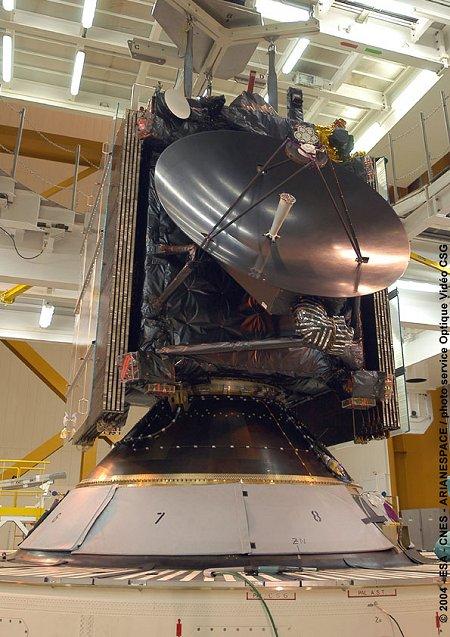
    Rosetta spacecraft

    Image: Rosetta spacecraft in its stowed configuration as it prepares for liftoff on board the Ariane-V. Image Credit: ESA/Arianespace. Original Image

    I first heard of Rosetta way back in 2004, when it lifted-off. I was then in college hanging around for my turn at a computer at a cybercafé waiting to access the Internet to learn the latest updates when I read about the mission. I thought of it, then, as a wild goose chase and dismissed it. I then caught up with news on the spacecraft on the ESA website and on Twitter later in 2011. I have been excited at the steady and slow progress it made as it gained on the comet since then and have especially been following their updates on their blog as well as following them on Twitter.

    There is a lot of good coverage in the blogsphere about today’s event which explains things a lot better than I ever will be able to, in my opinion. You should start with the ESA blog that covers the event itself as well as what they expect to do next (some science and find a place to land that lander, Philae). Emily Lakdawalla has a load of pictures from the comet. You can also go to Spaceflight Now’s Mission Update Centre that offers nice summary updates (for the time hungry) with links to detailed stories (for the information hungry). I’ll add more good blog posts about the Rosetta mission here as I find them.

  • Mars Society India participates in Mars analogous experiments for their rover

    The Indian chapter of the Mars Society was rolled out in January 2012. They are an independent organisation though affiliated to the Mars Society in the United States. For the past few days, they have been posting pictures from Australia where they have been involved at a very nascent analogous experiment with a Mars rover they developed.

    The Mars rover prototype developed by the Mars Society India being tested at the Mars analogous terrain in Arrkaroola in Australia. Image Credit: Mars Society, India. Original Image: here
    The Mars rover prototype developed by the Mars Society India being tested at the Mars analogous terrain in Arrkaroola in Australia. Image Credit: Mars Society, India. Original Image: here

    Analogous experiments are very important in the space development cycle. It is a way of testing hardware here on Earth on a terrain similar to one your hardware may encounter on another planet. Engineers go hunting for such analogous terrains and then bring the hardware in for testing. Once at such a site, they get a chance to test most of the things they want to.

    Mars Society, India, as I understand it has been developing this rover since the inception of the Indian chapter and has put the rover through lab tests in IIT-Bombay. This forms the next step in their development cycle. Working with Mars Society Australia, they picked the site at Arkaroola, Australia for their analogous testing.

    Srinivas Laxman wrote a piece in the Times of India about their experiments in Arakroola whereas their Facebook page has been updated with pictures almost on a daily basis since they were there. My hope is that once they return, they put together a public talk and exhibition of photos and the rover, giving the public in Mumbai a chance to interact and understand about what goes into and behind an effort to develop and launch rovers to Mars.