I have been listening to IVM Podcast’s The Seen and the Unseen podcast hosted by Amit Varma since about the last year or so. The important I learnt in lesson in this episode that the usual tags of left and right politics do not apply to Indian politics. Indian politics can be better understood based on the ideologies of identity and statism.
The cover art of the Episode 131 of The Seen and The Unseen
Amit’s earlies episodes espouses the classical liberal ideologies and are based on the idea of individual freedom. While the explanation made theoretical sense, it didn’t quite apply when I analysed many macroeconomic issues to try and understand why the government acted in the way it did. Hence, Amit’s episodes were critical of any government that was at the Center.
This particular episode presented a better political lens to understand the Indian political landscape. The episode is based on the book Ideology and Identity by Pradeep K Chhibber and Rahul Verma. Rahul Verma explains the terms ideology, identity and statism. He then takes us through Indian history post-independence as seen through the lens of identity and statism and explains how this bifurcation of Indian history makes more sense than the western right-wing and left-wing narrative.
The episode held several insights for me. That India had a rich “conservative” tradition but this was hidden from English readers like me. These traditions existed in the vernacular press in Hindi, Marathi etc. An earlier episode began digging at some of the features of the conservative tradition in India which seems to have been so different from the conservative traditions in other countries. It has been a fascinating listen for me.
I haven’t read the book but would definitely suggest listening to this episode if you want to decide either way about getting their book.
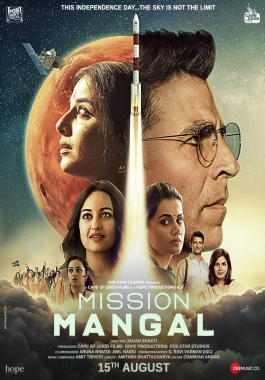
I went to PVR Cinemas at Pune’s Phoenix Marketcity Mall to watch Mission Mangal on Friday, August 15, 2019. Being a self-professed space geek, I expected the movie to be a cringe-show. It was.
Poster of Mission Mangal
Mission Mangal (2019) is a Bollywood movie inspired by the Mars Orbiter Mission (MOM). The mission involved the Indian Space Research Organisation (ISRO) flying a mission to Mars. The mission, a technology demonstrator, succeeded on it’s first attempt. The movie carries a disclaimer at the start of the movie which says that it is a fictionalised account.
The on-film depiction of ISRO is no where near it’s original. I don’t think a scientist in ISRO are insecure in their knowledge that they would feel threatened by a person who got his experience working in NASA and who returns to serve his country. This is the description of the villain of the movie. I think MOM borrowed and learnt a lot from NASA for the actual mission. MOM’s first signal acquisition was in fact from NASA’s Deep Space Network in Australia. I don’t think the movie really needed a villain.
The other issue that bothered me a lot is the need for a hero. Akshay Kumar is no where near the scientist that ISRO has. His imitation of talking to former President Abdul Kalam in Tamil was the lowest point of the film, in my opinion.
The Polar Satellite Launch Vehicle (PSLV) was made much more muscular and eye-candy than it actually is. There were a lot of holds on that American launch pad. Bollywood also made it into a two stage launch vehicle rather than the four stage rocket it is. I loved the sound and capture of the lift-off which reminded me so much of the Shuttle launches. India countsdown in minutes and seconds and not from 100 seconds.
There are struggles of the women scientist in ISRO. Tackling pressure at home, managing family, managing expectations of mother-in-laws, difficulty in getting a flat because of belonging to a certain religion and live-in-relationships. I would have been happier if these stereotypes would not all be pushed throughout the film. Also, I didn’t miss the stereotype of a woman who could not drive on road handling navigation for an interplanetary mission.
So, with all those things that I didn’t like in the movie, it still pulled through because it manages something that I think ISRO fails at communicating. How difficult it is to get funding for a mission. What parameters are considered and how difficult it is to plan a mission. It also attempted to explain orbital mechanics. The movie takes a dig at superstitious practices that ISRO itself follows. Akshay Kumar’s only positive show in the movie seems to be standing up as a rational person to some superstitious practices in the Mission Control Room.
I still think that the movie is a good starting point for a movie based on a scientific mission. For that, it is worth seeing. As I said at the beginning, I cringed a lot while watching the movie.
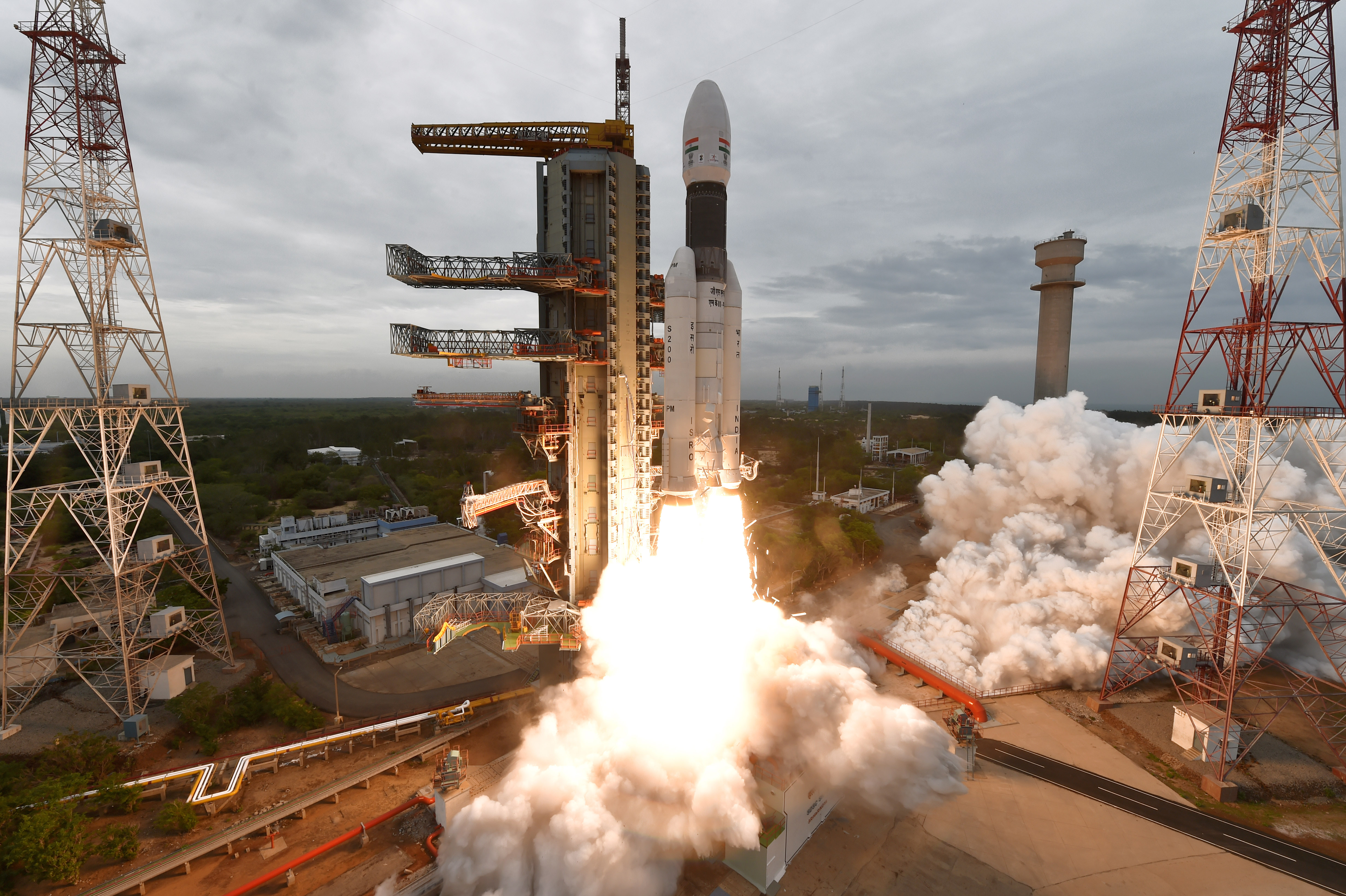
Chandrayaan 2, India’s second mission to the Moon lifted off from Sriharikota on July 22, 2019. The spacecraft was launched on board India’s GSLV Mk-3 rocket on it’s maiden non-development flight.
GSLV Mk 3 lifts-off with Chandrayaan 2. Image Courtesy: ISRO
It came after a launch scrub surrounding which there was lack of information and a lot of speculation. I watched the launch with my grandmother in Mumbai.
Since the launch, the spacecraft which currently has an orbiter and lander attached to each other performed 5 orbit raising manoeuvres on the way to the Moon.
India adopted this gradual orbit raising manoeuvre in order to balance the limitation of the spacecraft and the launch vehicle. A lower mass of the spacecraft would enable the launch vehicle to place the spacecraft into lunar orbiter but it would then not be able to carry any meaningful payload. The launch vehicle had only enough power to place Chandrayaan 2 in a geosynchronous transfer orbit.
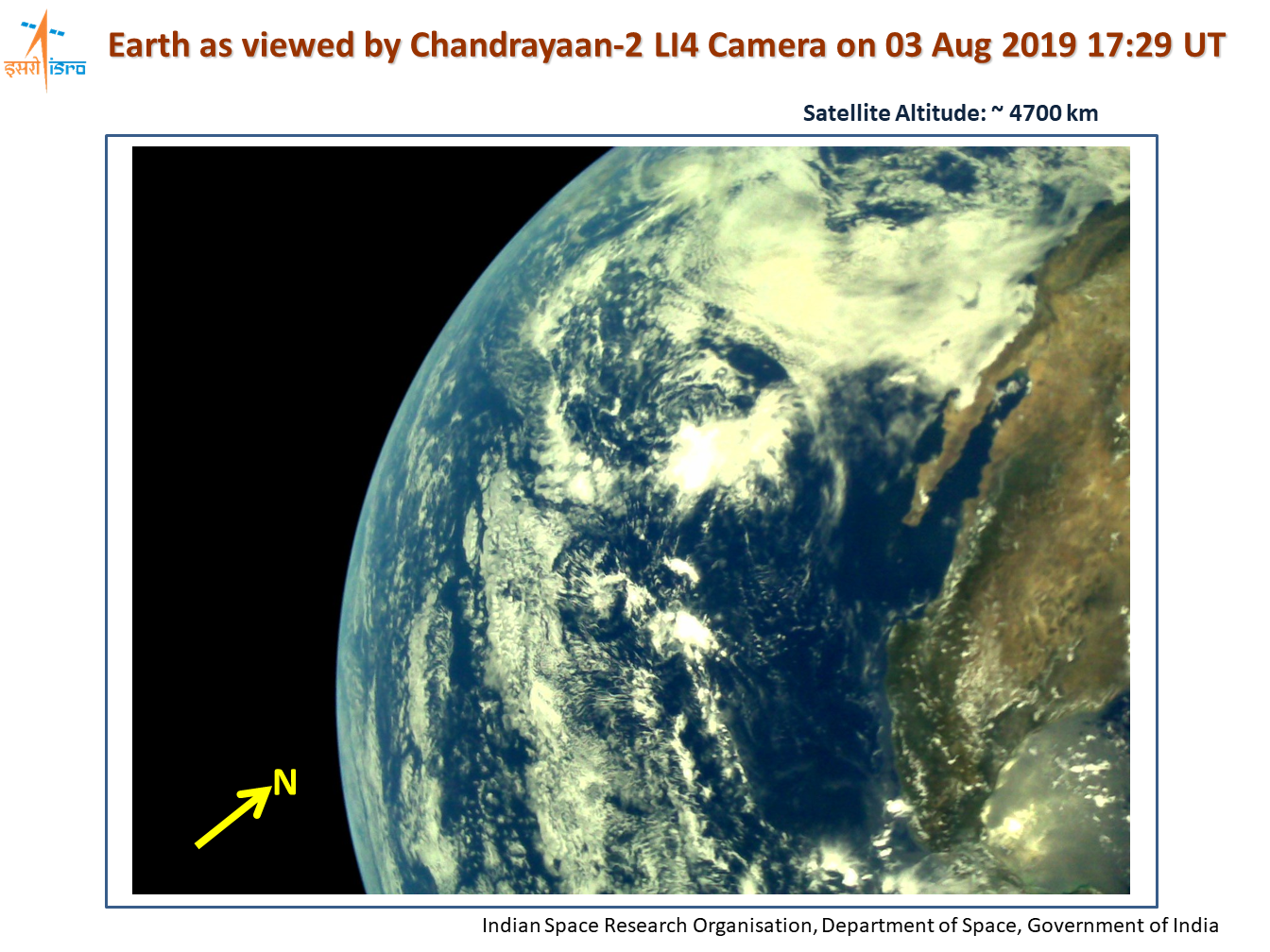
Image of Earth taken by the LI 4 camera on board Chandrayaan 2. Image Courtesy: ISRO
After the 5th orbit raising manoeuvre, the spacecraft will push off towards the Moon called Trans Lunar Insertion on August 14. Afterwards, the spacecraft will perform one more burn called the Lunar Orbit Insertion on August 20 that will let the spacecraft be captured by Moon’s gravity.
I have been following the works of travel blogger Shivya Nath since I found India Untravelled on Google. I wanted to go to Spiti and was looking for places to stay there and this was one experience that I wanted to have. She used to run the site that discovered these homestays before she sold that company to become a digital nomad. Not going to Spiti remains one unchecked item in my bucket list.
I picked up her book hoping to regain my bearings and rediscover my love for travel once again. I was going through a particularly difficult phase at work and hence, even reading the book got postponed for a really long time. I bought the book on September 18, 2018. I made slow progress but it’s finally done.
My travels have mostly been with family. I have travelled solo very few times.
Shivya talks about two journeys in the book. One, were her journeys solo to different parts of the country and across the globe. Another, is the parallel personal journey of overcoming restrictions of society and the ones that she herself placed and overcoming these to become a digital nomad and a travel blogger that she is today.
Her journeys across the world are well covered on her eponymous blog, The Shooting Star. But, I’d recommend the book more for reading about her parallel personal journey. For anyone who travels, one knows that this is a given as we travel more and more. But, it is still wonderful to uncover. Resistance from parents, hesitation before taking the entrepreneurial jump, worries about safety while travelling solo, meeting strange people in strange lands, discovering the things that matter to us the most and perhaps most importantly chasing the dreams and turning them into reality. It is this part of the book that I really enjoyed.
Ayn was sitting at the console today. She got a notification for a
Longreads story on the beginning of the Quantum Computing on the
Moon. She opened the notification to read the story.
Quantum Computing came to the Moon with the Indian company, Pradnya Labs. Pradnya Labs was founded by Pradeep in 2020 after he quit his banking career. He started it for teaching Artificial Intelligence and Machine Learning to his peers. He found that more money was to be made by teaching others than the application of these skills in an industry that youngsters were getting into than someone who lacked experience in the field.
Pradeep turned out to be a much better teacher than an employee or a worker in India’s software industry. Pradnya Labs then expanded into digital literacy drives for the elderly. This Pradnya Labs saw as Corporate Social Responsibility as the company grew big in Southern India and went public in 2024. However, students who left Pradeep came back to join him in India as teachers. Along with them came two important people – Shruti and Sriram.
Shruti worked with Microsoft in the US and was working with its Quantum Computing division. Sriram came from Tesla and came from its famous Batteries Division. In a famous meeting held in a tea shop in Palakkad, they encouraged Pradeep to foray into Quantum Computing. First, they held classes for Quantum Computing core processes.
Pradeep learnt that Quantum Computers would not sit in people’s hands like ordinary computers. These would be installed in the cloud and would communicate with people’s devices through broadband. From the profits that Pradnya Labs made up to 2025 and raising money from family and friends, Pradnya Labs founded it Quantum Computing Division with Shruti heading the same.
In 2026, Pradnya Labs produced the first quantum computer, called Adi. Pradeep thought that putting these quantum computers in the sothern pole of Lunar craters would provide them with natural cooling. The Aitkens basin was identified. He spoke with Indian Space Research Organisation (ISRO) Chairman, Pavan. Pavan was not sure if Pradeep had a working idea and hence called his colleague at the Indian Institute for Information Technology (IIIT) Hyderabad, Mukunth for setting up a demonstration. Adi was setup with the quantum computer built at IIIT and was test run. Adi outperformed the IIIT-Q by 15 seconds.
Pavan asked Pradeep how they hoped to communicate with the Moon? Pradeep said a relay satellite would be placed near the Moon and would re-send the signal to Earth. Although, Pavan was not fully convinced, he agreed to place one Adi on the Moon’s Aitkens basin.
Meanwhile, Sriram was working away in a nearby lab in Hyderabad to build Tesla style battery packs within which the quantum computer could be carried to the Lunar South pole. He added a communications module. The body of the Adi-packs were tested in ISRO labs in Bengaluru. After they came through successfully, the first Adi-packs were launched to the Aitkens crater in 2025.
Through 2026, ISRO, IIIT and Pradnya Labs tested the relay system and found that the speed that Adi got was lost in communication with Earth. Dwitiya was launched in December 2026. Developed in the Pradnya Q Labs in Coimbatore, Dwitiya was faster than IIIT-Q by 83 seconds. ISRO launched a Dwitiya pack to the Aitkens basin in 2027. Happy with the results, Pradnya Labs got orders for Dwitiyas themselves as well as for time for use on the Lunar Dwitiyas.
Meanwhile Sriram got in touch with his former boss at Tesla and through him got Pradeep to talk to Elon Musk. Pradeep asked Musk for a redesign of their Starlink satellites to provide a way to receive data from the Moon and relay it to Earth. Working through 2027 and 2028, the Starlink 2.5 satellites were launched by SpaceX in 2029. These provided improved speed, better data crunching and faster applications. With the advent of this, many of the other service providers in India started gaining an equal footing.
Pradnya Labs’ profits soared. In 2030, Isha Ambani of Jio approached Pradeep with a new idea. She wanted Jio to build satellites that would relay the information from the lunar Dwitiyas back to Earth. Pradeep shared that they were working on Tritiya. One Tritiya would launch next year. But, one demonstration at the Pradnya Labs Quantum Computer simulator meant she paid for the construction of three more Tritiyas exclusively for use of Jio. In addition, she also paid Exseed Space for the construction of 25 Jiosats that would relay the information for users in the Indian subcontinent.
A total of five Tritiyas were launched to lunar surface at the Aitkens basin. Two were used for scientific data crunching for science institutions in India. Three were used by Jio. They said the three lunar data centers took care of half their data center needs on Earth.
It was one of the
Tritiya that had predicted that an asteroid was to hit Earth in 2040.
Ayn was one of the few human beings that left on the spacecraft one
year before impact was predicted. Today was the day when the asteroid
would hit Earth.
Akrasia is the state of acting against your better judgment. It is when you do one thing even though you know you should do something else. Loosely translated, you could say that akrasia is procrastination or a lack of self-control. Akrasia is what prevents you from following through on what you set out to do.
An important thing to look out for is:
Time inconsistency refers to the tendency of the human brain to value immediate rewards more highly than future rewards.
This is one thing that I’m trying to fix:
This is one reason why the ability to delay gratification is such a great predictor of success in life. Understanding how to resist the pull of instant gratification—at least occasionally, if not consistently—can help you bridge the gap between where you are and where you want to be.
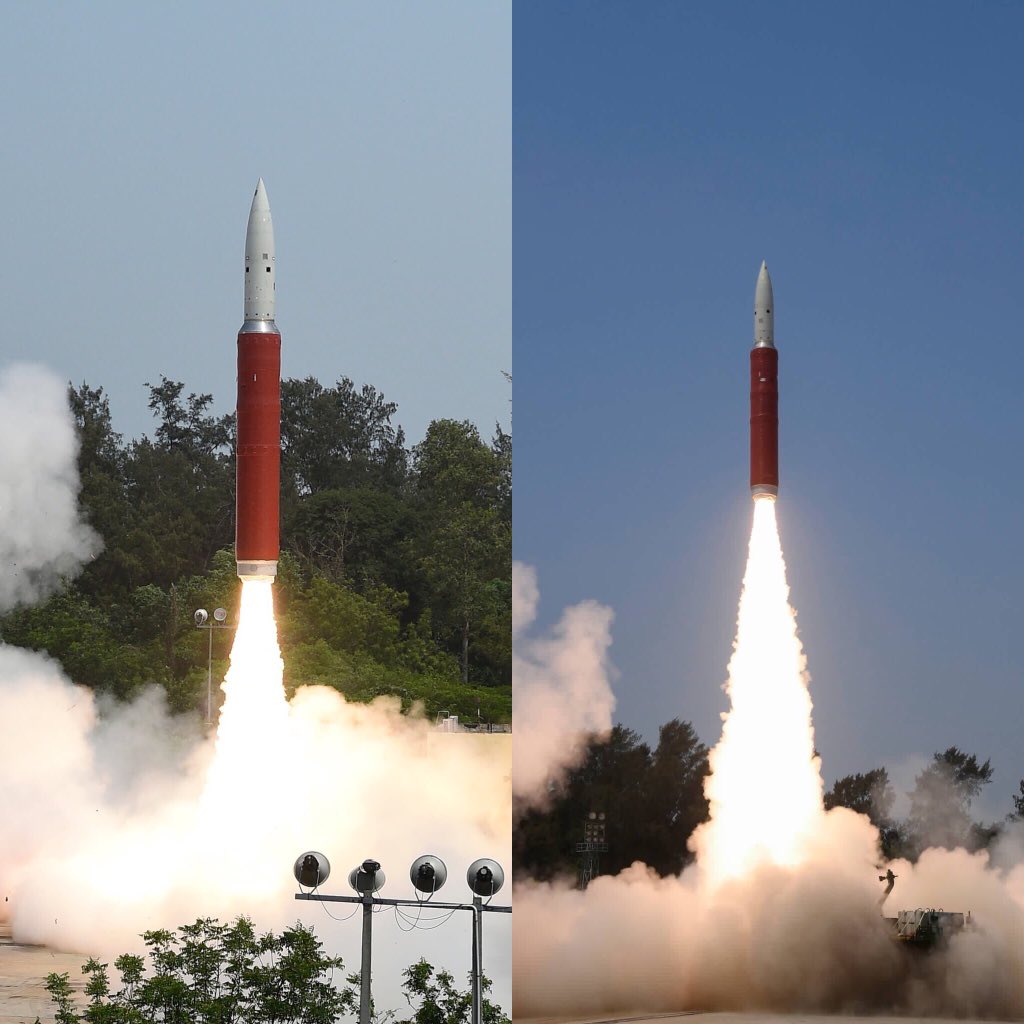
Pictures released of the Anti Satellite Missile Test conducted by India on March 27, 2019. Image Credit: Shiv Aroor/LiveFist
Indian Prime Minister Narendra Modi announced today that India had successfully carried out an Anti Satellite Missile Test (ASAT). The mission was code named Mission Shakti. A missile was launched from the Dr. Abdul Kalam Island Launch Complex off the coast of Orissa and hit an Indian satellite orbiting at 300 km. The hit was successful.
It is to be said that this is an important technology demonstration on the part of the Defence Research and Development Organisation (DRDO). It is a capability that only three other countries in the world have – USA, Russia and China. Of these, China seems to be the reason that India accelerated the development of the ASAT. China did the ASAT test in January 2007 by destroying a satellite in a 800 km orbit. The US responded to this with tests of its own in 2010 by destroying a satellite in a 300 km orbit.
India’s response was a Ballistic Missile Defence (BMD) test it performed in 2012 where an incoming missile was intercepted by an interceptor missile. DRDO which had developed the said capability said that it had the building blocks to test the ASAT by 2014. However, it is believed that then UPA Government under Dr. Manmohan Singh did not give the DRDO the go-ahead for this project. It is believed that India feared further restrictions on technology transfer from the US as the basis for not giving the project the go-ahead. It is believed that the go-ahead came after the Narendra Modi government when it came into power in 2014.
It is essential to seperate the civilian and defence space programmes. India did this in 2008 in response to the India-US Civilian Nuclear Deal. Although ISRO launches defence satellites into orbit, it does not intend the end purpose of such a mission be purely military. DRDO developed and launched the target satellite and launched it on a PSLV-C44 this year in January.
With this test, India has a slight advantage over China. Although, China has a ASAT capability it is widely believed that it does not have the capability yet to destroy incoming missiles provided by a BMD programme.
In today’s test India seems to have pranced around all the international treaties that look to prevent the weaponization of space. The concept took root in a 1969 treaty called the Outer Space Treaty. The Treaty is today called outdated and there are several loopholes that many countries today take advantage of like China did in 2007 and India did today. The US has been working to ban anti-satellite tests since 2010 but has failed in building any consensus on the subject. India seems to have conducted the test to ensure that it slips through the door before it closes, metaphorically.
There is a lot of political discussion on whether the timing of the announcement of the mission by the Prime Minister today is a violation of the Model Code of Conduct which is in force for the 2019 National Elections. But, that is for the Election Commission to look at. I do not see any need to do this so urgently unless the anti-satellite test ban were to come into force some time in the near future and India had an inkling as to the timing of the same. The simplest explanation is that the mission was ready and the go-ahead was given by the Government thinking of it as a matter of national defence and prioritised the decision over the Elections.
There is also worry of the creation of space debris which would be left behind by the satellite that was destroyed by the missile today. However, they have the US example of 2010 which also destroyed a satellite in a similar orbit and which lasted in orbit for about 3 years. Against this, stands the Chinese example whose destroyed satellite in the 800 km orbit is still believed to be in orbit. We are given to understand that the debris would eventually get pulled down by Earth’s gravity and will burn up in the Earth’s atmosphere before causing any significant damage. This matter is debatable.
All in all, given the timeline and the current available knowledge, India responsibly tested its capability keeping multiple issues in mind – space debris, Outer Space Treaty and current regional geopolitics.
More reading
The Ministry of External Affairs posted a Frequently Asked Questions section on its website on today’s test. Curiosly, this is not on the Ministry of Defence or the DRDO website. It has useful information and the official version of what transpired.
LiveFist – Shiv Aroor is a defence journalist who maintains a defence blog. His writeups cover most of the technical details and the defence organisational intrigue that was involved in today’s mission. The post linked here also has multiple links that are worth following up on if you’re interested in more details of the ASAT.
There is a 2012 India Today article being circulated on Twitter claiming that India had build capability required for today’s test in 2012 itself. There is significant difference between capability and technology demonstration. And, I believe it’s always a good idea to test a technology before use, if you can.
Vasudevan Mukunth wrote in The Wire about the Mission Shakti, which also analyses the technicalities of the Mission in detail which is also a good overview if you only want to understand what this whole hoopla is about.
Alexandra Witze writes for Nature about a decision relating to NASA and ISRO joint mission called NASA ISRO Synthetic Aperture Radar (NISAR) decision to point at the Antarctic rather than the Arctic.
The decision is based on the fact that the Europe’s Sentinel satellite is covering the Arctic region. Also, SAR satellites are built such that they point either to the North or the South pole. Hence a call was taken on which Pole the NISAR would be facing.
I grew up in Mumbai and had heard of Khagol Mandal on my visits to Nehru Planetarium but never had the courage to ask my Dad to go for one of their all night camp until I was in college. I attended a few of their talks and Wednesday meetings.
However, given that the Internet was full of American websites I too felt the need for splitting the clubs along the science and engineering line. Since, I was more interested in the science vs engineering divide, I started SEDS India in 2004.
Reading the article, I wonder how different life would have been had I started a Rocketry Hub in Khagol Mandal rather than wasting precious time setting up SEDS India.

 Parallel Spirals