Tag: Bullet Journal

  • My Note Making Workflow

    I was wondering during lunch about how I can improve my note making workflow. This thought arose because I have also been thinking about improving my task capturing workflow at work.

    I was introduced to the difference between note taking and note making in a post by Anne-Laure Le Cunff. Note taking is about integrating the knowledge in your matrix and hopefully improving your life.

    I have focussed on note taking so far because I had a hard time getting that under control. My approach changed when I read Cal Newport’s Slow Productivity. The first principle in Slow Productivity is Do Fewer Things. Accordingly, I reduced the amount of content that I read.

    I wrote here earlier about how I wanted to reduce this consumption by considering how I consume social media posts. I wrote here about how I reduced that even further to the blogs that I read. I wanted to slowly repair my damaged attention span that allowed me to take a lot of notes but not make many notes.

    Late last year, I purchased the same pocket notebook that Hiran suggests in how he uses a bullet journal and using his idea of numbering the bullet instead of the pages and using an index. I was able to take more notes in the pocket notebook.

    But, I also like keeping the A5 sized Bullet Journal since I like to write a lot by hand. I started spending more time copying things over from the pocket notebook to the Bullet Journal.

    I did this because my 7 y.o. daughter would raid my empty notebook stack to repurpose it for her own use. The casualty rate of the empty notebooks was quite high.

    At the other end my 2 y.o would pick up the pocket notebook I would be using and treat it as he liked. He would tear it, rip it apart, or colour in it, depending on his mood.

    I found myself repeating the same things when I looked at my notes. I seem to be going through the same stuff or reading authors who seem to be saying the same thing.

    This the process I am now considering as a result of asking the question (refer to the sketchnote at the bottom right for the question), How can I improve workflows for capturing? [An earlier version of this read as, “This is the process I am now considering:”, updated 27 March 2025, 2308 hrs]

    • Write down the note in the physical A5 Bullet Journal or Pocket Notebook.
      • This includes some highlights from books, blog posts, or articles that I read on Readwise’s Reader.
      • This includes some screenshots or notes I take on Google Keep. This is usually when I listen to videos, podcasts or audiobooks.
    • I am thinking of writing these notes at a certain frequency to Roam Research. The highlights from Readwise’s Reader sync with Roam Research.
    • I am thinking of then exporting these notes to my laptop where I am considering the option between Emacs or Obsidian.
    • Since these are text notes, mostly, I hope to back them up to offline storage.

    This is not the end of the story. It has already been 3 months. So, the idea behind this post is to help you catch up with what’s happened so far.

    The next part will drop when I finish thinking and implement the system outlined here.

    Update 1: 31 Mar 2025

    Saurabh hopped on a call with me. He suggested using the Eisenhower matrix to determine importance of the notes and then blocking out time on the calendar to grapple with the note.
  • Update – Using my Bullet Journal as my Zettelkasten

    I had written on this blog about the practice of using my Bullet Journal as my zettelkasten on 19 May 2020. I had forgotten about it in the haze of the pandemic. I re-discovered the post as I was linking my thinking (h/t Nick Milo) in the past week or so.

    In the Spirals section of my weekly notes last week, I mention the Antinet and the zettelkasten videos I had been watching on YouTube.

    So, after binging on many videos in the last two to three weeks, I seem to have gotten exactly at the point I was at when I wrote my post on 19 May 2020. Before I forget the lessons I learnt, let me summarize the points I made in that blog post again.

    • I use many digital tools and hence my data is stuck on many different platforms (like Evernote, Roam Research, etc.)
    • Moving a zettelkasten into a bullet journal reduces the clutter of index cards.
    • Threading in zettelkasten reminded me about a video about threading in the bullet journal.
      • Index in a bullet journal is the master collection. Similar to an index card in the zettelkasten.
      • Collection threading is done by writing the reference of the page number next to the page number in the next collection.
      • Notebook threading is done by using book number + page number next to the page number.
      • A Tiny Ray of Sunshine has a detailed post on threading.

    I have been writing my notes about podcasts, YouTube videos, books, articles, etc. in my bullet journal since I started keeping one. These can be considered as bibliography notes or quick notes.

    What would make my bullet journal into my zettelkasten would be to introduce progressive summarization that Tiago Forte talks about in his book, Building a Second Brain.

    Another thing needed is to introduce a way to review the content in the bullet journal in a periodic manner and link my thinking.

    A thing I noticed that the spirals I go down are naturally linked to each other. This focus reduces the need of too much categorization naturally. I can look through instances by using the index without the need to opening or delving too deep into any particular notebook.

  • Using a Zettelkasten in a Bullet Journal

    In my last post I explained the concept of the Zettelkasten. Many of the articles that I linked to in that post suggest using digital tools to implement the Zettelkasten.

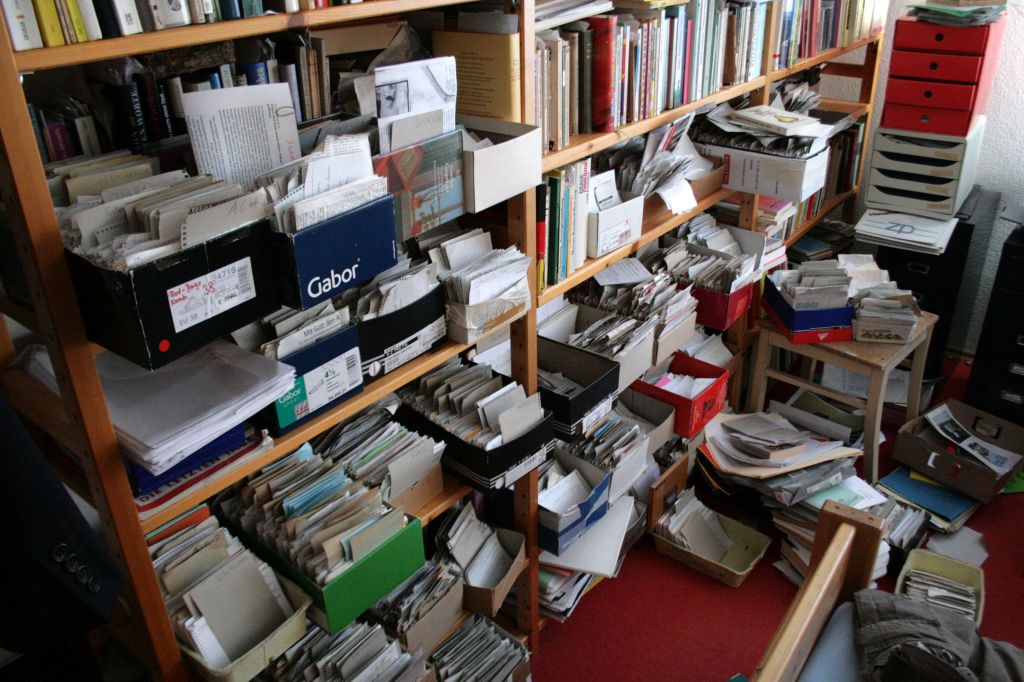
    Zettelkasten. Image Credit: Kai Schreiber via Wikimedia Commons.
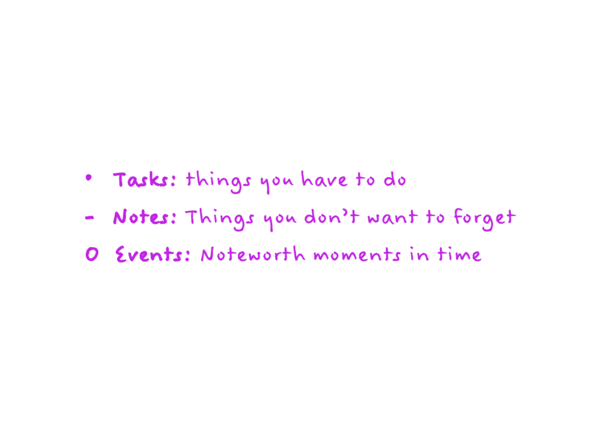
    What the bullets in a bullet journal stand for. Image Credit: BulletJournal.com

    I have had a history of not trusting digital tools. This is because I have used many of them and move to the shiny new object when I find one. This has led to my information being stuck in various digital tools like Evernote, Notion and now some on Roam Research.

    The idea of a second brain requires something that we would trust we would use. Else, we just keep our ideas and thoughts in our head.

    I needed something that I would trust I would use and would be analog.

    This is where the Bullet Journal comes in. I have used this analog tool for the past six months. I am starting to build enough trust in entering information there knowing that I will use it. The physical presence of the written word also dispels fear about losing ideas in various silos.

    Moving a Zettelkasten into a Bullet Journal reduces the clutter of index cards that it leaves behind. While, Zettelkasten enriches the practice of reflection in the Bullet Journal. It pushes us to link the ideas we jot down in the Bullet Journal with each other in a way that our brain does. This also helps us remember these ideas better.

    Zettelkasten in its original avatar is analog. It uses a sort of threading system using boxes and alphanumeric references to each idea. The word threading reminded me of the practice of threading used in Bullet Journal.

    Zettelkasten in it’s original avatar is analog. BuJo is also analog. I thought there must be a way to tie both these practices together. Threading is used to refer to a previous section as a way to provide continuity to a post. The video explains threading:

    I want to extend the concept of threading to use it more than just for providing continuity of a collection or notes within the Bullet Journal.

    A latitude or longitude is expressed in degrees, minutes and seconds. Similarly, a bullet can be referred to as volume, page number and line number. This means that each bullet in your notebook can be linked to another bullet within the same notebook or even another notebook.

    This threads similar ideas together in the course of writing your bullet journal. I would suggest using the Index to collect tags related to a similar idea together. This would give you an index that would collect the page numbers on which ideas are being discussed. You can take a minute to go through these tags during your weekly or monthly reflection. You can also refer to the index when you are struggling with an idea related to the tag.

  • Why journal?

    I have been keeping a bullet journal (BuJo) again since I moved to Pune in July. Although, I still have not completely migrated from mind to BuJo, I have been lately trying to figure out how to keep a diary within my BuJo.

    Ryder Carroll posted an online tutorial today on YouTube about how to do this. From the website, where there is a companion blog post, Ryder goes into why he thinks we should journal, that I think is worth sharing here:

    It’s often hard to understand what we’re feeling, or why we feel the way we do. Though we can’t  will  ourselves to change the way we feel, we can change the way we think. Journaling provides a powerful way to unpack our mind and our hearts. There, with it all laid out on the page, we’re granted the clarity, context, and distance that we often lack when things get rough. It can shift our perspective enough to change our mind, and with it, the way we feel.

    Journaling can also be a great way for you to explore ideas, and deepen your appreciation for the good things that come and go so quickly. By putting pen to paper, you get to relive the good times and preserve them in loving detail so that you may revisit them for years to come. 

    Ryder Carroll, Long-form Journalling, bulletjournal.com

    If you do not write a diary or keep a journal, I think this is a good reason to keep one and maybe to begin today.

  • Bullet Journal

    I used to keep a Bullet Journal way back in September 2015. By November 2015, I was writing so much work related stuff that I didn’t want to open it again. I abandoned it. I found it while surfing Evernote related help videos, in the YouTube suggested videos for you.

    I found inspiration here and here and instructions here to dust off the old bullet journal from my diaries rack and use it again. Have kept it ready for use. Haven’t seen too many guys using it here in India, though. Examples welcome.