Tag: commercial space

  • ISRO to launch 5 British satellites as its first commercial launch in 2015

    ISRO will launch 5 British Satellites on behalf of Antrix Corporation (which is ISRO’s commercial arm) on board the PSLV-C28 vehicle on July 10, 2015. This is the PSLV’s 30th mission. ISRO will use the PSLV’s Extended Length (XL) variant to launch 1440 kg payload consisting of 5 British satellites into orbit.

    The 5 satellites are the Surrey Satellite Technology Limited’s (SSTL) DMC3 satellites and CNBT-1 satellites and the Surrey Space Center’s DeOrbitSail spacecraft.

    DMC3 satellites

    The DMC stands for the Disaster Management Constellation of 3 satellites built by the SSTL for it’s wholly owned subsidiary, DMCii (DMC International Imaging Ltd) which is executing this project for a Chinese company, 21AT.
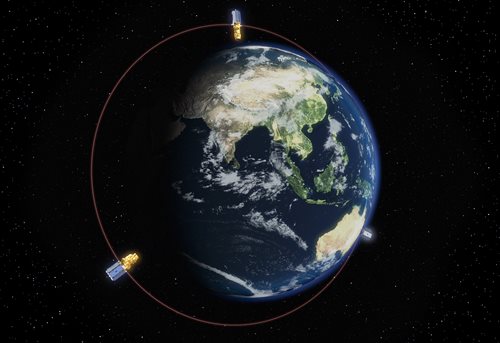
    A visualisation of the orbit and position of each satellite in the DMC constellation. Image Courtesy: SSTL
    A visualisation of the orbit and position of each satellite in the DMC constellation. Image Courtesy: SSTL

    The DMC constellation is a group of 3 small satellites placed in orbit 120 degrees apart, as shown in the image above. The idea is to quickly image areas which have been struck by disaster with high-resolution cameras (1 m resolution) with a capability to provide very fast down link in order to help make the images available quickly in order to assess damage and plan disaster response.

    CBNT-1

    I could not read much about this satellite but it seems that the company that built it, SSTL will share more details after the launch. All that is known for sure right now is that it weighs 91 kg and is a technology demonstrator mission.

    DeOrbitsail

    This is an interesting 7 kg 3U cubesat with dimensions of 10 x 10 x 34 cm. It contains a highly densely packed 4 x 4 meter sail which will be deployed in space in order to increase drag in order to cause the spacecraft to deorbit and return back to Earth. The project is developed by the Surrey Space Center (not the same as SSTL).

    PSLV-C28
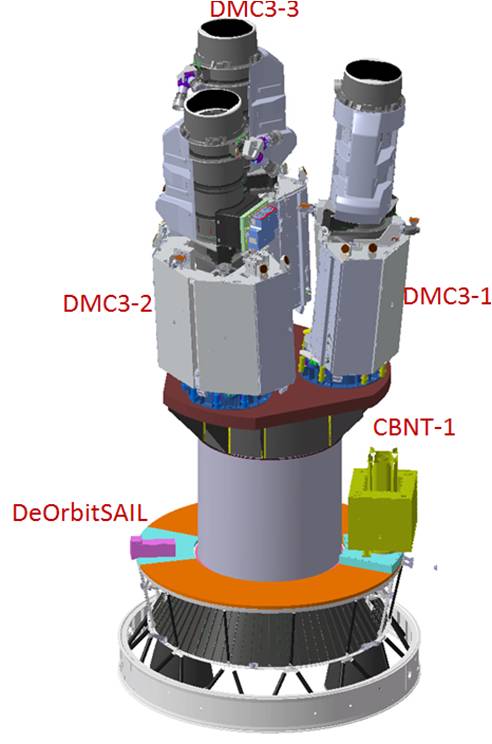
    The Spacecraft mounted on the Launch adapter called the L-adapter. Image Courtesy: ISRO
    The Spacecraft mounted on the Launch adapter called the L-adapter. Image Courtesy: ISRO

    For ISRO, the challenge begins with the three DMC3 spacecrafts. It had to fit in these 3 satellites each of which has a length of 3 meters into the 3.2 m diameter, 8.9 m long payload fairing of the PSLV-XL. They resolved the issue by changing the launch adapter. A launch adapter is basically a platform on which the satellites are kept and launched from once the last stage of the PSLV reaches the designated orbit and orientation. The vehicle uses a new launch adapter which has a triangular deck and is called the Multiple Satellite Adapter – Version 2 (MSA-V2).
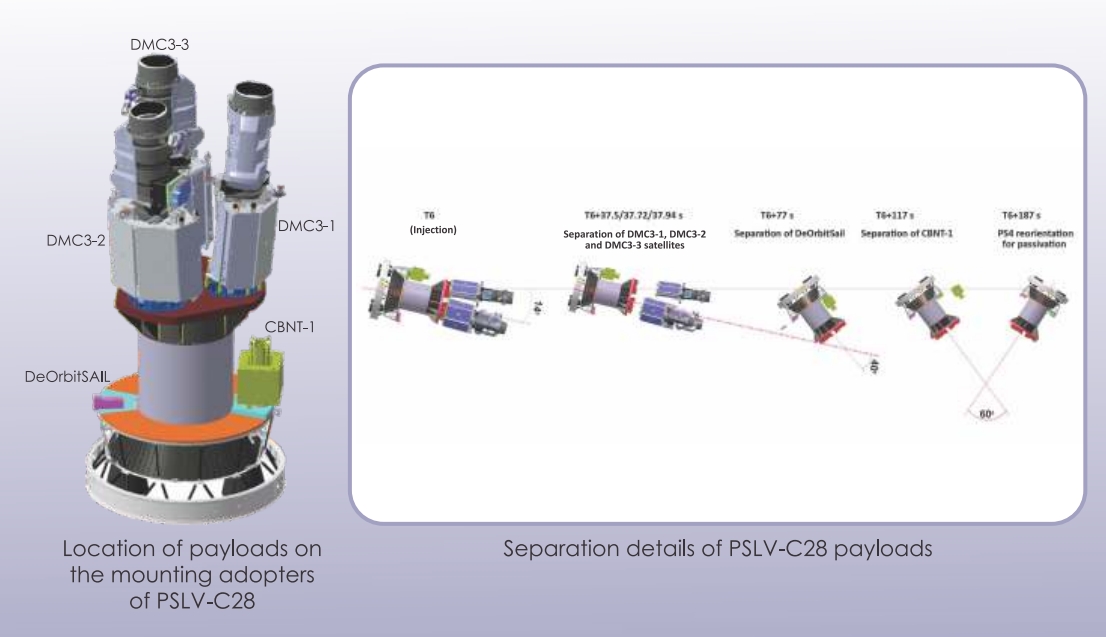
    Illustration of the Multiple Satellite Adapter - Version 2 (MSA-V2) with the satellite mounted and showing the launch of various satellites. Image Courtesy: NasaSpaceflight.com
    Illustration of the Multiple Satellite Adapter – Version 2 (MSA-V2) with the satellite mounted and showing the launch of various satellites. Image Courtesy: NasaSpaceflight.com

    A success now will help cement the PSLV’s record and hopefully bring more business Antrix’s way. This launch shows that even commercial launches can make requirements on a proven launch vehicle that if managed would improve the agility of the variety of satellites that the PSLV is capable of putting into orbit. This agility lowers cost and enables Antrix to reach a wider market to sell launches on the PSLV. Wishing ISRO Godspeed.

  • Past Week in Space #1

    A hopefully weekly column in this blog that seeks to track the weekly space news. It doesn’t have the usual NASA/ESA traffic unless it is important. I think there are enough blogs/forums out there covering such things without having to add something of my own. The timeline is in reverse chronology.

    1. The NASA’s M3 team which has been discussing the science behind the mission on its blog announced the final result of its efforts by announcing that the M3 had found iron-bearing minerals on the lunar surface. Data from this 7 kg mapper on board Chandrayaan 1 provides an opportunity for scientists to look at the Moon with high spatial and spectral resolution.
    2. The ISRO chairman said that anyone who is “young, healthy, physically active and has a terrific spirit of adventure” can come and be a part of India’s cosmonaut corps. This is an oppertunity that I guess, many of you have been waiting for!
    3. Europe got its first dark sky park in southern Scotland this week. As the report clarifies further this is a recognised park by the International Dark-Skies Association. There are also only two other dark sky parks – one in Utah and another in Pennsylvania.
    4. Every Christmas the guys at the top-secret NORAD use their useful and super-secret equipment to track Santa. In this venture they have tied up with Know-it-All Google giants. Here is Santa going past the Taj Mahal(YouTube video) captured using its top secret web cams and advanced surviellance cameras. These cameras are used only once in a year to track Santa.
    5. ISRO also updated its website with more images from Chandrayaan 1’s . The images posted on the Chandrayaan 1 website has very poor captioning. I do hope that with the announcement of more missions like the manned space flight and mission to Mars, ISRO’s information skills improve. The images were updated on December 24.
    6. Chairman, ISRO announced a slew of missions at the CII conference in Delhi. Confirmed are the fact that Chandrayaan II’s design is ready and that the agency was on the road to putting a rover on the Moon by 2012. It also announced the year of India’s Mars Mission – 2013. Following these more robotic missions involved landing a space craft on an asteroid and a comet flyby mission. On the Indian human space flight front, Indians are going to fly on board a Russian space craft in 2013 and will fly in an indigenous space craft in 2015.
    7. A state of the art communication satellite jointly built by Antrix/ISRO and EADS Astrium for one of Europe’s largest telecom operators Eutelsat was successfully launched from Kourou, French Guyana. The satellite weighing a huge 3463 kgs lifted off on an Ariane-5 rocket at 0405 hrs (IST) on December 21. ISRO completed the satellite in a cool 26 months at a cost of $80 million. The Economic Times reported that Antrix/ISRO made a handsome $40 million profit from the same. The Ariane 5 placed the satellite in Geosynchronus Transfer Orbit or GTO after which ISRO controlled the satellite from its Master Control Facility or MCF-Hassan, stabilized the satellite with repeated Liquid Apogee Motor (LAM) firing to place it in final orbit and deployed its appendages.
    8. In another rocketry related event at ISRO this week, ISRO tested the new indigenously developed cryogenic engine. The test was conducted at the Mahendragiri facility of the Liquid Propulsion Systems Centre (LPSC). The engine will be used on the third stage of Geosynchronus Satellite Launch Vehicle or GSLV. The engine develops a thrust of 73kN in vaccum with a specific impulse of 454 seconds. The engine works on staged combustion cycle and runs an integrated turbopump at a speed of 42000rpm. This will allow GSLV to place a 2200 kg payload in Geosyncrhonus Transfer Orbit.