Tag: India

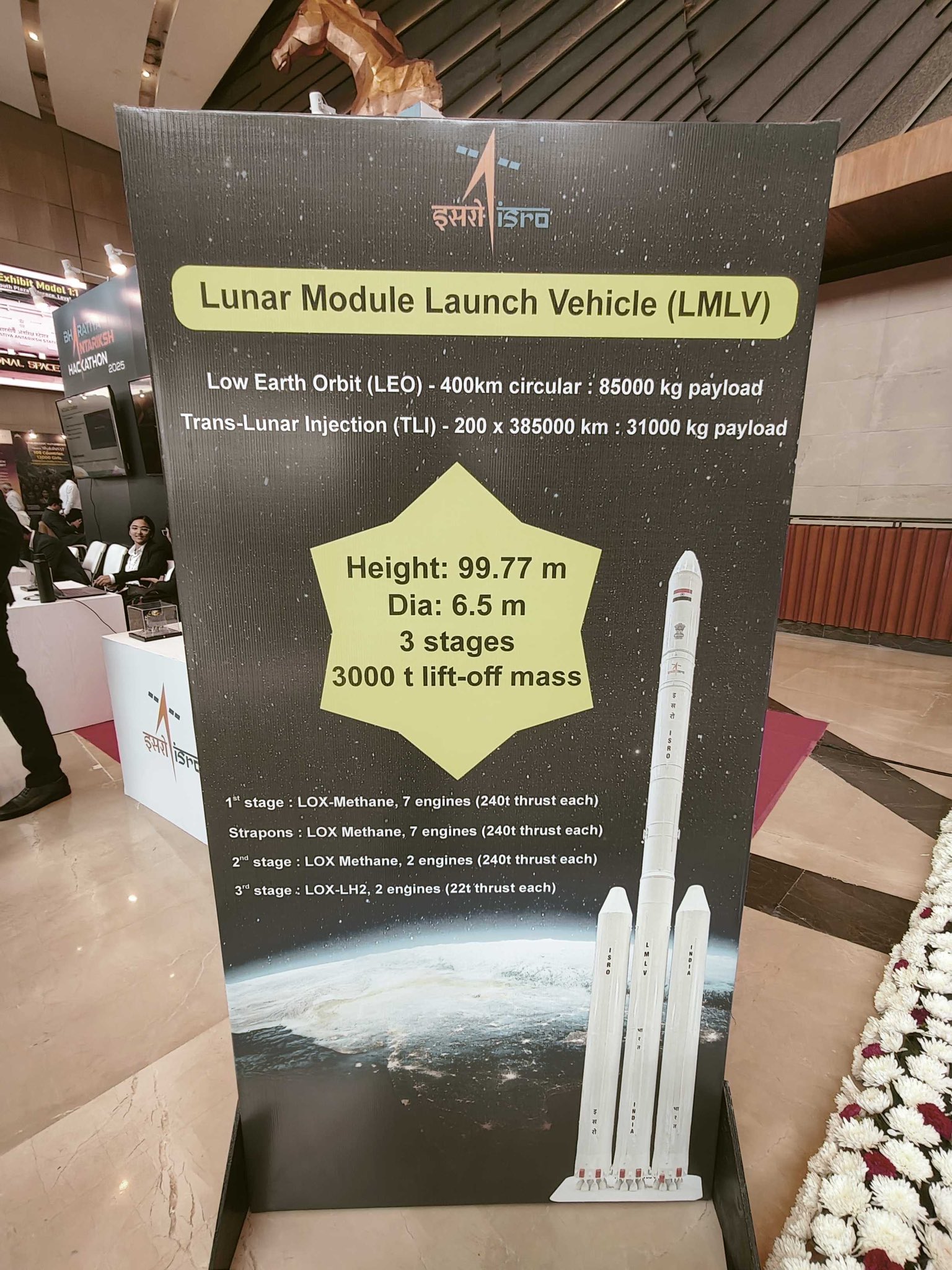
  • We started off with the New Generation Launch Vehicle (NGLV,). Then, there was Lunar Module Launch Vehicle. Then, NGLV was named Soorya. There is confusion about whether the NGLV and LMLV are different vehicles or the same vehicle. ISRO keeps changing nomenclature. This is the latest avatar of LMLV according to Anshuman.

    This is a version with 3 stages, 99.77 m height and 6.5 m diameter. This looks like a version they are developing of NGLV for lunar missions. Just like LVM3 and HLVM3 and hence interchangibly used.

  • What India must talk to France about Space?

    Suhasini Haidar, writing for The Hindu, talks about the upcoming visit of Indian Prime Minister Narendra Modi to France. A key paragraph to highlight in the article:

    India and France are also hoping to strengthen ties over collaboration in space that dates back to the 1960s. Apart from collaborations in launching satellites, the two sides are also looking at training astronauts and partnerships in space industrial engineering, it is learnt.

    Haidar, Suhasini. “Co-Development Rather than Co-Production Will Be Focus of India-France Ties, Sources Say.” The Hindu, 6 July 2023

    France provided inputs on solid fuel technology to ISRO with the Centaures rocket in the 1970s. Working together on the Viking liquid engine, under an arrangement with the European Society for Propulsion (SEP), provided valuable inputs to develop India’s workhorse Vikas engine in the 1980s. The French helped in setting up the Liquid Propulsion Systems Center (LPSC) at Mahendragiri, Tamil Nadu.

    Arianespace has provided launch service for various Indian communication satellites, as India struggled with mastering cryogenic technology. ISRO and CNES has worked together on two satellites related to climate studies, Megha-Tropiques and SARAL. A future collaborative mission, Trishna, is slated for launch in 2024.

    India and France can play an important role in space science. I would love to see a continuation of co-operation of Earth observation satellites that are built to study Earth’s climatic systems. I believe that collaboration with France particularly with the mission to Venus would be a shot in the arm for the Indian Venus Mission, called Shukrayaan. France has experience with working on the Vega missions with the Soviet Union.

    The study of Mars is a rosy colonization dream today. The study of Venus provides an understanding of where the Earth could be headed because of global warming and climate change. I think there must be as many if not more missions to Venus as there are missions to Mars today.

    France is also a signatory of the Artemis Accords, and along with Australia is trying to look for an international arrangements to govern access to and resources on the Moon. This is an essential middle path that India must try to support. Global supply chains are important to keep mission costs low.

    India must try to book cheaper slots on the Ariane 6. There is a 6 ton and higher category of satellites that Indian launch vehicles can currently not support. India must also try to get more French companies to try to fly on Indian launch vehicles. There could be an opportunity coming up during the period of transition between Ariane V and Ariane 6.

    At the industry level, I believe there are opportunities to collaborate in data sharing and data analysis. Indian space startups could try to provide satellite, satellite sub-systems, and propulsion systems to French startups.

  • India’s Space Policy – Sowing Now to Reap Later

    Note from the Author: I wrote this piece in March 2022. I did not get around to publishing it anywhere. Hence, posting it here. Some of the information mentioned here is outdated.

    Introduction

    India has pursued a space program since the 1960s with the intention of benefitting its people for the past sixty years. For this period, the program was dominated by a single government player with an innovative production capability nurtured through these years. But, the Indian government now wants private players to play a bigger role – to design products, develop them, and market them to the world. Against this backdrop, the Indian Government opened up the space sector in 2020. This led to the need to make policies and institutions that would help India tap into this hidden potential.

    Opening up India’s Space Sector

    The Union Finance Minister, Nirmala Sitharaman announced the opening of eight sectors in May 2020 as part of the INR 20 lakh crore (USD 300 billion) Atmanirbhar Bharat Abhiyan (Self-reliant India Campaign). Space was one of the sectors that opened up as part of these reforms.

    The Government said that it wanted the private sector to be a player in the space sector. She said that the Government would provide a level playing field for the non-governmental private entities to build satellites, launch vehicles, and provide space-based services. She promised that future planetary exploration and human outer space travel opportunities would be open to non-governmental private entities. Towards this, she promised access to facilities of India’s space agency, the Indian Space Research Organisation (ISRO), and a liberal geospatial policy.

    India identified that space held a huge commercial potential for growth. It wanted non-governmental private entities (NGPEs) to be part of this growth. When the Government says NGPEs it is referring to academic institutions, start-ups, and industry. 

    As a part of opening up the space sector, NewSpace India Ltd (NSIL), which was set up in the previous year, was repurposed to drive a move from a supply-driven to a demand-driven model. NSIL would act as an aggregator of demands from the market. It would then supply the services provided earlier by ISRO. For this, it would take over ownership of ISRO’s operational launch vehicle and satellite fleet. It would commercialize the production of the launch vehicle fleet by handing it over to a private consortium. 

    The opening up also involved setting up a regulator, Indian National Space Promotion and Authorisation Centre (IN-SPACe). IN-SPACe would provide a one-stop shop for all space-related activities in India. ISRO would then concern itself with the research and development of various space technologies and applications.

    IN-SPACe would “promote, hand hold, permit, monitor and supervise space activities by NGPEs and accord necessary permissions as per the regulatory provisions, exemptions and statutory guidelines”.

    Developments since the Announcement

    A draft Space Activities Bill, 2017 had been floated for comments from stakeholders and the public. This bill was to provide an overall legal framework for the space sector. As of February 2022, the bill has completed public and legal consultations and has been sent to the various Ministries for their approval.

    IN-SPACe was established. Pawan Goenka, a former Managing Director of the Indian automobile major, Mahindra & Mahindra, was made Chairman of IN-SPACe. It was reported in February 2022 that ISRO facilities and expertise were extended to the NGPEs. ISRO facilities are being shared with these private entities at no or reasonable cost basis.

    NSIL undertook its first fully commercial launch for Brazil’s Amazonia 1 and fourteen ride-share satellites in February 2021, on the Polar Satellite Launch Vehicle’s (PSLV) PSLV-C51 mission. It is also undertaking the first demand-driven communication satellite [PDF] launch. It will launch the GSAT-24 communications satellite to fulfill the demand of Direct-to-Home company, Tata Sky (now Tata Play). The launch is expected to take place on board the European Ariane V in the first half of this year.

    The Department of Space had provided various draft policies on its website for comments. These include draft policies on Space Communications, Remote Sensing, Technology Transfer, Navigation, Space Transportation, Space exploration and Space Situational Awareness, and Human Spaceflight through 2020 and 2021. India, at present, has, only Space Communications and Remote Sensing policies. 

    Although space startups have been present in India since 2011, there was a real acceleration in the number of startups that started following the opening up of the space sector. As per statistics shared by the Indian Government in February 2022, there are more than 50 space startups presently in India. These work in areas such as building satellites, launch vehicles, satellite subsystems like electric propulsion systems, as well as various space-based applications in remote sensing, agriculture, fisheries, economic growth forecasting, etc. The Indian Government hopes to attract foreign direct investment (FDI) in the space sector.

    Obstacles in the Way

    As with any reform, there is a feeling that the reforms are not being implemented fast enough. It is not known when the draft Space Activities bill would be cleared by the Union Government and tabled in Parliament. The Space Communications policy is expected to be finalized by April 2022. The status of the other policy drafts is currently not known.

    In the interim, ISRO is tasked with clearing the backlog of remote sensing, communication, navigation, scientific, and interplanetary missions of national importance which have been delayed as a result of the COVID-19 pandemic. India has only had 5 launches from India since 2020. One of them was a failure. There are limits on the number of launches ISRO is able to do in a financial year (March to April). This period of transition would be a difficult one to manage at ISRO, as it would have to fulfill launches for NSIL as well. 

    NSIL floated tenders for the commercialization of the PSLV in 2019. It has still not been announced as to who the tender is awarded to. There are two other operational launch vehicles, the Geosynchronous Satellite Launch Vehicle (GSLV) and the Geosynchronous Satellite Launch Vehicle Mark III (GSLV Mk-III) that also need to be similarly commercialized. 

    All these delays then make the regulator, In-SPACe ineffective to do much other than provide access to DoS facilities until there is regulatory clarity with the publication of draft policies and the passage of the draft Space Activities Bill in Parliament.

    Hopeful Future?

    While it is expected that the infrastructure put in place after the announcement of the space reforms, would take anywhere from half a decade to a decade, the future remains hopeful. 

    In the decade, India expects to launch interplanetary missions to the Moon, Mars, and Venus. It also expects to operationalize its human spaceflight program in the first half of this decade. In addition, it expects to launch missions for communications, remote sensing, navigation, and scientific applications.

    It is expected that these reforms would bear fruit in the future decades. India hopes to participate and play a bigger role in the global space economy. It hopes that its start-ups today will provide goods and services not only for India but also for the world. 
  • Should India sign the Artemis Accords?

    I wrote a piece on The Wire Science with the above title. You can find the article here.

  • India conducts an Anti Satellite Missile Test

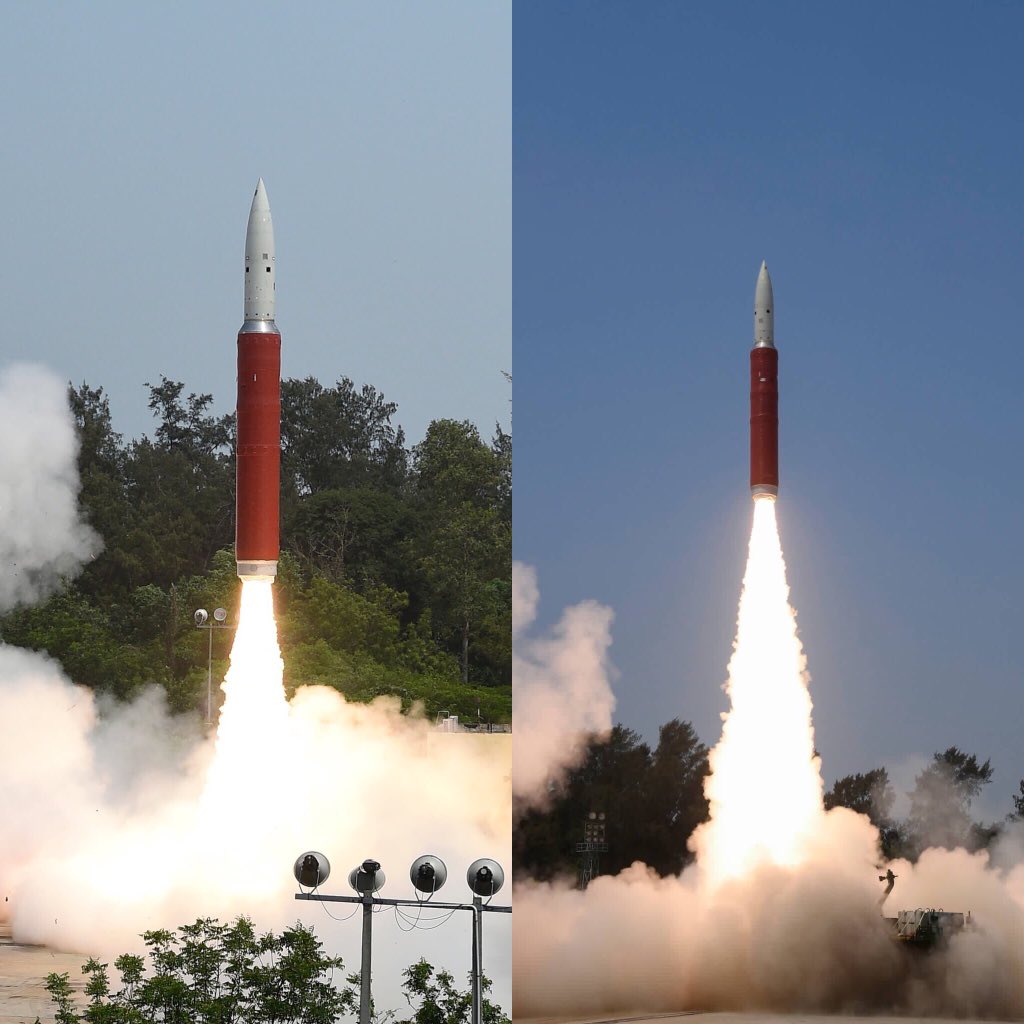
    Pictures released of the Anti Satellite Missile Test conducted by India on March 27, 2019. Image Credit: Shiv Aroor/LiveFist

    Indian Prime Minister Narendra Modi announced today that India had successfully carried out an Anti Satellite Missile Test (ASAT). The mission was code named Mission Shakti. A missile was launched from the Dr. Abdul Kalam Island Launch Complex off the coast of Orissa and hit an Indian satellite orbiting at 300 km. The hit was successful.

    It is to be said that this is an important technology demonstration on the part of the Defence Research and Development Organisation (DRDO). It is a capability that only three other countries in the world have – USA, Russia and China. Of these, China seems to be the reason that India accelerated the development of the ASAT. China did the ASAT test in January 2007 by destroying a satellite in a 800 km orbit. The US responded to this with tests of its own in 2010 by destroying a satellite in a 300 km orbit.

    India’s response was a Ballistic Missile Defence (BMD) test it performed in 2012 where an incoming missile was intercepted by an interceptor missile. DRDO which had developed the said capability said that it had the building blocks to test the ASAT by 2014. However, it is believed that then UPA Government under Dr. Manmohan Singh did not give the DRDO the go-ahead for this project. It is believed that India feared further restrictions on technology transfer from the US as the basis for not giving the project the go-ahead. It is believed that the go-ahead came after the Narendra Modi government when it came into power in 2014.

    It is essential to seperate the civilian and defence space programmes. India did this in 2008 in response to the India-US Civilian Nuclear Deal. Although ISRO launches defence satellites into orbit, it does not intend the end purpose of such a mission be purely military. DRDO developed and launched the target satellite and launched it on a PSLV-C44 this year in January.

    With this test, India has a slight advantage over China. Although, China has a ASAT capability it is widely believed that it does not have the capability yet to destroy incoming missiles provided by a BMD programme.

    In today’s test India seems to have pranced around all the international treaties that look to prevent the weaponization of space. The concept took root in a 1969 treaty called the Outer Space Treaty. The Treaty is today called outdated and there are several loopholes that many countries today take advantage of like China did in 2007 and India did today. The US has been working to ban anti-satellite tests since 2010 but has failed in building any consensus on the subject. India seems to have conducted the test to ensure that it slips through the door before it closes, metaphorically.

    There is a lot of political discussion on whether the timing of the announcement of the mission by the Prime Minister today is a violation of the Model Code of Conduct which is in force for the 2019 National Elections. But, that is for the Election Commission to look at. I do not see any need to do this so urgently unless the anti-satellite test ban were to come into force some time in the near future and India had an inkling as to the timing of the same. The simplest explanation is that the mission was ready and the go-ahead was given by the Government thinking of it as a matter of national defence and prioritised the decision over the Elections.

    There is also worry of the creation of space debris which would be left behind by the satellite that was destroyed by the missile today. However, they have the US example of 2010 which also destroyed a satellite in a similar orbit and which lasted in orbit for about 3 years. Against this, stands the Chinese example whose destroyed satellite in the 800 km orbit is still believed to be in orbit. We are given to understand that the debris would eventually get pulled down by Earth’s gravity and will burn up in the Earth’s atmosphere before causing any significant damage. This matter is debatable.

    All in all, given the timeline and the current available knowledge, India responsibly tested its capability keeping multiple issues in mind – space debris, Outer Space Treaty and current regional geopolitics.

    More reading

    The Ministry of External Affairs posted a Frequently Asked Questions section on its website on today’s test. Curiosly, this is not on the Ministry of Defence or the DRDO website. It has useful information and the official version of what transpired.

    LiveFist – Shiv Aroor is a defence journalist who maintains a defence blog. His writeups cover most of the technical details and the defence organisational intrigue that was involved in today’s mission. The post linked here also has multiple links that are worth following up on if you’re interested in more details of the ASAT.

    There is a 2012 India Today article being circulated on Twitter claiming that India had build capability required for today’s test in 2012 itself. There is significant difference between capability and technology demonstration. And, I believe it’s always a good idea to test a technology before use, if you can.

    Vasudevan Mukunth wrote in The Wire about the Mission Shakti, which also analyses the technicalities of the Mission in detail which is also a good overview if you only want to understand what this whole hoopla is about.

  • India at Mars

    Short version: India’s Mars Orbiter Mission spacecraft successfully fired it’s Liquid Apogee Motor (LAM) today to correct its trajectory and also served as a test for the LAM which had been sleeping for about 298 days now whilst the spacecraft sped in the general direction of where Mars would be. As of 9:30 AM today, MOM is in Mars’ sphere of gravitational influence, it test fired and trajectory corrected at 2:30 PM today. Long version below.

    It was 2:30 PM today when ISRO tweeted that the MOM may currently be firing its LAM to perform a test to check if it’s still working and also execute a very small trajectory correction so that the spacecraft will be set up to park into Mars orbit come the morning of September 24. About 15 minutes after that, ISRO announced to the world that they had fired the engines successfully for nearly 4 seconds.

    ByJG5vxCYAA7xvw


    Image: ISRO flashed this image on Twitter with the caption, “Test Firing of Liquid Engine: Guided by wisdom, Executed by youth”. link to the orignial pic

    I was really sceptical about ISRO’s prospects of doing a Mars mission. They worked really hard and pulled through extra shifts to ensure that a spacecraft would be ready in time for the Mars launch window in 2013. Little news items were strewn around showing progress that ISRO made that showed that ISRO was working towards the goal of launching in 2013 but nothing quite indicated that they were ready to launch. As the launch window approached, they quickly got the spacecraft off Earth on a smaller launch vehicle than one would anticipate being used for a Mars mission anywhere else in the world.

    The modified PSLV, a workhorse adaptable launch vehicle performed excellently delivering the spacecraft to its intended orbit. The spacecraft then performed orbit raising manoeuvres and slowly headed out towards the heliocentric orbit. As the spacecraft pushed off towards Mars, my skepticism slowly waned away.

    For a technology demonstrator mission, the most critical part of the mission is to show that the fundamental building blocks work and can function. With today’s LAM firing, I think that ISRO proved a very crucial component of the mission design. Skepticism kept me away from posting anything here for a very long time. I have to say that I am now very hopeful that we can do this. I seek nothing more than a gentle nudge that puts the spacecraft in an elliptical orbit around Mars.

    Critics of this mission have been plenty and have criticised each component of this mission design. ISRO has answered its critics thus far by action, something I think that many Indians would do well to ape.

  • Visting all National Parks in India by 35

    National Parks in India are not as famous as they are in the United States, where there is a good National Park Service. However, this is not surprising given the fact that most national parks came into existence in the 1980s. They did not exist in the youth of our parents. They now exist and travelling pioneers are visiting these national parks and slowly word is spreading among the general public about their existence.

    As per Wikipedia, India has proposed 166 National Parks. Of these it had established only 96 by the year 2007. You see the hidden potential?

    In contrast, the US opened national parks in 1872.

    I wanted a challenge in my life that combined geography and the challenge for travel. I have enunciated it in my expectation of visiting all the National Parks in India before I turn 35. This is a strange claim for me to make – a person who has not visited a National Park which was less than 20 km away from me – the Borivali National Park. However, when I go to a National Park I would like to explore several things – interactions with villages and towns in the peripheries, the attitude of the current generation of Indian Forest Services officials, the flora and fauna of these parks and above all, enjoying the whole Park experience – knowing I am among the first few exploring these areas.

  • First Report on Space Tourism in India

    Note: I wrote this on my earlier blog hosted as https://parallelspirals.blogspot.com. I recovered the text from the WayBack Machine. This post appeared on April 5, 2011. I’m trying to collect here again all my old writings spread on various blogs.

    Clark Lindsey posted on his RLV and Space Transport blog yesterday about this first report on space tourism in India. The report is brought out by the University of Petroleum and Energy Studies (UPES) and McGill University. I had a cursory glance through this report and given below are my thoughts about this report.

    The Report is done by a University (UPES) which you would not equate with space. It is done by the Center for Aviation Studies and released by a Secretary in the Civil Aviation Ministry. Again, not really showing involvement from anyone in the space business in India today. This makes it a tad difficult to understand their background with relation to this subject.

    The Report itself is in an interesting format. It puts out the condition in the US and compares the same with the Indian situation and draws unfortunate parallels. For example, it talks about building spaceports merely by extending airports. It even talks about DGCA playing a role similar to what the FAA does in the USA.

    The Report is perhaps a first that is publicly released and perhaps lays the foundation for in-depth topic specific reports on various aspects of space tourism. There have been interesting suggestions for space tourism vehicles based out of India – as an example Earth2Orbit’s Sushmita Mohanty suggested developing the Space ReEntry Experiment vehicle(SRE)  as a space tourism vehicle out of India. Such bold suggestions were not studied or considered during the course of this report. It also depended rather heavily on the US scenario and did not envisage anything from the Indian perspective which could have made it a more worthwhile report rather than trying to make it an Indian copy of a US model.

    India has many interesting alternatives. Entrepreneurial companies like Team Indus and Earth2Orbit are sprouting in India which could develop and improve SREs or even totally new ventures developing rockets and crafts that could handle the technology aspect. A Space Transportation Authority could be setup coming out of the current Launch Authorisation Board from within ISRO. There is already an Indian expecting to fly in SpaceShipTwo.

    All in all, I think that the report is an important first step which was not bold enough and forward thinking enough but which I hope pushes many more studies and public interest in the idea of space tourism.

  • Spending the 100 Hours in India

    This blog post was first posted in the 100 Hours of Astronomy Blog. The content was recovered using Internet Archive’s Wayback Machine. I have posted the content here for purposes of keeping record.

    This is my first blog post here. I am Pradeep Mohandas, an amateur astronomer from India and also a member of SEDS. The International Year of Astronomy got me back to focus on my amateur astronomy work which was languishing because of several other space related activities that I was participating in and I’m always thankful for that. For my first post, I thought I should talk about the activities happening as part of 100 Hours of Astronomy in India.

    Most amateur astronomers in India were excited by the idea of an International Year for Astronomy when the International Astronomical Union presented this idea in 2003. When it was passed by the United Nations and became an event with support from the United Nations Education, Scientific and Cultural Organisation (UNESCO), the excitement grew. Word spread immediately online – through the several mailing lists, newsletters, astronomy clubs initially. In the run up to IYA, prominent Indian newspapers (both English and regional language newspapers) carried extensive articles and spread the word among the non-astronomy community and I’m sure it reminded many people of their own brief stint with astronomy and perhaps even got some to try it out again.Towards the end of 2008 and early 2009, word spread faster through the net, via mailing lists, more press notes (especially from the Indian National Point of Contact – IUCAA) and groups like Astronomers without Borders and Sidewalk Astronomy.

    Even before the recent Chandrayaan launch, India has several crazy amateur astronomers who are very dedicated to astronomy. When I looked at online groups around my home in Mumbai in 2004, I found not one but several, who travelled to the outskirts of this city (40-60 Kms) to watch the night skies and follow their passions as amateurs. There were still smaller groups who went on their own, some looked from their building tops and from the online discussions in the groups I have been on, I think this is just scratching the surface when it comes to India. The timing of the 100 Hours is slightly unfortunate here in India, as it comes bang in the middle of exam season (yes, it is a season here), when students hardly venture out or are allowed to venture out of home in the constant desire for grades. But, still at the time of writing there were 29 events registered in India. This is likely to increase keeping in mind that Indians love to do things like registeration etc. at the last minute.

    Still, even with 29 events, another thing to look at is turn out. This is expected to be very high and our events are often described by various people as HUGE. I think we can wait for the reports at the end of the 100 Hours for more.

    Also, innovation is in the soul of the typical Indian amateur astronomer. This is more or less reflected in the events planned out for 100 Hours here in India. A group of amateurs from the state of Gujarat plan to celebrate “Sun Day” at the Modhera Sun Temple, a 11th century heritage site, popular with tourists. The amateurs here are also being supported by the Tourism Department of Gujarat. This is one of the few Sun Temples found here in India, the famous one being at Konark in Orissa.

    Another event is planned at Delhi’s Jantar Mantar, a 17th century Indian observatory. They will also project the webcast from the 80 observatories here. Another group will be doing a 100 Hours of Astronomy Van halting at various venues. At each halt they will put banners and posters on astronomy, put up a scope and show celestial objects, while playing famous movie songs on astronomy, moon and the stars. They also offer the songs as ringtones! The group also putting up exhibits of space crafts and astronomical philately.

    Many groups are also visiting the village panchayats and government schools to show villagers celestial objects through a scope, that they have never seen before. We could have done with more activities in public institutions like Planetariums and Observatories but the reported 7000 astronomy clubs are taking up the slack.  I hope you enjoyed this sampling of events from India. Best of luck with your own 10 Hours of Astronomy event!

    (Thanks to Mr. Manoj Pai, Secretary, CIAA for the details)

  • Let the elections begins!

    This was originally posted on https://pradx.org/blog. I retrieved the post using the Wayback Machine here.

    The Election Commission yesterday announced the dates for the national elections – April 16 through May 13. Results will be announced on May 16. 714 million people will vote with 522 constitutences will be using photo electoral rolls. The elections will take place across 8,28,804 polling stations and will be governed by 4 millions civic officials and 2.1 security officials. The largest democracy in the world swings into action.

    The political work outs have already begun with boards, flags, wall paintings, posters on the streets of villages and towns. In party headquarters, the alliances are being forged, the party tickets (the permission to run for a seat on behalf of the party) are being sold and candidates are being finalised. In the Election Commission voter list have been finalised and are running through a list of measures to keep the voting as transparent as possible. Various media houses are running with their own campaigns and coverage to get India to vote and to perhaps create a US like sentiment amng the masses in India. 

    A major element for this election would be the newly demarcated constitutencies by the delimitation process. Here’s how Mumbai looks now:

    1. Mumbai South: Colaba, Mumbadevi, Malabar Hill, Byculla, Sewri, Worli (MP: Milind Deora)
    2. Mumbai South Central: Anushakti Nagar, Chembur, Dharavi, Sion Koliwada (GTB Nagar), Wadala, Mahim (MP: Mohan Rawale)
    3. Mumbai North Central: Bandra, Vile Parle, Kalina, Chandivili, Kurla (MP: Eknath Gaikwad)
    4. Mumbai North East: Bhandup, Mulund, Vikhroli, Ghatkopar, Mankhurd and Shivaji Nagar (MP: Gurudas Kamat)
    5. Mumbai North West: Goregaon, Dindoshi, Jogeshwari, Andheri, Versova (MP: Priya Dutt)
    6. Mumbai North: Dahisar, Borivali, Kandivali, Magathane, Charkop, Malad (MP: Govinda Ahuja)

    This time for my first elections, I will be casting my vote along with 43 million other voters electing a representative to the Lok Sabha in the Mumbai South Central constitutency.