Tag: ISRO

  • Week 43/2025

    I used to write my Weekly Notes in a structured way, tracking my reading and writing progress. This time, I want to write it in a more free-form style, similar to how I did for Week 42.

    My parents visited and took the kids to Mumbai during the Diwali holidays. It was our first time home alone. You might expect us to get a lot done without the kids, but we mostly just relaxed and did nothing special.

    We watched three movies – Coolie (Tamil), Ronth (Malayalam), and Greater Kalesh (Hindi) on OTT. I started reading Kurashi at Home by Marie Kondo (which I could not find in her publications list on Wikipedia) and Make Epic Money by Ankur Warikoo. I listened to The Art of Spending Money by Morgan Housel and I Will Teach You to be Rich by Ramit Sethi. I did not finish any of the books I started and left them all unfinished. I am spending my time recovering from surgery watching Countdown and Lazarus.

    I am disappointed with my recent book choices. I didn’t read Between Worlds, which I wanted to. I read more on my mobile than anywhere else. Between Worlds is just sitting on my shelf after I read the first two chapters.

    I have been following several accounts on X that focus on manufacturing in India. While there are traditional manufacturing companies, these new-age creators showcase impressive manufacturing processes through engaging videos. We imagined these processes in our heads. I will share a few videos in another blog post.

    It was interesting to see how India’s manufacturing limits its space program and how ISRO built up its capabilities, helping the program grow. This serves as a useful model for other sectors in India. For instance, the Semi Conductor Laboratory (SCL) in Chandigarh could apply this approach to build the capability of the Indian semiconductor industry, leveraging SCL’s experience being an ISRO Center.

  • Bigger diameter for LMLV

    I had shared Anshuman’s post on X here in an earlier post.

    I saw a reply from Indranil Roy about why the increase in diameter from 5 m to 6.5 m is a big deal. This is because we were not able to manufacture rocket casings of the diameter in India.

    Here’s his thread on X:

    I looked up who was making rocket casings in India and found out that Walchandnagar Industries makes them. They have the capability to make 5 m diameter rocket casings according to their website.

    But, their brochure which seems to be more updated shows this capability to machine with wider diameters. So, the news about the 6.5 m diameter is a bigger deal than just an improvement in diameter. It is a deep improvement in capacity.

    Gareeb Scientist had interviewed former ISRO Chairman, Dr. S Somanath, where he also spoke about this limitation. You can find it around the 6 min 30 sec to the 7 min mark.

    There was also an episode of the NewSpace India podcast with Walchandnagar’s Chirag Doshi with insights on working with ISRO as an industrial partner right from the sounding rocket days.

  • Interview with M Mohanan of LPSC

    There was this interview with M Mohanan, Director of the Liquid Propulsion Systems Center (LPSC). As with all ISRO interviews, I don’t take their timelines very seriously but they usually point to the proper direction in terms of technology advancement.

    The interview in Malayalam was done by Asianet’s Arun Raj on the sidelines of National Space Day, held to commemorate the landing of Chandrayaan 3 near the lunar south pole on 23 August 2023. A series of programmes were held discussing the future of the various ISRO missions that I am still going through.

    There seem to be many people who were asking for a translation of this interview on X and Reddit. Hence, decided to do it here.

    I think ISRO is in an important transition from solid to liquid propellants for their launch vehicles. In this back drop, I think this is an important interview to track.

    • Interview with M Mohanan, who took over as Director, LPSC from V Narayanan, who became ISRO Chairman.
    • LPSC’s role in Chandrayaan 3 included the development of the landing motors that helped it to land successfully.
    • What after Chandrayaan 3? Chandrayaan Follow-on programme.
      • The ultimate mission is landing an Indian on the Moon by 2040, as per the Prime Minister’s vision. Work on this is in progress.
      • Chandrayaan 4 – sample return mission – landing a rover on the Moon – rover will excavate or drill a sample (rock or soil) from the lunar surface, take it back to lander, put it in a module which will take it to the orbiter and then return it to Earth.
      • Chandrayaan 5 – similar to Chandrayaan 4 but will be done in collaboration with JAXA (the Japanese space agency). Launch will be done by JAXA. New satellite propulsion systems are necessary because of the increased mass of the payload. The payload mass for this mission is approximately 6,500 kg. Indian payload masses have been close to 3,000 – 4,000 kg. We are developing the thrusters which are now in the qualification phase.
    • Semi-cryogenic engine:
      • We have developed two cryogenic engines successfully – GSLV CUS – 8 ton and LVM3 – 20 ton. SCE capability is comparitively very high. Semicryogenic engine propellant loading is 200 tons and the engine develops a thrust of 100 ton. We are developing a heavy launcher for this purpose in the future.
      • SCE is going to use liquid oxygen and pure kerosene (that we call ISROsene.
      • Engine manufacturing is complex: The temperature regimes and material used for this engine is very different. We have faced issue with qualification and manufacturing with the material used for the engine. We have overcome those issues and have started testing with the Power Head Test Article (PHTA, called the “brain” of the engine). We have successfully completed 4 tests. We are now moving to testing the engine as a whole.
      • We are first going to build the thrust chamber by the end of this year. We are going to build the stage by the end of next year. We are then going to test it in the LVM3. We will replace the L110 engine on the LVM3 with a 1-to-1 replacement. But, the engine will have comparitively higher thrust, that will let us carry a heavier payload to orbit – from the current 4 tons to 5.5 tons. That is our first aim, that we are trying to achieve by end of 2026 or early 2027.
      • Bharatiya Antariksh Station – We are planning to launch this on the LVM3 starting from 2028 and complete the commissioning of 5 modules by 2035. He seemed to imply that we will only be using LVM3 for this.
      • When we need to carry 20 ton payload to orbit or send humans to the Moon and bring them back, we need heavier launch vehicle with the capability to carry 100-120 ton to LEO. Hence, we are building NGLV as well as another launch vehicle in a modular format so that we can add an extra stage if necessary.
      • We are currently planning to use a 7 to 9 engine configuration in the first stage of the NGLV(Not sure if he meant this about the SCE or the LOX Methane engine).
      • We have got approval to develop a single 110 ton LOX Methane engine. We have started testing it since last week. Another test was held on the day of the interview. We will complete the development by the middle of next year at an engine level. Stage building will start as part of the NGLV project and is yet to begin.
      • Electric Propulsion – We are getting a PSLV built by outsourcing it to an industry consortium. The first launch mission is called PSLV-N1. PSLV-N1 will carry Technology Development Satellite (TDS-01). Ordinarily a satellite is put into a 150 x 36,000 orbit. But, this satellite will be placed in a 240 x 18,000 km orbit. The orbit raising of this satellite for circularisation of the orbit of 36,000 km will be done by electric propulsion. This has many advantages. A small thrust can be applied over a longer duration. Also, ordinarily 70-80% of the satellite mass is usually the propellant (fuel and oxidiser). With the use of electric propulsion, we can reduce the mass of the propulsion system from 3200 kg in a 4 ton satellite to a total of 100-150 kg. This includes a battery, an electric propulsion thrusters, and avionics. We have developed, qualifed, and delivered the thrusters successfully. The avionics have been qualified and will be sent for flight testing by the end of this month.
      • PSLV-N1 is scheduled for the end of this year. This mission carries a 300 mN thruster with a 4 kW power. Once this test is successful, we will increase the capacity to a 1 N thrust and 20 kW power system for an all electric propelled satellite. This requires a different battery and new technologies that will need to be developed. This will depend on the success of this mission.
      • Question on Gaganyaan since Mohanan had earlier worked with HSFC. Gaganyaan delays have been because of various reasons. Configuration and readiness of the G1 mission is completed. We plan to have 3 uncrewed missions before the crewed mission. We plan to do the first uncrewed mission, G1, by the end of this year.
      • The HLVM3 stages for the G1 mission are already in Sriharikota. The Crew Module that will help humans stay comfortably in orbit for several days and which can dock with ISS in the future is under preparation. ECLSS sytem is already done. Continued in the point below this.
      • We need to simulate the conditions of the parachute that will be used to return the crew module safely that begins 7 to 8 km over the surface of water.
        • Integrated Air Drop Test with a helicopter – For the first test we will use a helicopter with a simulated crew module and recover from the sea. This will be done this month.
        • Integrated Air Drop Test with a Test Vehicle – We will use a Test Vehicle carry an Orbital Module to a height of 15-17 km. We will drop it and control its descent with a parachute. This will be done in the next 2-3 months.
        • After we do these two tests, we will get a complete idea of landing mission sequence, parachute performance, and mission computer operation. G1 mission will be done following this.
      • Crew Module is getting assembled in URSC, Bangalore. LPSC is working on the Environmental Control and Life Support System (ECLSS) of the Crew Module which will carry the crew. ECLSS will maintain a temperature of 22 degrees C and a RH of 50%, control oxygen, carbon dioxide, oxygen percentage etc. The Cabin Pressure Control System and the Thermal and Humidity Control system is delivered and its integration is in progress. The thrusters of the propulsion system on the crew module and the service module have been tested under various conditions. It’s integration is also complete.
      • Crew Module and Service Module together is Orbital Module. After the integration at UPSC it will be moved to Sriharikota and the mission will be ready to launch.
      • No place for risk. Ordinarily, we focus on quality. A loss of quality is a loss of mission. But, in this case, there is a requirement for a layer of safety over and above just the quality requirements. This has more stringent certification requirements. There is a separate board for clearance of these missions just like for aeroplanes. We are discussing and holding meetings for safety approvals for the G1 just as if it was a crewed mission to prepare for the crewed mission.
      • Instead of TV-D2 for landing tests, we are doing it as a separate project that we call Vertical Take-off and Landing Experiment. The configuration will be similar to the Test Vehicle. The important part of this vehicle will be a throttalable version of the Vikas engine. This version can reduce the thrust of the Vikas engine to 30% of its power by throttling using valves and electronics. We have completed the test of the throttalable engine. We have to build the stage with landing legs and grids (to increase the drag)so that the stage can land. We will begin work on this next year and the landing test can be done within the next 2 years. We have to work out how high it needs to go for the test. The test with this vehicle will demonstrate the technologies needed for reusability of the first stage of the NGLV.

  • If ISRO is Batman…

    Chethan Kumar wrote a blog post for the Times of India titled, Trading frugal cape for tech-filled batcave, Isro must be Batman!

    In his post, he suggests that ISRO needs to become Batman, because:

    Because unlike most superheroes, Batman possesses no innate powers or alien technology. His strength comes from intellect, strategy, and a secret lair filled with gear he developed himself. He transformed through gadgets, resilience, and vision.

    He suggests ISRO needs a batcave and calls the private industry as Robin. So, I wanted to try and extend the comparisons.

    I think the Indian Government (Central or State) can be Alfred. The Wikipedia page on Alfred says:

    Alfred is depicted as Batman’s meticulous, disciplined, loyal and tireless confidante, butler, legal guardian, best friend, aide-de-camp, …

    I think the Government must play the role of a confidante, best friend, and legal guardian to both Batman and Robin. Robin may need more help in this regard now. Batman has matured a bit in this role now.

    I think NewSpace India Ltd would be the Wayne Corporation. NSIL should ideally play the role of funding for ISRO and private companies. It should ideally play the role of keeping the flywheel of the Indian space programme going. I felt that NSIL was a more natural place to host the INR 1,000 crore Venture Capital Fund than IN-SPACe.

  • Chandrayaan 3 landed successfully

    I watched the landing of Chandrayaan 3 at home with my wife and children. I also celebrated with them.

    Once completed, we had a Zoom call with members of Chalchitra Talks where we spoke for half an hour about the landing and I answered questions regarding the mission to the best of my ability.

    The lack of images since the landing has been frustrating. There were many conspiracy theories to try and explain the lack of images. There was speculation that the images were kept on hold for the Prime Minister to release them. This turned out to be unfounded. The images have still not been released!

    During an interaction with the Malayalam media (translated by me from Malayalam on Twitter and Mastodon), it became clear that this is simply because of poor camera angles and direction of sunlight at the landing site!

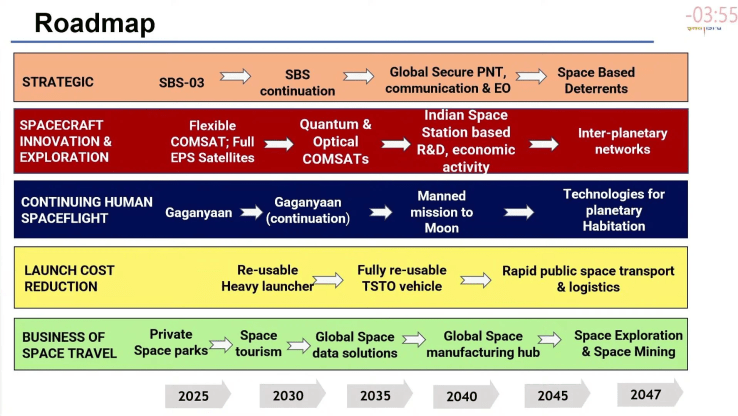
  • India’s Space Roadmap 2047 – Gaganyaan

    Today we take a look at the third layer of the Roadmap – Gaganyaan, India’s Human Spaceflight programme.

    ISRO has posted several updates related to various hardware testing of the Gaganyaan components.

    The Gaganyaan missions will initially be unmanned, followed by missions to Low Earth Orbit with the eventual goal of establishing an Indian Space Station.

    The Artemis Accords will pave the way for human missions to the Moon after gaining experience in Low Earth Orbit.

    Technologies for planetary habitation is somewhere in the realm between science fiction and early technology demonstration of these technologies on analog stations on Earth.

    It will require the development of a heavy launcher to send larger structures to Low Earth orbit to build the Indian Space Station and to reduce the time needed (from more than a month to a few days) to send a spacecraft to the Moon. ISRO has a heavy launcher plan on the drawing boards at this stage.

    It will also need to develop a module (similar to the Russian Progress or SpaceX’s Cargo Dragon) that could carry payload to the Indian Space Station or even the Artemis Gateway.

  • India’s Roadmap to Space 2047 – Spacecraft Innovation and Exploration

    I wrote about India’s Roadmap to Space 2047 in an earlier blog post. I wanted to share it without any comments at first, but then I decided to add my thoughts.

    The term “flexible COMSAT” refers to a type of satellite that can change its coverage, bandwidth, and frequency. This technology is being developed by ISRO, as mentioned in a PTI story published on the NDTV website.

    The term “full EPS satellite” is a reference to a type of satellite that uses only electric propulsion systems (EPS). The EPS system was first flown on the South Asia Satellite or GSAT-9, launched in 2017. The note says that this would reduce the mass of satellite from approximately 6 ton to 4 ton for the same capability.

    Quantum and Optical COMSATs are in various stages of development. Urbasi Sinha and her team in QuIC lab, Raman Research Institute, Bengaluru and an ISRO team at the Space Applications Center (SAC) are working on the building blocks of quantum satellites. The first optical communication payload was carried on the GSAT-29 mission.

    The Indian Space Station based R&D and economic activity is at least a decade into the future. Vellon Space, an Indian startup has been talking about space-age medicine and pharmaceutical manufacturing in space.

    Inter-planetary networks hold immense potential for the future of humanity! Imagine a world where communication seamlessly spans across celestial bodies, connecting Earth with other planets. The vision of becoming a multi-planet species becomes more tangible as these networks evolve. It all starts with the Earth-Moon system, but the possibilities for expansion are limitless. With initiatives like Artemis and the International Lunar Research Station, we are paving the way for a future where inter-planetary communication becomes a reality!

    ISRO may not focus as much on Earth observation satellites because there are many Indian space companies (Pixxel, SatSure, Dhruva etc.) working on remote sensing capabilities. They may continue with Earth observation missions until the startups can offer similar levels of data. On the other hand, there are fewer startups in the field of communications satellites technologies. The only one that comes to mind is Astrome among the NewSpace companies.

  • India’s Space Road Map up to 2047

    Reddit user u/Blazing_Phoenix_100 shared this screenshot of India’s space road map shared at the G20 summit. I plan on using this chart not to point out times where ISRO has fell behind this timeline. They have done that plenty of times but to understand the general direction they are headed in.

    In the absence of an official roadmap on the ISRO website, this becomes an important indicator of priorities until an official roadmap appears.

  • Role of ISRO in the future?

    Fortune India did an interview with Chairman, ISRO Dr. S. Somanath. This was one of the exchanges in the interview.

    Commercial human space travel is something which private players in some countries are offering. Can ISRO do this?

    We can, but it is not our job. It is the job of the industry. ISRO is a national agency. ISRO can develop the technology. But the practice of government funding ISRO to develop technology is going to stop. If a technology is needed, it will be developed by ISRO and industry through government-industry funding. So, now, the industry will have to put money into technology development. They have to do some R&D and develop technology.

    This is an interesting comment and perhaps provides an insight into how ISRO thinks of its evolving role in the new space policy regime in India post-2019.

    NSIL, the Department of Space’s commercial arm signaled the intention to move to a demand-driven model in the space sector. As an example, GSAT-24 was India’s first demand-driven satellite that NSIL/ISRO built for Tata Play (DTH service provider).

    If you read through the whole interview, you can see the lengths to which Somanath goes to protect ISRO’s role while trying to push the idea that industry must lead in the future. This is a new tension for ISRO to hold. I don’t think there is enough clarity on how this will happen for him to communicate the message well.

  • India’s Space Policy – Sowing Now to Reap Later

    Note from the Author: I wrote this piece in March 2022. I did not get around to publishing it anywhere. Hence, posting it here. Some of the information mentioned here is outdated.

    Introduction

    India has pursued a space program since the 1960s with the intention of benefitting its people for the past sixty years. For this period, the program was dominated by a single government player with an innovative production capability nurtured through these years. But, the Indian government now wants private players to play a bigger role – to design products, develop them, and market them to the world. Against this backdrop, the Indian Government opened up the space sector in 2020. This led to the need to make policies and institutions that would help India tap into this hidden potential.

    Opening up India’s Space Sector

    The Union Finance Minister, Nirmala Sitharaman announced the opening of eight sectors in May 2020 as part of the INR 20 lakh crore (USD 300 billion) Atmanirbhar Bharat Abhiyan (Self-reliant India Campaign). Space was one of the sectors that opened up as part of these reforms.

    The Government said that it wanted the private sector to be a player in the space sector. She said that the Government would provide a level playing field for the non-governmental private entities to build satellites, launch vehicles, and provide space-based services. She promised that future planetary exploration and human outer space travel opportunities would be open to non-governmental private entities. Towards this, she promised access to facilities of India’s space agency, the Indian Space Research Organisation (ISRO), and a liberal geospatial policy.

    India identified that space held a huge commercial potential for growth. It wanted non-governmental private entities (NGPEs) to be part of this growth. When the Government says NGPEs it is referring to academic institutions, start-ups, and industry. 

    As a part of opening up the space sector, NewSpace India Ltd (NSIL), which was set up in the previous year, was repurposed to drive a move from a supply-driven to a demand-driven model. NSIL would act as an aggregator of demands from the market. It would then supply the services provided earlier by ISRO. For this, it would take over ownership of ISRO’s operational launch vehicle and satellite fleet. It would commercialize the production of the launch vehicle fleet by handing it over to a private consortium. 

    The opening up also involved setting up a regulator, Indian National Space Promotion and Authorisation Centre (IN-SPACe). IN-SPACe would provide a one-stop shop for all space-related activities in India. ISRO would then concern itself with the research and development of various space technologies and applications.

    IN-SPACe would “promote, hand hold, permit, monitor and supervise space activities by NGPEs and accord necessary permissions as per the regulatory provisions, exemptions and statutory guidelines”.

    Developments since the Announcement

    A draft Space Activities Bill, 2017 had been floated for comments from stakeholders and the public. This bill was to provide an overall legal framework for the space sector. As of February 2022, the bill has completed public and legal consultations and has been sent to the various Ministries for their approval.

    IN-SPACe was established. Pawan Goenka, a former Managing Director of the Indian automobile major, Mahindra & Mahindra, was made Chairman of IN-SPACe. It was reported in February 2022 that ISRO facilities and expertise were extended to the NGPEs. ISRO facilities are being shared with these private entities at no or reasonable cost basis.

    NSIL undertook its first fully commercial launch for Brazil’s Amazonia 1 and fourteen ride-share satellites in February 2021, on the Polar Satellite Launch Vehicle’s (PSLV) PSLV-C51 mission. It is also undertaking the first demand-driven communication satellite [PDF] launch. It will launch the GSAT-24 communications satellite to fulfill the demand of Direct-to-Home company, Tata Sky (now Tata Play). The launch is expected to take place on board the European Ariane V in the first half of this year.

    The Department of Space had provided various draft policies on its website for comments. These include draft policies on Space Communications, Remote Sensing, Technology Transfer, Navigation, Space Transportation, Space exploration and Space Situational Awareness, and Human Spaceflight through 2020 and 2021. India, at present, has, only Space Communications and Remote Sensing policies. 

    Although space startups have been present in India since 2011, there was a real acceleration in the number of startups that started following the opening up of the space sector. As per statistics shared by the Indian Government in February 2022, there are more than 50 space startups presently in India. These work in areas such as building satellites, launch vehicles, satellite subsystems like electric propulsion systems, as well as various space-based applications in remote sensing, agriculture, fisheries, economic growth forecasting, etc. The Indian Government hopes to attract foreign direct investment (FDI) in the space sector.

    Obstacles in the Way

    As with any reform, there is a feeling that the reforms are not being implemented fast enough. It is not known when the draft Space Activities bill would be cleared by the Union Government and tabled in Parliament. The Space Communications policy is expected to be finalized by April 2022. The status of the other policy drafts is currently not known.

    In the interim, ISRO is tasked with clearing the backlog of remote sensing, communication, navigation, scientific, and interplanetary missions of national importance which have been delayed as a result of the COVID-19 pandemic. India has only had 5 launches from India since 2020. One of them was a failure. There are limits on the number of launches ISRO is able to do in a financial year (March to April). This period of transition would be a difficult one to manage at ISRO, as it would have to fulfill launches for NSIL as well. 

    NSIL floated tenders for the commercialization of the PSLV in 2019. It has still not been announced as to who the tender is awarded to. There are two other operational launch vehicles, the Geosynchronous Satellite Launch Vehicle (GSLV) and the Geosynchronous Satellite Launch Vehicle Mark III (GSLV Mk-III) that also need to be similarly commercialized. 

    All these delays then make the regulator, In-SPACe ineffective to do much other than provide access to DoS facilities until there is regulatory clarity with the publication of draft policies and the passage of the draft Space Activities Bill in Parliament.

    Hopeful Future?

    While it is expected that the infrastructure put in place after the announcement of the space reforms, would take anywhere from half a decade to a decade, the future remains hopeful. 

    In the decade, India expects to launch interplanetary missions to the Moon, Mars, and Venus. It also expects to operationalize its human spaceflight program in the first half of this decade. In addition, it expects to launch missions for communications, remote sensing, navigation, and scientific applications.

    It is expected that these reforms would bear fruit in the future decades. India hopes to participate and play a bigger role in the global space economy. It hopes that its start-ups today will provide goods and services not only for India but also for the world.