Tag: ISRO

  • Chandrayaan 2 on the way to the Moon

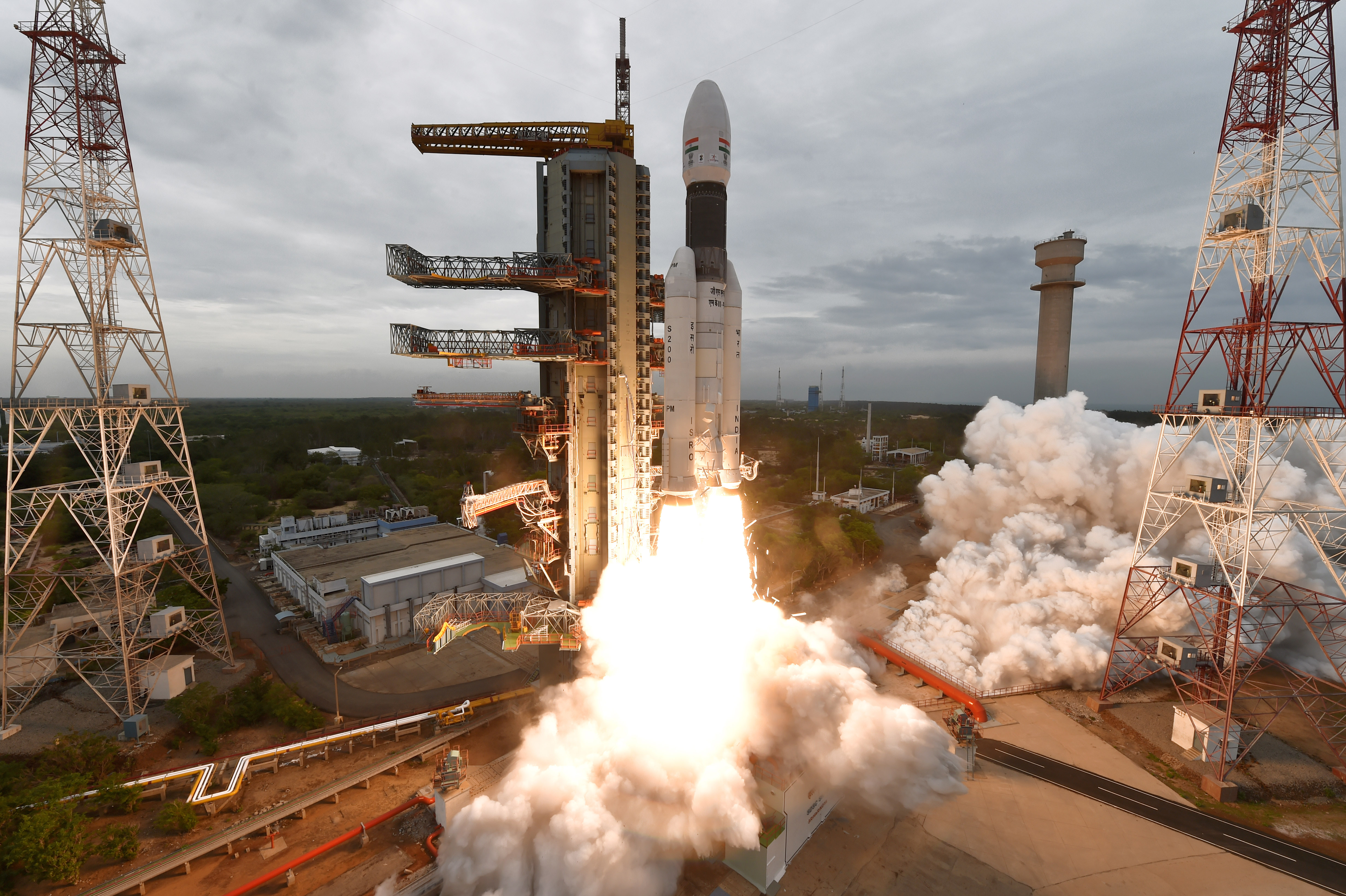
    Chandrayaan 2, India’s second mission to the Moon lifted off from Sriharikota on July 22, 2019. The spacecraft was launched on board India’s GSLV Mk-3 rocket on it’s maiden non-development flight.

    Photograph of the launch of the GSLV Mk-3 with the Chandrayaan 2 spacecraft by ISRO.
    GSLV Mk 3 lifts-off with Chandrayaan 2. Image Courtesy: ISRO

    It came after a launch scrub surrounding which there was lack of information and a lot of speculation. I watched the launch with my grandmother in Mumbai.

    Since the launch, the spacecraft which currently has an orbiter and lander attached to each other performed 5 orbit raising manoeuvres on the way to the Moon.

    India adopted this gradual orbit raising manoeuvre in order to balance the limitation of the spacecraft and the launch vehicle. A lower mass of the spacecraft would enable the launch vehicle to place the spacecraft into lunar orbiter but it would then not be able to carry any meaningful payload. The launch vehicle had only enough power to place Chandrayaan 2 in a geosynchronous transfer orbit.

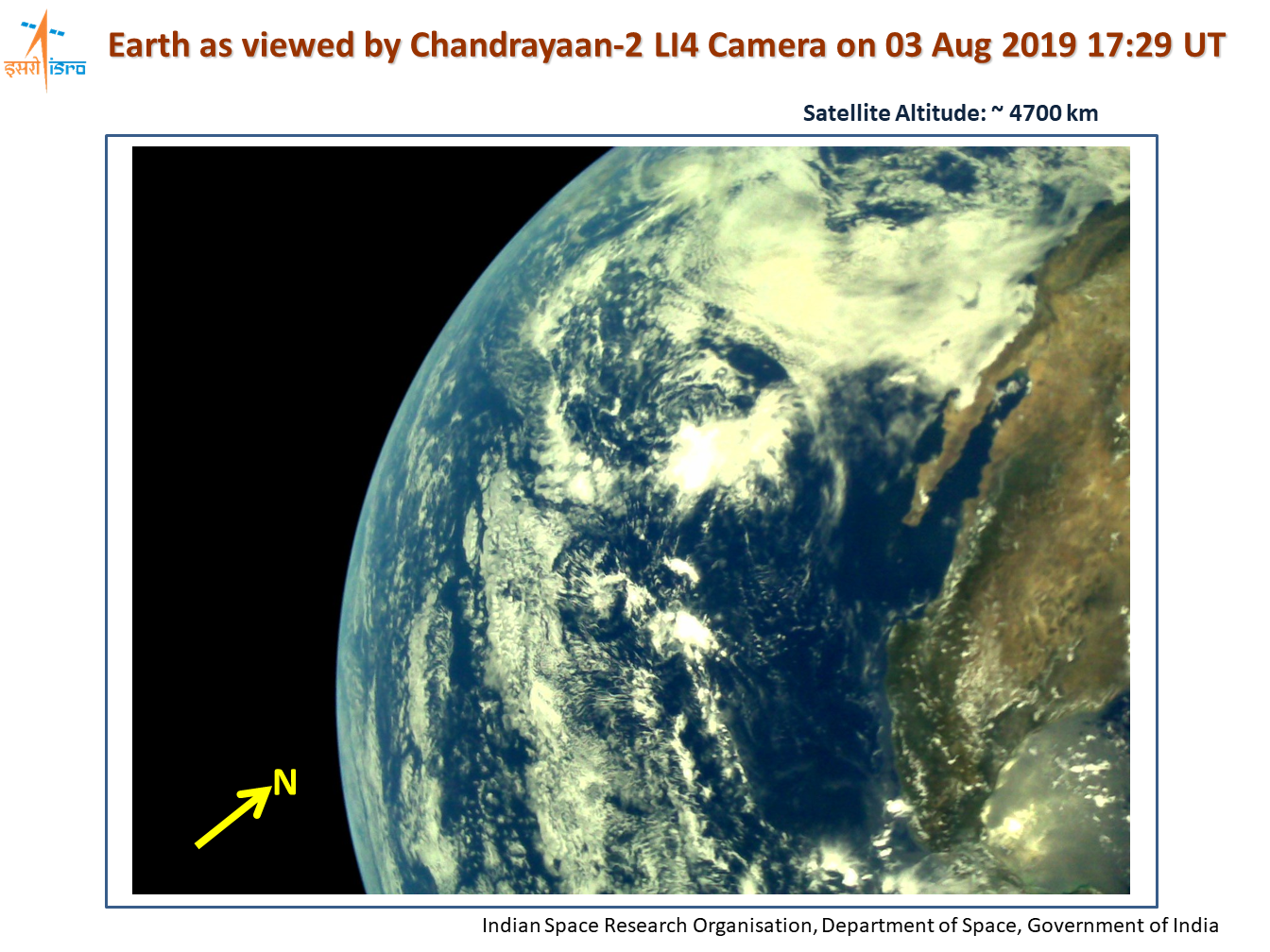
    Image of the Earth taken by LI4 camera on board the lander on Chandrayaan 2.
    Image of Earth taken by the LI 4 camera on board Chandrayaan 2. Image Courtesy: ISRO

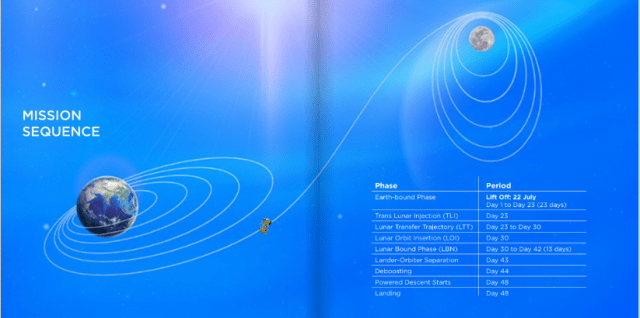
    After the 5th orbit raising manoeuvre, the spacecraft will push off towards the Moon called Trans Lunar Insertion on August 14. Afterwards, the spacecraft will perform one more burn called the Lunar Orbit Insertion on August 20 that will let the spacecraft be captured by Moon’s gravity.

  • NISAR will look at the Antarctic

    Alexandra Witze writes for Nature about a decision relating to NASA and ISRO joint mission called NASA ISRO Synthetic Aperture Radar (NISAR) decision to point at the Antarctic rather than the Arctic.

    The decision is based on the fact that the Europe’s Sentinel satellite is covering the Arctic region. Also, SAR satellites are built such that they point either to the North or the South pole. Hence a call was taken on which Pole the NISAR would be facing.

  • The South Asia Satellite

    The ISRO will launch the GSLV tomorrow carrying the South Asian Satellite on board. ISRO calls it the GSAT-9. It will carry Indian transponders that will be used by India, Nepal, Bangladesh, Bhutan, Sri Lanka and the Maldives. The Wire has a short video describing the significance of the launch and some prior history.

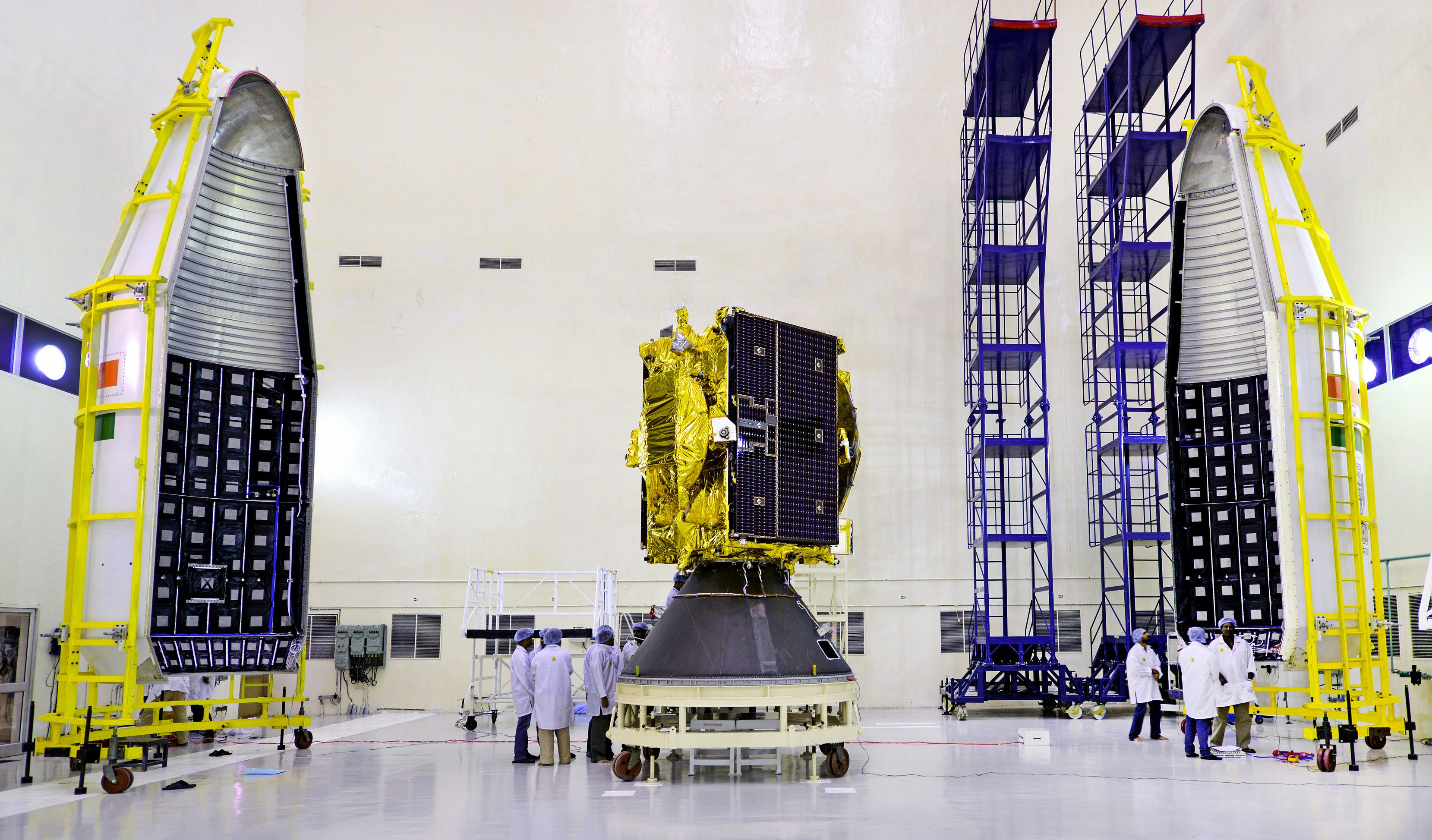
    11a8gsat-9seenwithtwohalvesofpayloadfaringofgslv-f09
    GSAT-9 seen with the two halves of the payload fairing of the GSLV-F09. Image Credit: ISRO

    I think this launch will be important for India for two things. One is to prove, further, the reliability of the GSLV as a launch vehicle capable of regularly delivering communication satellites into orbit. This improves with each launch. As this reliability improves, it brings in business in communication satellite launches as well as reduces India’s dependence on foreign launch vehicles. The second is to improve availability of transponders for users on the ground. Indian transponders can thence be leased and commercialized after meeting India’s requirements.

    It would be interesting to see if the use of the transponders by some of our neighboring countries provides them with sufficiently good experience that they will continue using Indian transponders or even ask for multiple transponders. This would make it important again to improve the reliability of the GSLV and the GSLV Mk-III to put enough communication satellites into orbit to service these future requirements. Could then India wean off South East Asian countries from American and European transponders to Indian ones?

    Interestingly, this satellite also carries with it an electric propulsion experiment. This satellite is expected to stay in orbit for 12 years. Communication satellites usually  last around 10 years. They have to carry as much fuel for what is known as station keeping. The satellites begin to drift from orbit like kites that we fly. We tug at the kite to keep it at one place and prevent it from drifting too far away. The satellite has no strings attached and hence the satellite will have to use fuel on-board to reach its orbit as well as to stay there.

    Using electric propulsion completely for doing station keeping would reduce the amount of fuel the satellite would have to carry. This means we can add more transponders which in turn would mean fewer satellites could meet the requirements. But, this is an experiment and hence ISRO is still carrying the fuel it normally would had the electric propulsion system had not been there. I am also delighted to hear that the GSAT-20 mission flying next year will also carry an electric propulsion system on board. The lessons we learn from the experiment on the GSAT-9 would be incorporated.

  • ISRO to launch 5 British satellites as its first commercial launch in 2015

    ISRO will launch 5 British Satellites on behalf of Antrix Corporation (which is ISRO’s commercial arm) on board the PSLV-C28 vehicle on July 10, 2015. This is the PSLV’s 30th mission. ISRO will use the PSLV’s Extended Length (XL) variant to launch 1440 kg payload consisting of 5 British satellites into orbit.

    The 5 satellites are the Surrey Satellite Technology Limited’s (SSTL) DMC3 satellites and CNBT-1 satellites and the Surrey Space Center’s DeOrbitSail spacecraft.

    DMC3 satellites

    The DMC stands for the Disaster Management Constellation of 3 satellites built by the SSTL for it’s wholly owned subsidiary, DMCii (DMC International Imaging Ltd) which is executing this project for a Chinese company, 21AT.

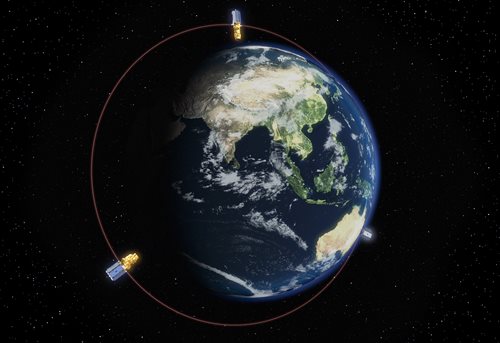
    A visualisation of the orbit and position of each satellite in the DMC constellation. Image Courtesy: SSTL
    A visualisation of the orbit and position of each satellite in the DMC constellation. Image Courtesy: SSTL

    The DMC constellation is a group of 3 small satellites placed in orbit 120 degrees apart, as shown in the image above. The idea is to quickly image areas which have been struck by disaster with high-resolution cameras (1 m resolution) with a capability to provide very fast down link in order to help make the images available quickly in order to assess damage and plan disaster response.

    CBNT-1

    I could not read much about this satellite but it seems that the company that built it, SSTL will share more details after the launch. All that is known for sure right now is that it weighs 91 kg and is a technology demonstrator mission.

    DeOrbitsail

    This is an interesting 7 kg 3U cubesat with dimensions of 10 x 10 x 34 cm. It contains a highly densely packed 4 x 4 meter sail which will be deployed in space in order to increase drag in order to cause the spacecraft to deorbit and return back to Earth. The project is developed by the Surrey Space Center (not the same as SSTL).

    PSLV-C28

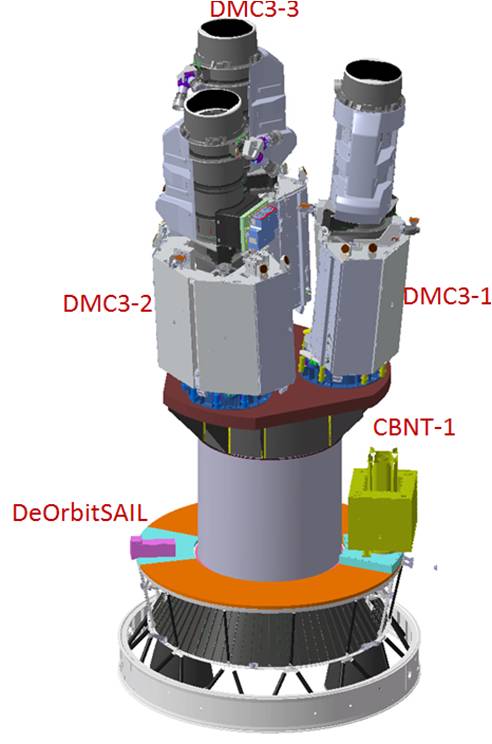
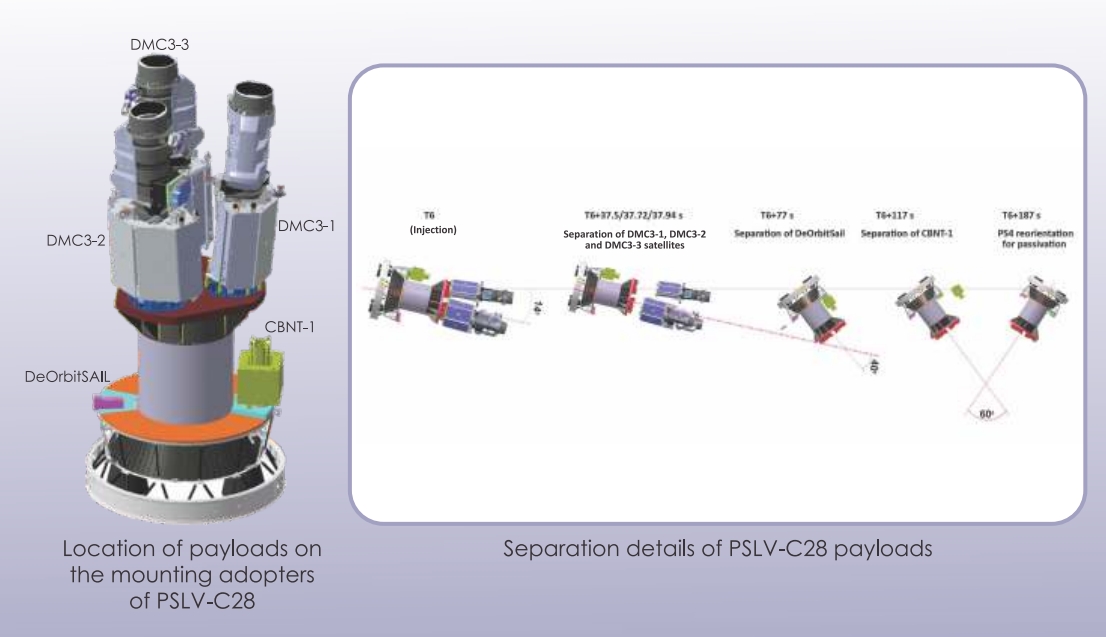
    The Spacecraft mounted on the Launch adapter called the L-adapter. Image Courtesy: ISRO
    The Spacecraft mounted on the Launch adapter called the L-adapter. Image Courtesy: ISRO

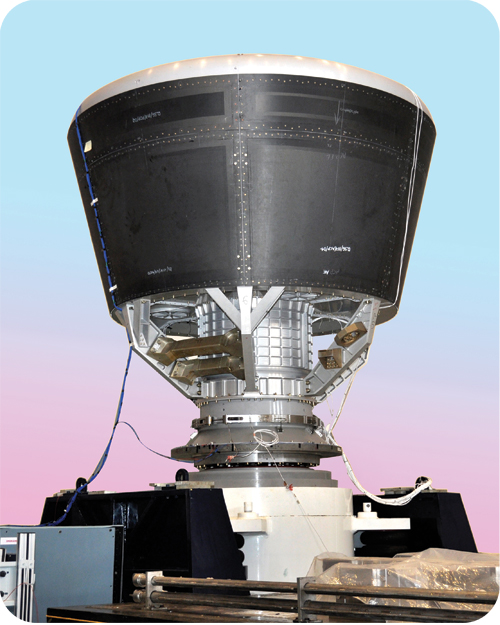
    For ISRO, the challenge begins with the three DMC3 spacecrafts. It had to fit in these 3 satellites each of which has a length of 3 meters into the 3.2 m diameter, 8.9 m long payload fairing of the PSLV-XL. They resolved the issue by changing the launch adapter. A launch adapter is basically a platform on which the satellites are kept and launched from once the last stage of the PSLV reaches the designated orbit and orientation. The vehicle uses a new launch adapter which has a triangular deck and is called the Multiple Satellite Adapter – Version 2 (MSA-V2).

    Illustration of the Multiple Satellite Adapter - Version 2 (MSA-V2) with the satellite mounted and showing the launch of various satellites. Image Courtesy: NasaSpaceflight.com
    Illustration of the Multiple Satellite Adapter – Version 2 (MSA-V2) with the satellite mounted and showing the launch of various satellites. Image Courtesy: NasaSpaceflight.com

    A success now will help cement the PSLV’s record and hopefully bring more business Antrix’s way. This launch shows that even commercial launches can make requirements on a proven launch vehicle that if managed would improve the agility of the variety of satellites that the PSLV is capable of putting into orbit. This agility lowers cost and enables Antrix to reach a wider market to sell launches on the PSLV. Wishing ISRO Godspeed.

  • Review: ISRO Annual Report 2013-14

    I saw the link to the 2013-14 Annual Report on the ISRO website thanks to the blinking “NEW” sign next to it. Usually, ISRO reports go over the top with missions that they tend to be working on and hoping to cover more ground than they realistically could. It usually had timelines that no one knew how they’d meet.

    The 2013-14 Annual Report is different. It states the basic facts under each section and dwells very slightly on the future course of the missions under development. I am not really sure how I feel with this change especially since they did the unthinkable in putting together and launching the Mars Orbiter Mission in record time.

    I have had things weighing on my mind this whole year. This meant that I have not been that on top of space developments as I have been in the past. The Report, put together as a sort of summary of what happened in the 2013-14 period that it covers, hence make lovely reading for me but really bland reading for people already in the loop. The Report is a long series of things which just goes like, “This happened, this happened, this happened, and you know what, this happened too!”

    Without further ado, let’s go through this report now, shall we?

    I like to begin with the Space Transportation Systems section and begin with the GSLV Mk-III project. This three stage vehicle is now prepping for a passive cryogenic stage flight carrying the Human Spaceflight Crew Module on top to test the design of the whole stack. ISRO has never done this before – flown a mission without a payload – since each launch cost so much. However, the string of failures that the GSLV Mk-I and Mk-II saw has slowed the approach they’re taking with the Mk-III or LVM3 as they refer to it internally and presentations they make. The passive cryogenic stage means that the cryogenic stage does not actually fire whilst the giant twin S-200 and the liquid L-110s will fire and take the vehicle up to a certain height and the engineers will get valuable data that can be used to improve the design and fix flaws in the aerodynamics. I really loved this picture of the CE-20 cryogenic engine that is at the heart of the third stage of the LVM3 in the Report undergoing a hot test.

    CE-20-Thrust-Chamber-new

    Image: The CE-20 cryogenic engine undergoing a hot test. Image Credit: ISRO. Image Source

    Next, again in the Space Transportation Systems section is an eerie sounding title called “Pre-project Activities of the Human Spaceflight Programme”. The ISRO asked the Government for some money to put together the systems that would enable a human spaceflight programme. This section basically details on what happened under that head. The most interesting aspect for me in this are the Crew Module Atmospheric Re-entry Experiment (CARE) and information related to tests for the Crew Escape Systems. CARE is expected to be on top of the LVM3 experimental flight I talked about above. This is an important test because it gives us crucial indications as to what the Crew Module can handle during an atmospheric re-entry or to put it bluntly, if humans inside it can survive an atmospheric re-entry. I am not really in favour of mingling this along with LVM3-X and think ISRO is trying to do too many things at once.

    5HSP-CMImage: The Crew Module undergoing a test. Image Credit: ISRO. Image Source

    ISRO loves indecipherable précis. Pray, expand on this? “Functioning of newly developed Head-end Mounted Safe Arm (HMSA) for solid motors in Crew Escape System was successfully demonstrated.” The work with parachutes with tests conducted in Chandigarh and Agra is interesting and I wish ISRO shares more of these on its Facebook and Twitter sites. With pictures, please!

    I really need to read up on this LVM3-X flight. I think I’ve not really understood it well. Under the GSLV Mk-III section, it does not make mention of the Crew Module flight during the LVM3-X flight whereas the section above does. Hmm!

    If you wander to the Space Sciences and Planetary Research section, the section on the Mars Orbiter Mission piqued my interest but ended in disappointment. The section is a nice synopsis of what’s happened so far. No looking at the future. No mention of a future/planned Mars mission. The mission does deserve kudos for its achievement thus far and I think the section does not do it any justice. The section on Chandrayaan-II is more interesting. This is the section in which the marked toning down of ISRO’s Reports becomes most glaringly visible. Earlier reports were talking of Chandrayaan III or even IV by 2015. This Report only marks the parting of ways with Roscosmos and the tough job of developing a lunar lander that lies ahead of ISRO. It does not even offer a guess at the possible launch time-frame, though news reports have been pushing it further and further into the future. Pendulum swings! They’ve now got their launch vehicle – the GSLV Mk-II. They’re working on the orbiter and rover since they were working with Russia. The parting of ways on the project means that they had to rework the project with an Indian lander.

    Chandrayaan 2 rover mobility test
    Image: Chandrayaan-II Rover undergoing mobility test under reduced gravity conditions. Image Credit: ISRO. Image Source

    The Audit Observation section also has an important paragraph on Edusat, India’s effort at tele-education. Whilst ISRO has been at pains to make this into a success, the CAG seems to report that the planning was bad and basically all the ground infrastructural network did not come up as expected. As the network developed, the satellite idled with no useful function. By the time the network on ground developed, the satellite seems to have given up waiting. I also think that similar criticism can be levelled at ISRO for its planetary projects to Mars and the Moon. Chandrayaan-II seems to be coming almost a decade after it’s predecessor launched and there is no mention of the next Mars mission at all.

    Annual Reports usually make drab reading except for people who follow intently. Earlier, ISRO has gone overboard with planning and now seems to be extra shy thanks to all that it wasn’t able to achieve as promised. I think the Report needs to strike a healthy balance of information on the projects undertaken in the year and a glance at what’s coming in the future, especially if it is exciting.
  • ISRO’s Naughty Boy puts India in the Cryo Club

    The “naughty boy” reference in the title of this post is how the Mission Director, GSLV K Sivan called the GSLV. He said the naughty boy had finally obeyed the flight path and delivered the GSAT-14 into orbit.

    Today’s success is a big deal for India. India has been trying to build launch vehicles capable of launching communication satellites since the 1990s. They initially thought they would buy the technology from the Soviet Union. It’s collapse and faced by pressure from the US, India’s then ISRO Chairman, Prof U R Rao decided to embark on India’s indigenous cryogenic programme called the Cryogenic Upper Stage Project (CUSP). The launch today is the final culmination of that project started in 1994. As the current ISRO Chairman rightly said, “20 years of efforts in realising an indigenous engine and stage has now fructified”.

    Today’s success was built on the hard work of a lot of people in industry and in ISRO. The problems that have been plaguing the project in the last 5 years include three flight failures. The team had undergone a gruelling review from several boards and had made several design changes and run several tests. The failures as the LPSC Director said after the launch were painful.

    I must admit that I was really tense before the telecast started. The telecast began at 1530 hrs (IST) on Doordarshan instead of the publicised 1552 hrs (IST). Seeing the sombre faces of those present there did not ease my tension. My tension persisted till about the cryogenic engine ignition.

    Unlike ordinary telecasts that are met with quiet claps at each stage separation event, people were actually up on their feet after the second stage separation. The first smiles and applause broke out as the cryogenic engine lit up as planned. As the ignition was sustained, that is, more claps broke out. A few smiles appeared on the people’s faces 300 seconds into the flight of the cryogenic stage. As the stage efficiently provided enough velocity to the put the satellite into orbit, everyone in the Mission Control Center was on their feet and with their faces glued to the screen. I had not seen so much tension in the room even during the Mars mission!

    I personally would rate this success a higher one than even the Mars mission. Success in this critical technology enables India’s space programme to indigenously launch communication satellites, launch interplanetary missions like the Chandrayaan-II and perhaps even the second Mars mission and opens the ground for heavier science missions that India has not considered yet.

    While this was an important success, the improvements need to continue and the GSLV needs to show more consistency in its success rate in the future before it can be trusted with more important missions like Chandrayaan-II. If the GSLV Mk-III mission slated for March-April 2014 succeeds, India will gain capability in launching all classes of satellites it builds by the end of this decade.

    There are more tests in the road ahead, but tonight we celebrate another important milestone  in the Indian Space Programme. I had a nice medu-wada sambhar, the fuel that powers ISRO in the evening to celebrate.

  • GSLV-D5 Preparations On!

    The GSLV D5 is scheduled for launch on January 5, 2013 at around 1618 hrs. (IST). Preparations are afoot at the Vehicle Assembly Building where each of the stage of the rocket is being assembled to form the GSLV.  A Mission Readiness Review on December 27 will confirm the time and date of launch, as per reports.

    Integrating the indigenous cryogenic stage to the GSLV. Image Credit: ISRO

    The most challenging part of this mission is the indigenous cryogenic stage. The 8 page brochure includes one whole page for the various design improvements that ISRO has undertaken for this mission. The changes have been made in the fuel booster turbo pump of the cryogenic engine that was believed to be the cause of the failure of the GSLV D3 in April 2010. Improvements have also been made to the aerodynamics of the launch vehicle and the wire tunnel that runs from the payload bay right down to the first stage. These were believed to be the cause of the failure of the GSLV-D4 which was destroyed by range officer after the vehicle veered out of control. ISRO has also instituted more tests than it had generally carried out for launch vehicle missions, which it prefers to do in-situ during missions.

    An interesting addition to this mission is a video imaging system to keep watch of the lower shroud movement. It was this shroud that is suspected to be the culprit in snapping of the control wires that led to the failure of the GSLV-D4 mission. The Russians were blamed for this. It will be interesting to learn of lessons learnt from this mission.

    They have also changed and are using a newer stage for this mission. As the countdown clock was running for the same mission on August 19, the second stage had popped a leak. A review found that the older tank used for the stage had cracked due to ageing. I can imagine many tanks wasting away without use as the GSLV launches keep getting delayed.

    The development and success of the GSLV is critical for India. Several of its space missions have been scaled down due to the lack of reliability of this vehicle system. This along with the Mk-III are critical for self sufficiency in launching our geostationary satellites, future interplanetary missions and even the human space-flight programme. I wish good luck to the GSLV team.

  • ISRO on Social Media Misrepresentations

    Note: I wrote this on my earlier blog hosted as https://parallelspirals.wordpress.com. I recovered the text from the WayBack Machine. This post appeared on December 17, 2013 as per the permalink. I’m trying to collect here again all my old writings spread on various blogs.

    Update: ISRO posted this on their Facebook page earlier on Tuesday which seems to imply that they’re planning to expand their presence on Facebook and Twitter. If true, these fake profiles seem to have done more for public outreach than India’s space enthusiasts have achieved thus far. Kudos to the people behind the fake profiles!

    I have congratulated ISRO’s social media presence with respect to the Mars Orbiter Mission. Their official page is linked to from the ISRO website. This press release tells me that ISRO is yet to understand social media much like many Indians, myself included.

    There have been a multitude of unofficial ISRO accounts on the agency as well as it’s various missions, ostensibly trying to ape similar efforts by NASA. These may be well meaning individuals trying to inform the world about ISRO through a channel it is not present on using information from ISRO press releases and news stories. I myself did this when Chandrayaan 1 launched in 2008.

    The critical difference, in my opinion, is being open about the fact that the account or the page is not an official ISRO page. I did so on my Chandrayaan 1 representation.

    I think one does not go after these people with a legal notice. At least, not until one has sent them a warning.

  • First Trajectory Correction Maneuver of Mars Orbiter Mission tomorrow

    Tomorrow, as I will be celebrating my brother’s birthday, the Mars Orbiter spacecraft will perform the first of the four trajectory corrections on its path to Mars.

    A Facebook update posted just now revealed that the spacecraft will fire its 22 N thrusters for about 44 seconds at 6:30 am (IST).

    Best wishes to ISRO and birthday wishes to my brother 

    :)
  • The Age of the GSLV Mk III

    India’s GSLV Programme has always been tumultuous. It began in the 1990s in a bid to become self-reliant in launching communications satellite. Indian satellites were being launched primarily on the European Ariane-V launch vehicles. These are an expensive affair.

    The story seems to be that India, unable to develop its own cryogenic engine fast enough, purchased them from Russia. It then build modified versions of the PSLV first stage solid fuel and second stage liquid fuelled engine to build the GSLV Mk-I. Sanctions imposed on India after the nuclear tests in Pokhran and US pressure allowed India to obtain only 7 Russian cryogenic engines in the late 1990s. Of these 6 engines have been used flying the successful GSLV-D2 and GSLV-F01; and GSLV-D1, GSLV-F02, GSLV-F04 and GSLV-D4, all of which ended up being failures. In the meanwhile, India having developed its own cryogenic engine tested it flying the GSLV-D3, which was a failure. India now hopes to test the cryogenic engine again for the GSLV-D5 in January, 2014.

    The GSLV programme reminds me of the ASLV programme or at least my reading of that programme. Of the four flights, only one was successful. The five stage all solid fuel carrier rocket lofted 150 kg to LEO is said to be India’s “rites of passage” into the launch vehicle technology. I see the GSLV as a similar rites of passage into the heavy lift capability. I think the ASLV was dumped faster than the GSLV because we didn’t have that much time or money to waste. ISRO is slightly better off today and we’re looking for a success with the indigenous cryogenic technology design, a breakthrough we’ve not had yet, before we move on. Like ASLV was moved on to the PSLV.

    The learnings from the GSLV Mk-II programme, in my opinion, will power the Mk-III programme’s success. The first experimental launch is planned to be done in 2014.