Although I have lived in Pune for two-and-a-half years, the Pandemic meant that I have not explored the city.
I was looking for book stores in Pune. There are many of the ones that play an academic role. Many shut down during the Pandemic. Pagdandi seems to the city-wide favorite. However, I was not happy how they treated my wife and daughter when I was inside the store. I have not returned there since.
The search for another bookstore began. A search revealed Book World. This is a bookstore on Pune’s Fergusson College Road (FC Road). The Google review says they have a good manga collection.
I went there on the two wheeler expecting parking to be an issue. I left my two wheeler a little way off and walked on FC Road. I loved the vibe on FC Road. There were road side shops selling clothes and books. There was place to sit and hang out. There was a Kalakar Katta where artists were seen drawing portraits. I am not sure if there were writers or readers there.
I went down the steps and to Book World to see books on a center table and spread from floor to ceiling on the walls around. I spotted some of the latest books on the shelves there including some old copies of famous books. They had a really good collection of books there.
I bought a copy of Ryan Holiday’s The Daily Stoic for myself. I bought a copy of Mahabharatee by Shruti Hajirnis Gupte for my wife. I bought a few children’s story books for my daughter.
I moved to Palakkad, my home town from Pune in the second last week of July. We drove our car from Pune to Palakkad. I will write separately about that experience. In this post, I would like to document for posterity the reasons for my decisions.
When we entered lock down in March 2020, my initial expectation was that India was much better off than other countries at that point in time. Hence, my expectation then was that if we stayed put at home, we would be safe. Things would run their course and we might return to normalcy by June, at the latest.
As things unraveled, I realized that this was a much longer journey than I had anticipated. Things could remain unchanged for much longer. Colleagues at office were going to their native place in the months of May and June 2020. So, in June 2020, I decided to go to our native place.
Kerala had instituted a system of granting passes to the people entering the state. My application for travel to Kerala in June 2020 was declined. Many of my colleagues from work who were from Kerala traveled to the state at this time. We resigned ourselves to the fact that we might be stuck in Pune.
My main concern in staying on in Pune was the lack of a support system. If my wife was infected and had to be hospitalized, I was not sure if I would be able to take care of our daughter by myself. I could have got my relatives over but I did not want to complicate things for others for my incompetency.
So, when Unlock 1.0 started, we decided to apply again. Kerala then moved from a pass system to a registration system. Hence, we applied and received a pass on July 21. We started in the morning of July 23 and reached Palakkad in the evening of July 24.
Today is my daughter’s first day at school. She is in Nursery.
First, let me acknowledge my privilege in being able to afford a school that is starting on time during a pandemic. The classes are online. Being able to afford a separate laptop for her with enough internet bandwidth to attend class and for me to work from home is a blessing.
We were thinking of moving to Kerala in May 2020. I was working from home and schools were not slated to open till September 2020 this year. The interstate pass system had opened. We were applying for passes planning to drive down to Kerala. The request got rejected. On the evening of the same day, we got an email from my daughter’s school that school would open with online classes on June 10, 2020. June 10 is the day schools normally open in Maharashtra, where we are based now.
This stopped us from seeking a pass to go to Kerala and we decided to stay put here. Although classes are online, we were not sure how easy it would be to travel between Maharashtra and Kerala at some point in the future.
Many of the smaller private schools and government schools have still not opened and are wondering how to ensure that everyone can access academic content. There are concerns around content delivery and access. My daughter’s school has assumed that it’s parents have the privilege to access a laptop or a smartphone at home with good bandwidth.
A few days before the announcement, I was listening to Rukmini’s podcast, The Moving Curve. She was talking about the importance of opening up schools and day care facilities as a precursor to parents returning to work. In India, working parents choose and depend on schools to take care of their kids most of the day to enable them to go to work.
In a recent episode, Rukmini spoke of how a disruption of even a year in the student’s academic track leads to a loss in pay of about 15% per year later on in life. That’s getting one pay grade less than one deserves for the rest of life.
This helped me realize the importance of privilege of being able to have my daughter attend school now.
I was watching this video in Malayalam of efforts people are taking to prepare their child for school online. Cleaning up the background, setting up a desk for studying and providing water and sufficient lighting during studies. There are also health considerations like keeping a safe distance between the child’s eyes and the screen.
Online class about to begin… video in Malayalam
I lent the table and chair I was using for working from home to my daughter. We put a sofa cushion on the seat so that the camera is at the correct height that she can be seen. We have moved furniture around so that the background is our wall. We also did a few test runs with my parents last night.
My daughter’s classes are on Microsoft Teams, a software that even I was only introduced to last year while I was working with State Bank of India. She has her own email id for accessing content and for school work.
My best wishes for everyone who are on this journey.
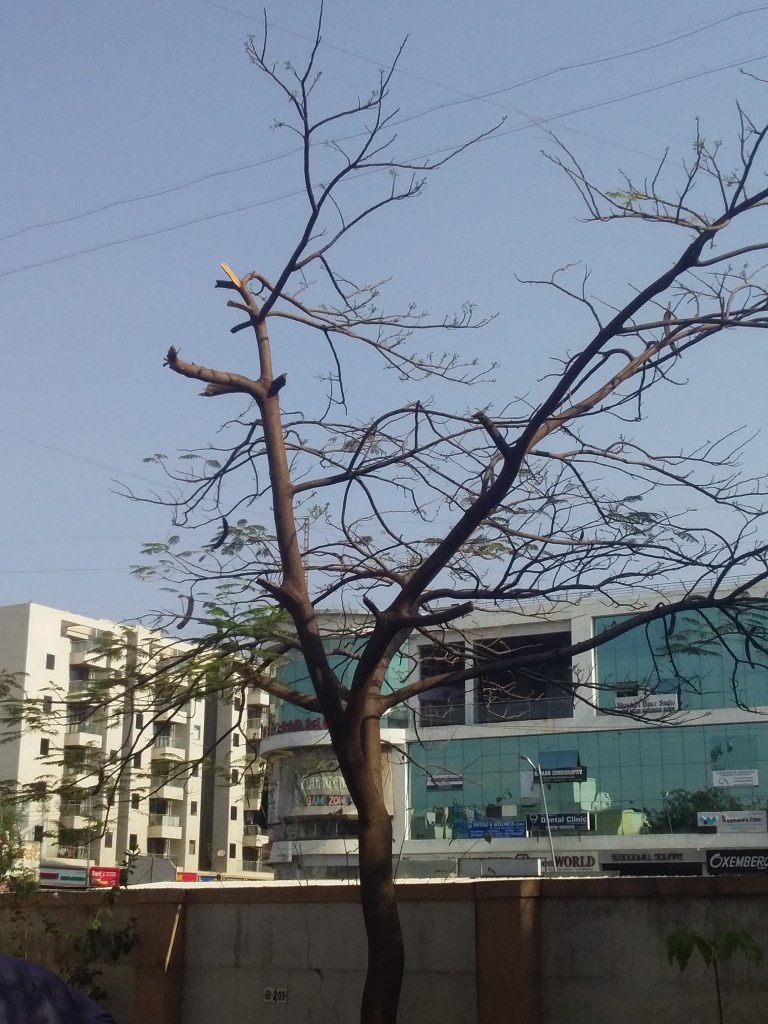
Gulmohar before it bloomed. Image credit: Pradeep Mohandas
We moved into this building only last July. I never noticed this tree because I never sat in our balcony overlooking the tree. I didn’t have the time nor the inclination. I was mostly staring into a rectangular device.
After the lockdown, my family sat in the balcony in the evening. It started as a ritual to enjoy the afternoon tea with a cool breeze to keep us company. This practice also gifted us some magnificent sunsets.
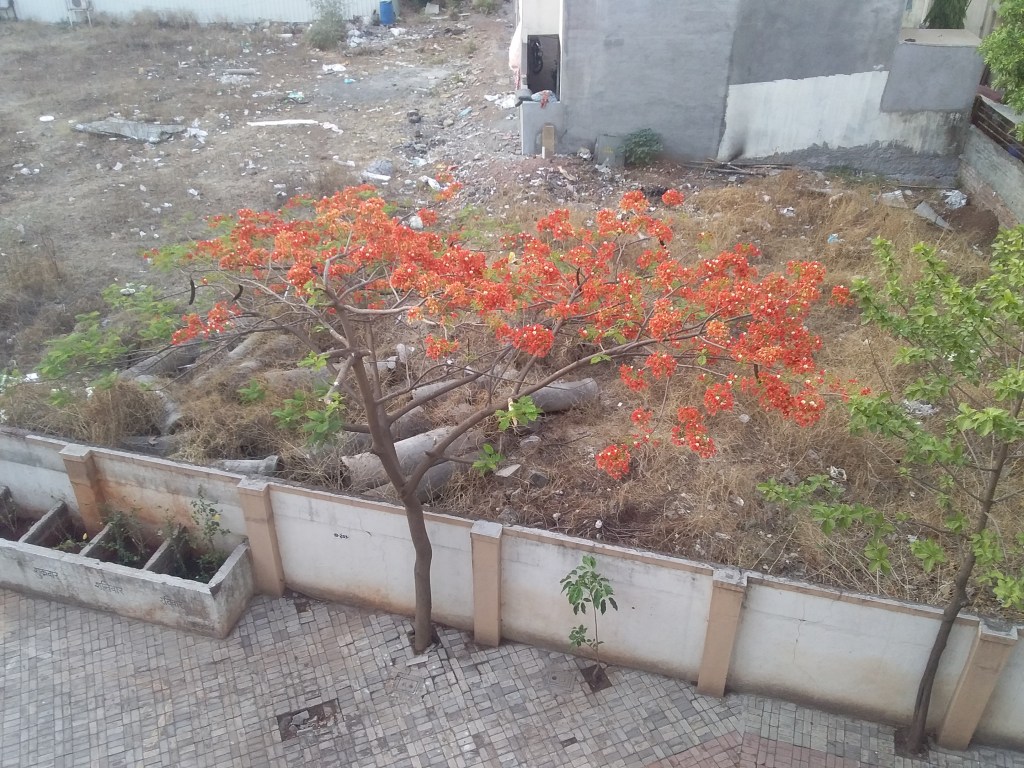
The blooming gulmohar seen from our balcony. Image Credit: Pradeep Mohandas
As the gulmohar bloomed, my wife identified it. After that we looked at it each day as it bloomed and turned into a place of refuge for winged refugees and a stray cat.
Since writing yesterday, the cyclone missed Mumbai and passed South of the city via the town of Alibaug. The Indian Meteorological Department said that the town faced wind speeds of 100-120 kmph. There was destruction but no loss of life.
Billboards torn away by the winds associated with Cyclone Nisarga
I posted two videos on YouTube. One of them showed a billboard near our home that was torn by the winds that lashed Pune as the outer envelope of the cyclone passed through the city.
The address was in the native language, Marathi. Above is the link to the Twitter thread of the address in English.
There has been torrential rain since 3 pm yesterday. The rain subsided late yesterday evening and was since a drizzle. We went to check that our vehicles were secure. We put the two-wheelers on the center stand.
Today morning there has been no rain but has been particularly windy. I recorded a short video of the fast moving clouds I was noticing since today morning:
Cyclone Nisarga Effect
People have been used a site called Windy.com to follow the storm. Friends and relatives shared the link to the site via WhatsApp and Twitter. The site is built by a few people in the Czech Republic and seems to perform well even on mobile. I think that’s the reason why it has become quite popular.
While we brace for the storm, I hope you stay safe too.
India is under Lockdown 4.0. There are more than one lakh COVID-19 positive patients in India. There are about 400 in the ward of the city where I live. The Lockdown has been extended up to May 31 in the state.
After struggling with the Lockdown through March and April, I feel that I have some more control and the processes that I laid out for work and home have started showing some benefits. That many of the Lockdown requirements were eased added to the sense of control I felt.
I got myself a desk and two chairs. We had not purchased these since I did not feel the need for a table when I was working from office. I spent most of my time at home using my mobile phone. With working from home, I was spending 8 to 10 hours on the laptop. Other than a place to keep it also helped in ergonomics and lends itself to multiple other uses.
I continued consuming news only through 3 Things and The Moving Curve. I have started adding other news through newsletter, blogs and tweets but reduced it’s consumption through May. But, I try to keep away from news of the pandemic but that has been difficult.
I started packing my work laptop after completing a day at work. I also practiced locking up the room I used for work. This gave me a sense of separation between work and home. I also tried to limit working hour whenever possible. This also helped family understand when I could be disturbed.
We upgraded the internet connection at home which has helped with multiple people using the wifi at home.
Changes outside also helped. Before May 17, government announcements frequently changed when shops would be open and when not. These notifications changed in 2-3 days. This had led to a lot of anxiety. Shops staying open for longer hours and more shops opening up since May 17 has returned a sense of certainty. Power and Internet connections have also become more reliable in May.
I first heard of coffee brewers when I read Mehul’s Twitter update that he was participating in a brewing competition and came in at no 3. Coffee brewing is basically the process of making coffee from the stage of coffee beans to a concoction that you can consume.
Today, we met at The Fat Labrador, a cafe situated in Bavdhan, Pune.
Coffee devices and brewing paraphernalia that we used today. Image Credit: Pradeep Mohandas
This is the second meetup of Pune’s Coffee Brewers Club. We started out with discussing coffee recipes that some of the brewers had arrived at ostensibly after a lot of experimentation with a lot of coffee devices. There was a lot of talk of mgs of coffee, minute-second readings of the time they allowed it to brew and broadly methods by which coffee was brewed (immersion and pour over).
After that introduction, Mehul spoke of the factors that affected a good coffee output: temperature, pressure and time. We then got to try both the methods using a pour over method and an Aeropress.
We tried tasting different beans that Mehul had carried with him from Mumbai. After a few rounds of this, we got to try out an espresso from a hand pressed espresso machine.
Mehul ended the session on how us newcomers could begin getting a glimpse into the world of coffee brewing. He suggested getting the coffee that is freshly roasted (3-4 days old roasted coffee). I was assured that Indian roasters do not usually sell stale coffee. This is to be consumed over the period of next 3-4 weeks for best effect.
He suggested beginning with a simple process of coffee brewing. Get fresh ground coffee put it in a cup of boiling water, let it brew for about 3-4 minutes and then consume. The next step would be to have an aeropress to make the coffee. Aeropress is considered a very versatile, cheap and easy to carry device that does most of the functions that a coffee brewer is looking at and hence quite highly recommended. It comes at a price range of about three to four thousand.
The next step up is getting a simple grinder. Mehul had got his off AliExpress for about INR 900. When we reach a place where we can’t turn the grinder anymore, we reach the zero setting. As we turn, the grinder churns out coarser coffee. If you plan to go ahead, you can invest in better grinders as they turn out more consistent and get control over the size of the coarseness of the coffee beans. Prefer manual over electronics.
The next investment is in a measuring pad. The cheapest one is off Amazon that costs INR 200-300. This helps to measure the amount of coffee beans you take. This too gets complicated with higher price where a timer gets added on which helps you measure brewing time.
The next investment suggested for your upward spiral into the world of coffee brewing is a goose-neck kettle. This is useful to control the way in which water is poured on the ground coffee beans. These comes with insertable thermometers that helps you control the temperature of water that is used for your coffee.
I am not sure whether I am going to personally follow through with coffee brewing beyond say South Indian filter coffee. However, I’ll let these notes remain for future reference. I also got hold of ground filter coffee powder from the Fat Labrador that I will try out. I had a good filter coffee and Bombay Masala sandwich after the meetup.
Great to meet Mehul after a long time and nice to meet fellow coffee enthusiasts in a new city. If you find any errors in the notes above, they are most likely mine, and request you to leave them in the comment section to help me fix them.
(added later) Mehul shared links on the Pune CBC WhatsApp group for some of the products he recommended. Sharing here for the sense of completion:
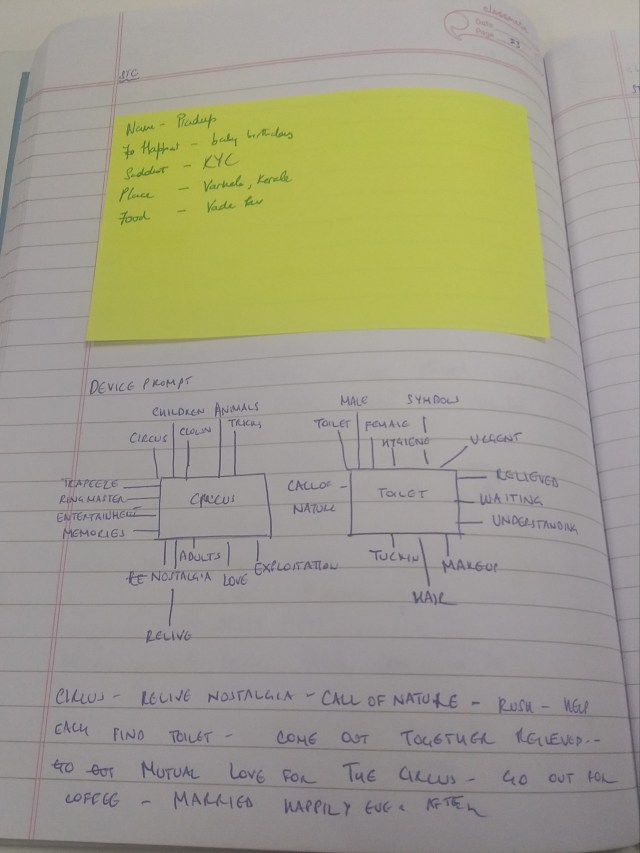
The first session had all of us (about 37 of us) introduce ourselves with our name, favourite food, favourite place, happiest moment of our life and the saddest moment of our life.
While I shared the above information openly, the second session took my saddest moment and tore it apart. In Hemant’s defence, he asked for my permission on whether he could take this apart publicly in class. He also said that he would also try and help me to find closure on this life event. People in the room were encouraged to see the moment through various lens (sarcastic, best case or positive scenarios, negative scenarios like imagining a dead man as a bad man etc). The idea was to openly map everything about the event in details unbiased or with little of my own bias of this experience using something akin to a mind-map.
I did not know while agreeing to this that I would be submitting myself to relive the event through such excruciating detail. While for others this was merely an event, for me it was a lived experience. They were trying to come up with all the factors that led up to the event as a story. Hemant asked us to present the story as is without judgement. He said the audience would judge and that we need not judge on behalf of the audience. I can’t say this gave me closure. It disturbed me a bit and took me a nice lunch in the company of friends to find my balance again.
Answers I gave from the first and third session of the Learning Session on Storytelling. Image: Pradeep Mohandas
The third session used device prompts. We were divided into teams of six. We were given photographs as device prompts. We were given two photographs – one of a circus and another of a toilet sign. We were asked to prepare mind maps like we had for the second session. We were then asked to outline a story based on the same.
In the photo above, I’ve shared answers I gave on the first session and the mind map and the story outline I created for the third session. I will flesh out the story here in a future blog post.
Shri Krishna Jayanthi is celebrated as the day when Krishna was born. This falls on the day of Rohini Nakshatram in the month of Chingam, as per the Malayalam calendar. This fell on August 23, 2019.
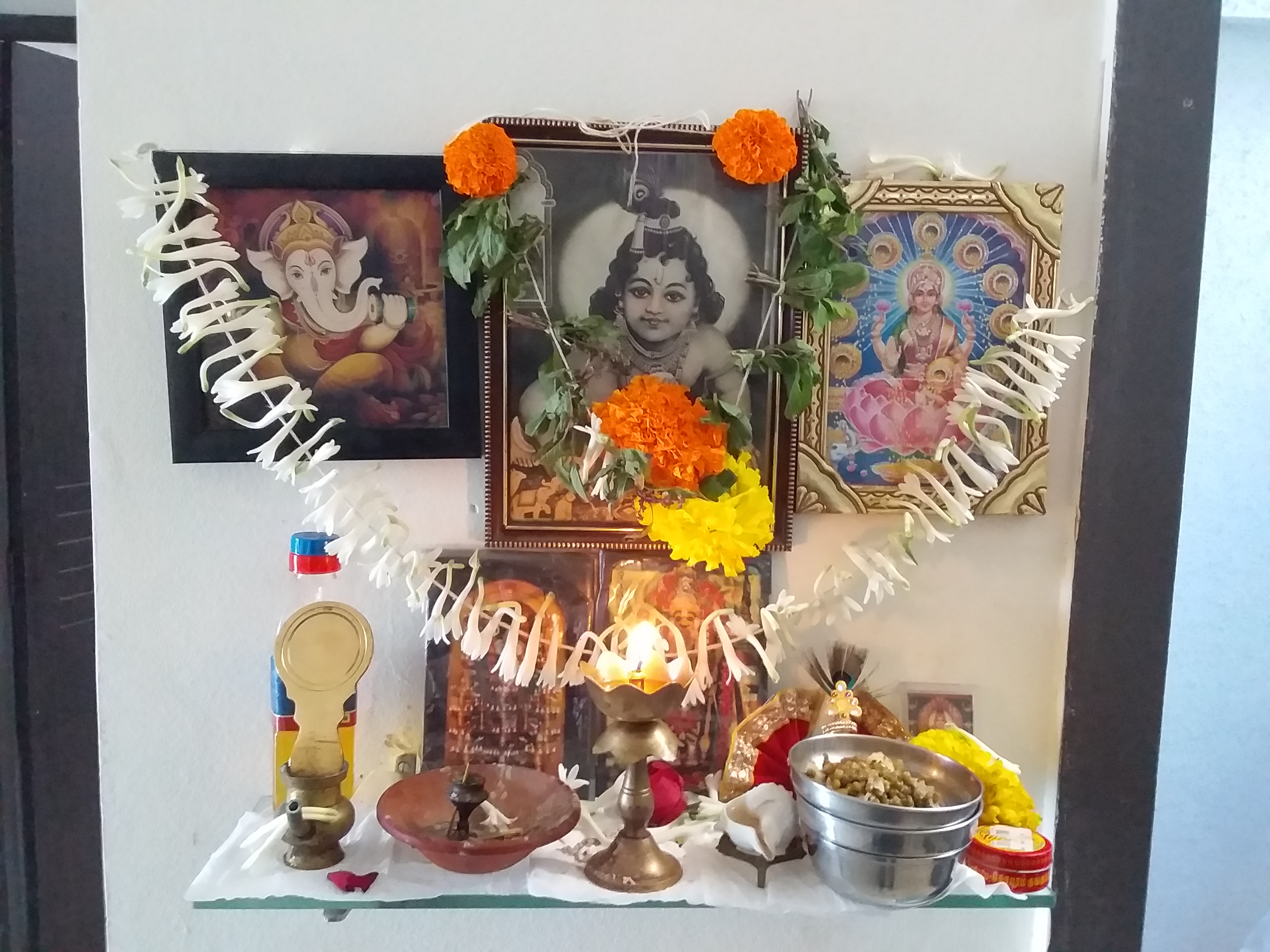
We celebrate this day by decorating the pooja room, undertake fasts, offer Prasad like Appam and Palpayasam , chant the Vishnu Sahasranamam and play devotional songs. Shri Krishna Jayanthi is also known as Ashtami-Rohini, Janmashtami or Gokulashtami.
Our pooja place decorated for Shri Krishna Jayanthi. Credit: Pradeep Mohandas
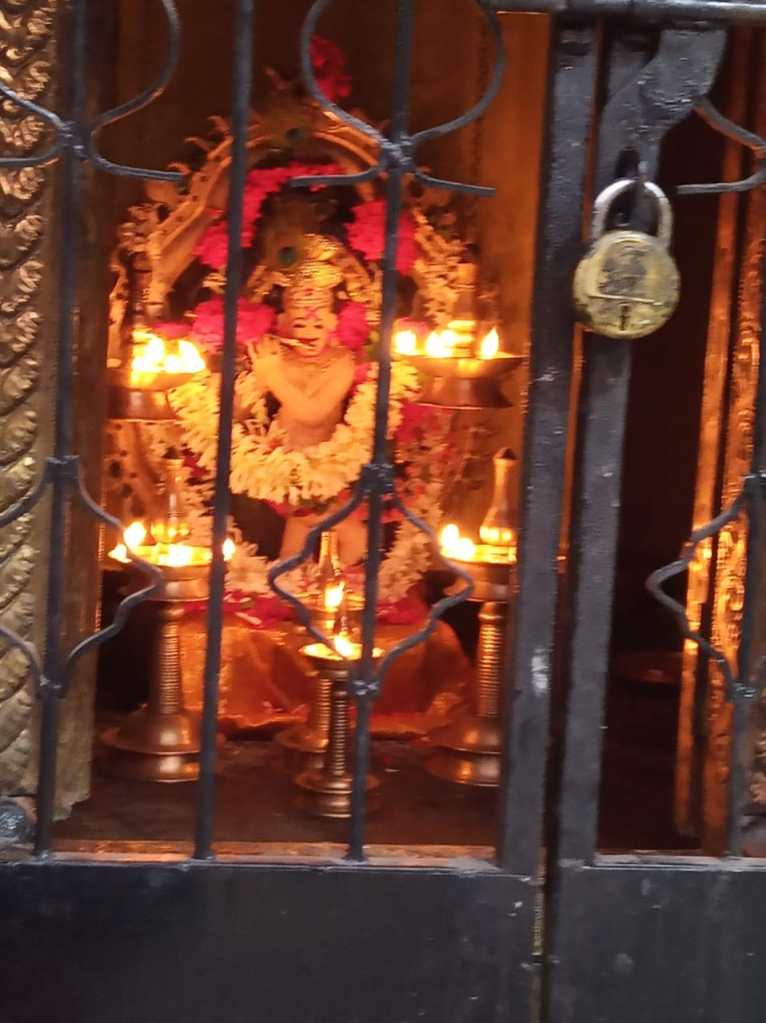
It was a working day for Pradeep ettan. After he returned from office, we went together to visit the Ayyappan temple at Dhanori. The statue of Krishna was beautifully decorated with sandalwood.
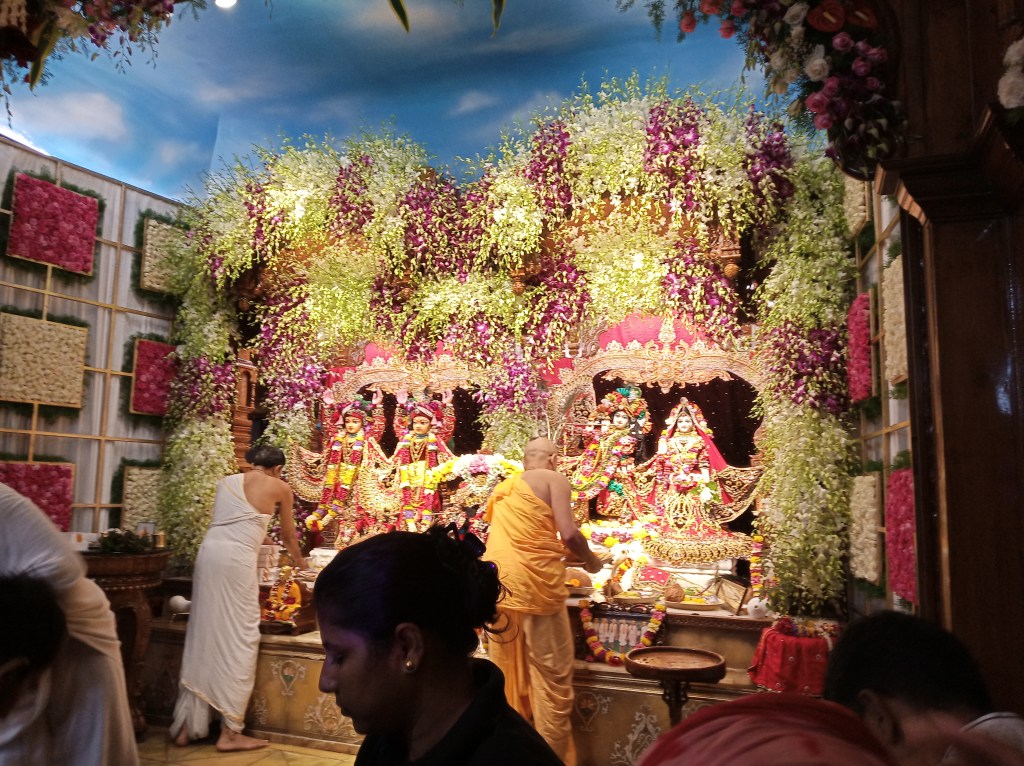
The Sanctum Sanctorum at the Ayyappa Temple, Dhanori, Pune. Credit: Dhanya VallatSanctum Sanctorum of the ISKCON Temple, Camp, Pune. Credit: Dhanya Vallat
From
there we went to the ISKCON temple in Camp, Pune. The temple had created a
carnival like atmosphere and depicted the life of Krishna in life size
displays. The statue and sanctum sanctorum was beautifully decorated with
colourful flowers.

 Parallel Spirals