Tag: Space

  • Week 43/2025

    I used to write my Weekly Notes in a structured way, tracking my reading and writing progress. This time, I want to write it in a more free-form style, similar to how I did for Week 42.

    My parents visited and took the kids to Mumbai during the Diwali holidays. It was our first time home alone. You might expect us to get a lot done without the kids, but we mostly just relaxed and did nothing special.

    We watched three movies – Coolie (Tamil), Ronth (Malayalam), and Greater Kalesh (Hindi) on OTT. I started reading Kurashi at Home by Marie Kondo (which I could not find in her publications list on Wikipedia) and Make Epic Money by Ankur Warikoo. I listened to The Art of Spending Money by Morgan Housel and I Will Teach You to be Rich by Ramit Sethi. I did not finish any of the books I started and left them all unfinished. I am spending my time recovering from surgery watching Countdown and Lazarus.

    I am disappointed with my recent book choices. I didn’t read Between Worlds, which I wanted to. I read more on my mobile than anywhere else. Between Worlds is just sitting on my shelf after I read the first two chapters.

    I have been following several accounts on X that focus on manufacturing in India. While there are traditional manufacturing companies, these new-age creators showcase impressive manufacturing processes through engaging videos. We imagined these processes in our heads. I will share a few videos in another blog post.

    It was interesting to see how India’s manufacturing limits its space program and how ISRO built up its capabilities, helping the program grow. This serves as a useful model for other sectors in India. For instance, the Semi Conductor Laboratory (SCL) in Chandigarh could apply this approach to build the capability of the Indian semiconductor industry, leveraging SCL’s experience being an ISRO Center.


  • If ISRO is Batman…

    Chethan Kumar wrote a blog post for the Times of India titled, Trading frugal cape for tech-filled batcave, Isro must be Batman!

    In his post, he suggests that ISRO needs to become Batman, because:

    Because unlike most superheroes, Batman possesses no innate powers or alien technology. His strength comes from intellect, strategy, and a secret lair filled with gear he developed himself. He transformed through gadgets, resilience, and vision.

    He suggests ISRO needs a batcave and calls the private industry as Robin. So, I wanted to try and extend the comparisons.

    I think the Indian Government (Central or State) can be Alfred. The Wikipedia page on Alfred says:

    Alfred is depicted as Batman’s meticulous, disciplined, loyal and tireless confidante, butler, legal guardian, best friend, aide-de-camp, …

    I think the Government must play the role of a confidante, best friend, and legal guardian to both Batman and Robin. Robin may need more help in this regard now. Batman has matured a bit in this role now.

    I think NewSpace India Ltd would be the Wayne Corporation. NSIL should ideally play the role of funding for ISRO and private companies. It should ideally play the role of keeping the flywheel of the Indian space programme going. I felt that NSIL was a more natural place to host the INR 1,000 crore Venture Capital Fund than IN-SPACe.

  • Weekly Notes 3/2025

    2173 weekly left. 5 Weekly Notes shipped including this. Yay, etc.

    AI generated image to try and represent this week. I wasn’t this relaxed, though!

    Space Heavy

    This was a very space-heavy week. Most of the week was spent on X and LinkedIn, where these updates are mostly available. I wish it were not so.

    India docked two satellites in orbit, 3 Indian space startups flew to orbit onboard SpaceX’s Falcon 9, Jeff Bezos’ Blue Origin reached orbit, SpaceX’s Starship had a wonderful booster catch and the blow-up of the Ship on the way to orbit.

    I summarize most of the Indian activities in the 65th edition of Pradeep’s Space Newsletter.

    Personal

    This was also a week of doctor visits – for my son and for my wife.

    I missed going to either the Indian Science Festival and the Pune Public Policy Festival. I am planning to go for the Pen Festival.

    I got my driving license renewed after holding it for 20 years. Renewed for 10 more years now.

    Reading

    I am continuing to read these books:

    • Moustache, S Hareesh, Trans. from Malayalam by Jayasree Kalathil (77% completed)
    • The Notebook, A History of Thinking on Paper, Rolland Allen (37% completed)

    I also enjoyed reading these links:

    Watching

    I only watched Asura this week on Netflix. I need to write about it here on the blog. This line from the trailer made me choose to watch this, “Girls are like Asura … Asuras are Indian gods. Outwardly, they have virtues like justice, wisdom, and courtesy. Though, they love to slander.” It made me think again about what Asuras really are.

    You may also enjoy watching:

    Writing

    I am so happy with a lot more personal blogging that I did this week.

    Blog posts

    Newsletters

    I got back to writing on Roam Research again.

  • Space, Nuclear and Quantum

    I recently tweeted looking out for people in the civilian nuclear energy space:

    Do share any people you may know about on Twitter. Thanks in advance.

    Space

    India has developed reasonable capabilities in space. It is now embarking on developing a civilian space sector. In the strategic sector, India has developed a Defence Space Agency and Defence Research and Development Organisation (DRDO). It has secured communication and remote sensing capabilities.

    The importance of the space sector is to continue reliable communication, navigation and remote sensing capabilities without having to depend on foreign countries. It is also to build and develop products and services in India that can be provided to the world at competitive prices.

    I think we may be late on this path but we are on the right path with respect to space.

    Nuclear

    India needs to grow. India needs energy for this growth. Meeting these energy needs using hydrocarbons is not sustainable.

    I think nuclear will form a large percentage of sustainable energy production in the country.

    Quantum

    Quantum is important for research and computing today. But, in the future, there will be quantum computers that will need Indian expertise to operate and program.


    My understanding of Quantum and Nuclear is limited. I have not been watching these fields as closely as I have watched Space. What I have listed above are my assumptions. This is the starting point for my thinking about these fields.

  • Cargo (2019)

    A spacey afterlife, I had tweeted after I first saw the trailer of Cargo on YouTube.

    Netflix trailer for Cargo

    I have had a love affair with space since I was a teenager. But, I wasn’t the brave type of fellow who would enjoy being strapped to a rocket. So, I had settled for dreams of being an engineer on Earth who sent people out into space. If forced to leave Earth, I would definitely not be in the first few flights off Earth.

    The only way for me to access space in those teenage years through the pages of a science fiction book. I have recently started reading Indian science fiction again by reading Gautam Bhatia’s The Wall. I thought this was a movie I could watch as part of that project.

    Going to space after death! People seem to be going to and from the spacecraft without rockets. But, I wonder if the fear of sitting on a rocket will play a role after you die.

    Death is a great segue to spirituality, my other interest. Hinduism views death as the first step in the reincarnation process. One dies. Then, one is re-born. The idea is to break this cycle of life, death and re-birth. My personal reading in spirituality has been centered around the Upanishads. I see them as a mental model to answer some of the difficult questions I have till science gives us more concrete answers.

    Cargo combines space and death in a very innovative way.

    References

    As I watched the movie, I was looking up the movie on Wikipedia and Google to understand more of the space and spirituality references the movie uses. What follows are the ones that I found.

    The connection to bulls as the mount used by Yama, the Hindu god of death is the logo for the Post Death Transition Services. It is well branded on the coffee mug that the protagonist uses.

    The spaceship where they ‘transition’ human beings from one life to the next are called Pushpak. Pushpak is the first reference to a vimana in Hindu texts. This is a chariot built by Vishwakarma for Brahma, the Hindu god of creation. This is the vehicle that Ravana later stole from Kubera, the Hindu god of wealth who got it from Brahma. Vishwakarma is the divine architect and god of architects and engineers. Look at how technical and step-by-step the ‘transition’ is. Doff of the hat to Vishwakarma?

    The lead is named Prahasta. Prahasta is the General of the Lankan army and Ravana’s maternal uncle. In the war with Rama, Prahasta is the general of the army leading the first wave. So, Prahasta in the movie, is one of the first six rakshasa-astronauts who fly the first Pushpak?

    Prahasta’s science guy at Ground control is named Raman sir. Doff of the hat to C V Raman?

    My take

    Many of the Upanishads take the question-answer mode between two or multiple people to tackle deep philosophical questions. Many of them have a guru-disciple setting. I think the movie sets the spacecraft as a back drop to have a few question-answer mode between Yuvishka as the student and Prahasta as a guru.

    I would consider everything else being nothing more than setting up the scene for this conversation.

    I am not sure if the human-rakshasa agreement where humans agree to be led by rakshasas is a commentary on the present political climate?

    I think there are more references and hooks that are present in the film that I may not get as I am not a full time movie goer.

  • Black Hole, Beresheet and Block 5

    On the eve of Yuri’s Night of 2019, a bunch of things happened around the letter B. Hence, the title of this post. All had a space connection.

    B for Black Hole

    Scientists from a group of scientists funded by America’s National Science Foundation released the first “image” of a black hole. The image was pieced together (this TED talk by Katie Bouman talks about how) using data collected by radio telescopes from North America, South America, Europe and Antarctica called the Event Horizon Telescope. Vasudevan Mukunth provided a nice background before the announcement on The Wire.


    Scientists have obtained the first image of a black hole, using Event Horizon Telescope observations of the center of the galaxy M87. The image shows a bright ring formed as light bends in the intense gravity around a black hole that is 6.5 billion times more massive than the Sun. This long-sought image provides the strongest evidence to date for the existence of supermassive black holes and opens a new window onto the study of black holes, their event horizons, and gravity. Credit: Event Horizon Telescope Collaboration

    I followed the announcement itself on Twitter. There was also a lot of attention directed at Katie Bouman for her work highlighted in her 2016 TED talk linked above but she was at pains to repeatedly call it the work of her team which is laudable. The South Indian comparison to a medu wada was inevitable I guess. That formed the best tweet during the afterglow of the announcement on Twitter.

    Tweet by @NirujMohan comparing the medu vada with the black hole image.

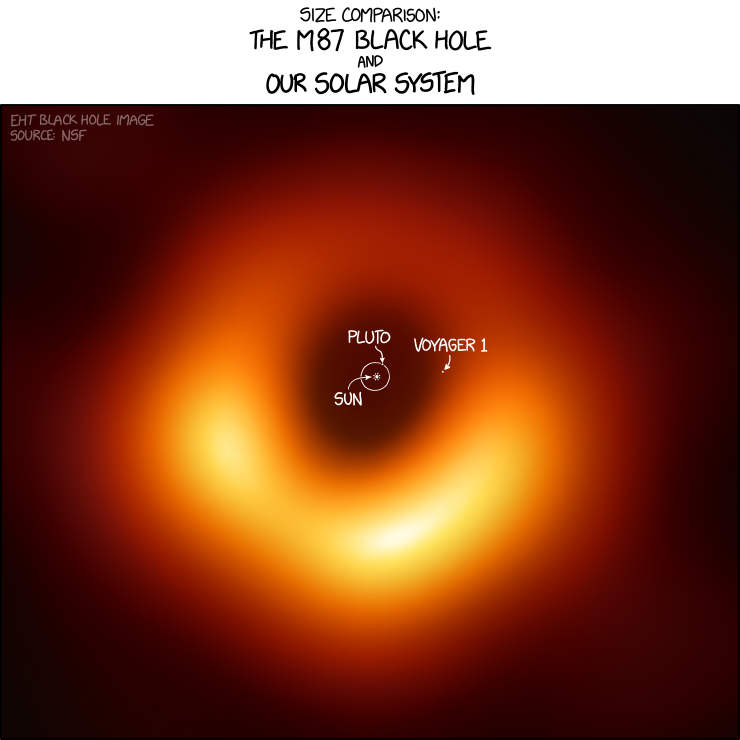
    XKCD also has a lovely cartoon giving a comparison of the imaged M87 galaxy to the size of our solar system that I found a wonderful tool to get the scale of the image. Sandhya Ramesh writing for The Print has a nice rundown of all the stuff shared during the press conference and the 6 papers published for the result.

    XKCD giving a size comparison between the size of our solar system and M87. XKCD notes that perhaps Voyager 1 has just passed the event horizon. Image Credit: XKCD, Randall Munroe.

    B for Beresheet

    A private spacecraft built by SpaceIL had its landing scheduled for April 12 Indian time. SpaceIL was a competitor in the Google Lunar X Prize. However, despite the fact that they could not meet the deadline for the Prize, they went ahead and launched their spacecraft to aim to become the first private spacecraft to soft land on the Moon but ended up becoming the first private spacecraft to hard land on the Moon. A malfunction in the lander’s main engine led to it crashing into the Moon at almost 500 km/hr from a height of 150 meters. So near and yet so far…

    Team Indus was also on it’s way to the Moon being the Indian entry to the Google Lunar X Prize but ISRO cancelled its contract for launching it on the PSLV. They are now trying to revive the launch and perhaps a nice stimulus is the opening of the chance of becoming the first private spacecraft to soft-land on the Moon. ISRO’s own Chandrayaan-2 is on an ever delaying attempt to launch to the Moon with the latest date being being the second half of 2019.

    B is for Block 5

    I cheated a little here to get the B’s in a string. But, this refers to the Block 5 of the Falcon Heavy which took off with a 6 ton Arabsat-6A. The launch was of a Falcon Heavy with an Ariane-V like configuration with one core first stage with two strap-on boosters.

    The focus of the mission seems to have been the launch itself. It is the world’s most powerful rocket. Also, the sights of the twin boosters landing seems to have eclipsed the whole mission. No one is even asking about Arabsat!

    I couldn’t catch the Falcon Heavy launch live but saw it while having breakfast in the morning on the next day. What a lovely day for space!

  • Bidding adieu to Dr A P J Abdul Kalam

    There were three things Kalam stood for me. One was his pioneering effort in developing India’s first launch vehicle, presenting the story of the Indian space programme for me. Second was his creation of realistic visions that are achieveable ergo sometimes controversial. Third was his leadership style that presents a challenge in today’s heavily result oriented market.

    I was introduced to Dr Kalam’s name in a book on the history of Indian space programme as the director of the SLV-3. He suddenly came into prominence when he was elected as the President of India. It was through his book, Wings of Fire that the Indian space programme became to me something more than an academic study. He introduced characters, events, trials and tribulations which made it more human. Compared to earlier texts which read more like a presentation of facts, figures and milestones, he shared the story in a language that any lay man could understand. The experiment, the calculation and every effort made to measure twice and cut once that was involved in the development of the SLV-3 perhaps presented what it meant to the whole nation to have a capability to become a space faring nation.

    As President, he also presented a somewhat rational and more modern version of the vision of India as a developed country by 2020. The economic crisis in 2008 likely dampened the achievement of that vision, but it seems to have been laid by the side by subsequent governments. But, it was not replaced with anything better. No person or government has since sought to present a vision for the country and then work to get a popular consensus to work to achieve it. Since then, the country has had no clear vision on what it means to be a developed country in the 21st century. Our future has since then changed to the whims and fancies of politicians and economists.

    Dr Kalam’s leadership style as presented in his books through anecdotes, is also something that inspired me. We don’t see leaders like those any more. He was one of the first who made a usable website understanding the role the web has to play, with inspirational quotes and quotations, opening up Rashtrapati Bhavan to visits for the common man and challenging the governments of the day to undertake ambitious projects that would work to inspire future generations. Leaders see things that others don’t. In his later days, he spoke of human presence on the Moon and Mars. He pushed ISRO to carry an impact probe on Chandrayaan-1 so that India touched the Moon on its maiden mission. These touch a vision that not many can see.

    The only thing that I can think of doing is dust my old copy of Wings of Fire and read it again and perhaps gain a glimmer of inspiration that could perhaps push me to do something extraordinary. He may have passed away but his mission of making India and the world a better place to live in lives on.

  • ISRO to launch 5 British satellites as its first commercial launch in 2015

    ISRO will launch 5 British Satellites on behalf of Antrix Corporation (which is ISRO’s commercial arm) on board the PSLV-C28 vehicle on July 10, 2015. This is the PSLV’s 30th mission. ISRO will use the PSLV’s Extended Length (XL) variant to launch 1440 kg payload consisting of 5 British satellites into orbit.

    The 5 satellites are the Surrey Satellite Technology Limited’s (SSTL) DMC3 satellites and CNBT-1 satellites and the Surrey Space Center’s DeOrbitSail spacecraft.

    DMC3 satellites

    The DMC stands for the Disaster Management Constellation of 3 satellites built by the SSTL for it’s wholly owned subsidiary, DMCii (DMC International Imaging Ltd) which is executing this project for a Chinese company, 21AT.

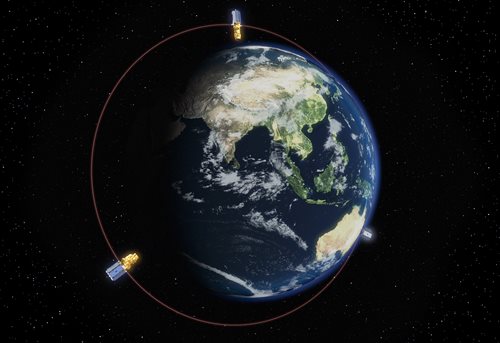
    A visualisation of the orbit and position of each satellite in the DMC constellation. Image Courtesy: SSTL
    A visualisation of the orbit and position of each satellite in the DMC constellation. Image Courtesy: SSTL

    The DMC constellation is a group of 3 small satellites placed in orbit 120 degrees apart, as shown in the image above. The idea is to quickly image areas which have been struck by disaster with high-resolution cameras (1 m resolution) with a capability to provide very fast down link in order to help make the images available quickly in order to assess damage and plan disaster response.

    CBNT-1

    I could not read much about this satellite but it seems that the company that built it, SSTL will share more details after the launch. All that is known for sure right now is that it weighs 91 kg and is a technology demonstrator mission.

    DeOrbitsail

    This is an interesting 7 kg 3U cubesat with dimensions of 10 x 10 x 34 cm. It contains a highly densely packed 4 x 4 meter sail which will be deployed in space in order to increase drag in order to cause the spacecraft to deorbit and return back to Earth. The project is developed by the Surrey Space Center (not the same as SSTL).

    PSLV-C28

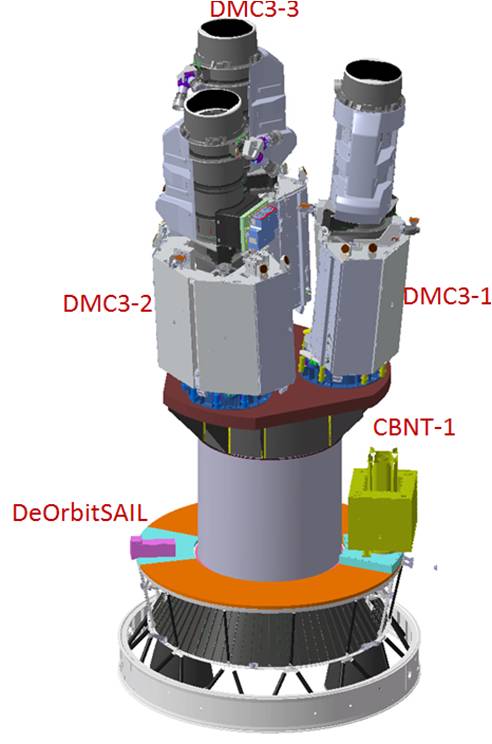
    The Spacecraft mounted on the Launch adapter called the L-adapter. Image Courtesy: ISRO
    The Spacecraft mounted on the Launch adapter called the L-adapter. Image Courtesy: ISRO

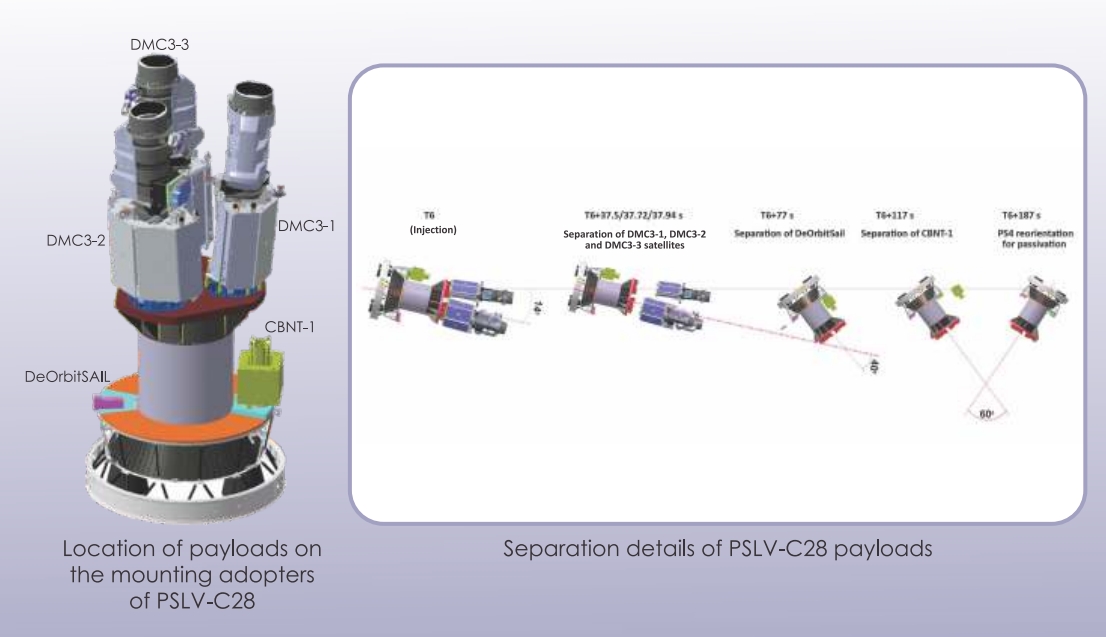
    For ISRO, the challenge begins with the three DMC3 spacecrafts. It had to fit in these 3 satellites each of which has a length of 3 meters into the 3.2 m diameter, 8.9 m long payload fairing of the PSLV-XL. They resolved the issue by changing the launch adapter. A launch adapter is basically a platform on which the satellites are kept and launched from once the last stage of the PSLV reaches the designated orbit and orientation. The vehicle uses a new launch adapter which has a triangular deck and is called the Multiple Satellite Adapter – Version 2 (MSA-V2).

    Illustration of the Multiple Satellite Adapter - Version 2 (MSA-V2) with the satellite mounted and showing the launch of various satellites. Image Courtesy: NasaSpaceflight.com
    Illustration of the Multiple Satellite Adapter – Version 2 (MSA-V2) with the satellite mounted and showing the launch of various satellites. Image Courtesy: NasaSpaceflight.com

    A success now will help cement the PSLV’s record and hopefully bring more business Antrix’s way. This launch shows that even commercial launches can make requirements on a proven launch vehicle that if managed would improve the agility of the variety of satellites that the PSLV is capable of putting into orbit. This agility lowers cost and enables Antrix to reach a wider market to sell launches on the PSLV. Wishing ISRO Godspeed.

  • Mirror Blog

    This blog will have a mirror blog setup by me on Blogger: http://paraspaces.blogspot.com. This is where I used to blog about a year or so ago. I’ve cleaned that up to put more space blog posts. I was considering removing this blog, but later decided to just mirror this blog in that one.