Tag: Space Roadmap 2047

  • India’s Space Roadmap 2047 – Gaganyaan

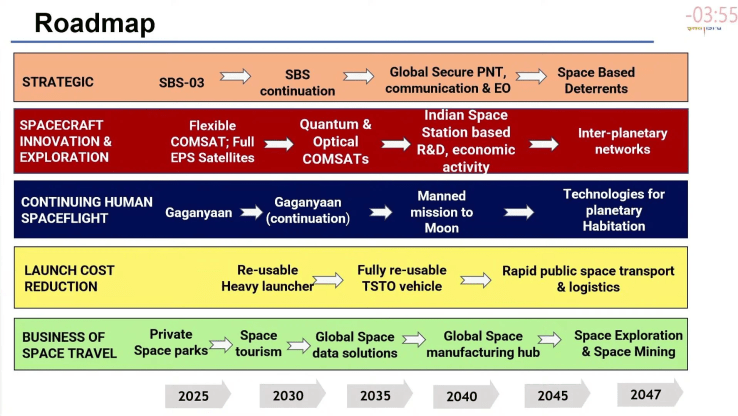
    Today we take a look at the third layer of the Roadmap – Gaganyaan, India’s Human Spaceflight programme.
    ISRO has posted several updates related to various hardware testing of the Gaganyaan components.

    The Gaganyaan missions will initially be unmanned, followed by missions to Low Earth Orbit with the eventual goal of establishing an Indian Space Station.

    The Artemis Accords will pave the way for human missions to the Moon after gaining experience in Low Earth Orbit.

    Technologies for planetary habitation is somewhere in the realm between science fiction and early technology demonstration of these technologies on analog stations on Earth.

    It will require the development of a heavy launcher to send larger structures to Low Earth orbit to build the Indian Space Station and to reduce the time needed (from more than a month to a few days) to send a spacecraft to the Moon. ISRO has a heavy launcher plan on the drawing boards at this stage.

    It will also need to develop a module (similar to the Russian Progress or SpaceX’s Cargo Dragon) that could carry payload to the Indian Space Station or even the Artemis Gateway.

  • India’s Roadmap to Space 2047 – Spacecraft Innovation and Exploration

    I wrote about India’s Roadmap to Space 2047 in an earlier blog post. I wanted to share it without any comments at first, but then I decided to add my thoughts.

    The term “flexible COMSAT” refers to a type of satellite that can change its coverage, bandwidth, and frequency. This technology is being developed by ISRO, as mentioned in a PTI story published on the NDTV website.

    The term “full EPS satellite” is a reference to a type of satellite that uses only electric propulsion systems (EPS). The EPS system was first flown on the South Asia Satellite or GSAT-9, launched in 2017. The note says that this would reduce the mass of satellite from approximately 6 ton to 4 ton for the same capability.

    Quantum and Optical COMSATs are in various stages of development. Urbasi Sinha and her team in QuIC lab, Raman Research Institute, Bengaluru and an ISRO team at the Space Applications Center (SAC) are working on the building blocks of quantum satellites. The first optical communication payload was carried on the GSAT-29 mission.

    The Indian Space Station based R&D and economic activity is at least a decade into the future. Vellon Space, an Indian startup has been talking about space-age medicine and pharmaceutical manufacturing in space.

    Inter-planetary networks hold immense potential for the future of humanity! Imagine a world where communication seamlessly spans across celestial bodies, connecting Earth with other planets. The vision of becoming a multi-planet species becomes more tangible as these networks evolve. It all starts with the Earth-Moon system, but the possibilities for expansion are limitless. With initiatives like Artemis and the International Lunar Research Station, we are paving the way for a future where inter-planetary communication becomes a reality!

    ISRO may not focus as much on Earth observation satellites because there are many Indian space companies (Pixxel, SatSure, Dhruva etc.) working on remote sensing capabilities. They may continue with Earth observation missions until the startups can offer similar levels of data. On the other hand, there are fewer startups in the field of communications satellites technologies. The only one that comes to mind is Astrome among the NewSpace companies.