My family and I drove to Morgaon on 4 January 2026. It was the first long drive I undertook after the operation in the second week of December. It was a two-hour drive one-way.
The drive to the temple was on mostly good roads except for a stretch between Hadapsar and a little beyond Phursungi. After that the roads were good and mostly empty. We made a stop at Kamat’s at Khalad on NH 965 for tea and our bathroom break.
We didn’t make any stops on the way back. We stopped after we crossed Magarpatta to snack on some makhana.
I first heard about Mayureshwar Temple associated with the Ashtavinayak pilgrimage circuit. It is the starting and ending temple to visit on that circuit. There are some fascinating myths associated with the temple.
The temple was really well planned. It had good parking space, not too many heckling commercial establishments, and really well kept temple surroundings. We had a good darshan after a small waiting time. I found it hard to pray though the darshan was relaxed.
I did not notice too much on this journey because I was really focussed on driving and my own driving comfort.
Addendum: 16 January 2026
I watched this post on Instagram that gives the story of Khandoba at Jejuri. This is near Mayureshwar. While standing in line, we saw several people who seemed bathed in turmeric and we were curious to learn more.
Wishing you a Happy New Year! I got a lot of recommendations and book gifts (mentioned below in the Reading section).
Reading
The Great Indian Retreat – Reading this is a more tangible form of saying what the Indus Valley Report reports in terms of India and Bharat and the disintermediation happening between them. There are also people like me who seem to be on the faultline moving between them not fully of one or the other.
Consider Phlebas by Iain M Banks – I’m listening to this on Audible. I’m 79% through this book.
The Artist’s Way by Julia Cameron – I’m doing the exercise given in The Artist’s Way along with a group of people who are in the Clear Writing Community. I’m 12% through this book.
On the Banks of Mayyazhi by M Mukundan, Translated by Gita Krishnakutty – I’m reading this as a part of The Purple Pencil Project Book Club.
The Blaft Book of Anti-Caste SF – This book was gifted to me by Diljeet Singh Narwal of Pineapple Elaichi Book Club as a Secret Santa gift for me even though I couldn’t participate in their Secret Santa. Thank you, Diljeet and PEBC!
When Privilege Pretends to be Economics by Vivek Kaul on newslaundry – Zomato and Blinkit gig workers went on strike on 31 December 2025. Deepinder Goyal of Eternal wrote a post on X. There were many counter-arguments of what Goyal wrote but this is what I thought was one of the best counter-arguments I read, as on date.
The TIFR website has information about the Kalyan Radio Telescope including pictures. The site was near the now-abandoned Kalyan airstrip.https://t.co/Sumr9UJ8uyhttps://t.co/yHncODy8zL
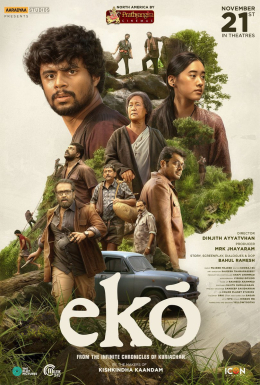
I spent the hours leading up to the New Year’s watching eko which dropped on Netflix. We watched together as a family. I really enjoyed watching this finale of the Animal trilogy.
The story telling with a twist in the tale reminiscent of Jeffrey Archer who wrote a book of short stories with that name. Doing that with three stories on television/theatre is difficult.
Eko serves as the third and final instalment of Bahul Ramesh’s Animal Trilogy, following Kishkindha Kaandam (2024) and Kerala Crime Files 2 (2025).
I recently needed to read about movies to understand the story better after just one viewing. I didn’t have the energy to watch them again to discover these hidden layers. I even overlooked some details when reading about them. That’s when I found the explanations on The Pirate Explains YouTube channel helpful.
The first video from the channel is about the questions you may have had you watched the movie only once. I would warn you against watching this video unless you have watched the movie at least once.
The same channel had another video that fixes the timeline in the movie for you, but I didn’t think that was that much of a value add.
Sometimes protection and restriction, both look the same. This is the thought with which Bahul Ramesh wrote eko. I enjoyed learning about his intuitive writing of the first draft in this interview with Baradwaj Rangan.
He has a really unique storywriting process. Dialogue, Screenplay, and Story.
But, eventually, this means that I can’t post a review immediately after watching it.
This post is usually meant for weekly posts. However, as we move towards the end of the year, there is an itch to talk about the whole year as well. I hope I can keep the itch aside after one sentence.
2025 was a very inconsistent year for me. Week 52 was not so. I got a lot of writing done at work.
Social Media consumption
I have increased my time spent on Substack, Facebook, Instagram, Mastodon and X. I wanted to reduce my time spend on X, but most of my space reading and breaking news happens here. This is important to me because I plan to start writing Pradeep’s Space Newsletter again.
Substack is getting better. But, I only see Venkatesh Rao use all of Substack features (Notes, Chat, besides the newsletter) fully. This is what I am aspiring to do. I tried to do that this week but quite unsuccessfully.
I have started getting tired of YouTube.
I want to try doing something like what Winnie Lim suggests here:
The influence social media had on me was not overt – it was not as if I felt compelled to scroll something or I would feel twitchy, but rather it gave me an easy way out whenever I was bored and wanted to be engaged. It just felt shallow, and I seem to be at a point of my life when I wanted something more out of myself. I don’t really know what is that something I am searching for.
I too am at a point in my life when I want something more out of myself.
Writing
I have seen Doc Searls get back to writing blog posts like he does since Wordland launched. He writes about this here:
My original blog was a mix of both. But my writing streams branched when I started blogging here using WordPress in 2007. Social media was taking off, and writers began using Twitter, Facebook, Linkedin, and the rest for publishing short stuff. In the midst, tweet became a verb. So my long stuff stayed here, while the short stuff went out on platforms.
What I’m doing now with Wordland is shifting my short-burst bloggings from social media platforms that are not mine to this blog, which is mine: going from dependence to independence. Dave, father of Wordland and much else, is leading that shift, and I advise paying attention to what he’s writing and doing.
I want to try doing that here.
Rohini writes on social media (mostly, Mastodon) and she compiles them on her blog. That is another approach that I find appealing.
Reading
Kathleen Gough and Kerala: Maddy writes about anthropologist Kathleen Gough who studied in Kerala around the 1950s and wrote about Nair kinship and matrilineal families.
Black Gold, Green Future: Abhed Manocha writes this wonderful Substack post on the Oilfields (Regulation and Development) Amendment Act, 2025. He explains how this changes India’s focus from a licensing mindset to a focus on strategic energy security and Ease of Doing Business mindset. [My LinkedIn post on the same.]
The writer Vinod Kumar Shukla and actor Sreenivasan passed away this week. I read many of their obituaries (one in the Indian Express and one in the newsminute). I also consumed many of them on Instagram.
Chop Wood, Carry Water by Andrew Taggart: A look at karma yoga at a time when karma mostly has just mundane tasks. It is a short book with a lot of wisdom packed in its pages. It can be read easily but its a really hard re-think and do.
Consider Phlebas by Iain M Banks: I am listening to this on Audible. I am about 57% done in the book. I am reading it again after reading them while still in school.
Watching
These three videos from India in Pictures talk about the three of the four Vedas, their practical application and how the geographical setup in which they were written.
I started listening to the sermons of Sharath A Haridasan in Malayalam after my first hospitalization of 2025. I had dropped listening to it after my second hospitalization. I picked it up again after the third hospitalization. This one talks about kavu and kshetrams and the difference between the two. He also talks about how the practices of worship are getting standardized.
This is a very good podcast interview talking about contrarian investing in India. He says, “The detachment to money helps you to make money.” He says that the issue he has is selling too early. He says he overcame this with the idea of substitution. He doesn’t sell something until he has a better opportunity that he wants to buy before he sells.
India replaced 29 labour codes into 4 labour codes. This video in Hindi talks about how it impacts you.
I started this week with a plan to get a lot of things done. Life, had other plans. It dropped me in the Hospital for the third time this year. I was discharged on Friday.
Unlike my other Hospital stays this year, this one was marked by an absence of phones and a lot of time spent staring at ceilings. I thought I would read some books but I got nothing done.
It’s good to be back home and able to write, even on a mobile device. Not yet back to 100%.
I missed many events in Pune that I had hoped to attend. I wanted to take my daughter to see and meet the Pune urban sketchers community and also see some of the stationary they had on offer.
I have been thinking of using mostly Instagram, Facebook, Substack and Mastodon through most of next year. I am not thinking of it as a rule.
I got a lot of work done in the past two weeks. But, I had recurrent health scares that kept me away from writing. This weekend I was really busy with several home improvement works. Hence, the delayed post here. But, better late than never, as had been the case in the last few weeks.
I am currently reading Oh, Life Relax Please by Swami Sukhabodhananda and listening to Consider Phlebas by Iain M Banks. I went to the library after a long time. I donated Jatan Mehta’s book Seven uni verses among several other books to the public library here. There are many more books that I plan to give away.
I also attended my first in-person event in a long time. The talk was on geology of the Himalayas by Suvrat Kher. I have been reading his blog, Rapid Uplift for a really long time. His latest blog post, Landscapes: PIndari Glacier Trail formed a part of the talk. I also had the chance to meet some of my friends there, whom I had missed meeting because of the surgeries.
I started reading blog posts on Readwise again. I have also removed X, Mastodon, and Instagram apps on the phone.
We used to listen to Kantha soon after our marriage. It was on our playlist. We used to also listen to this song along with Aalayal Thara Venam also by Masala Coffee.
The song went off our playlist for a while as the kinds of songs we heard changed over the years. The Hindi-speaking world was introduced to this song in 2021 through the Dice media series, Little Things in Season 4.
The recent resurgence of the song on Instagram was with a viral dance video nicely choreogragraphed by Alexander Noel. There are various spin-off versions of the dance steps you would have seen on your Instagram feed (if you’re addicted).
I have been unhappy with 2025 and want to make the most of the year. I’m planning to rewrite a novel I drafted last year for NaNoWriMo. I envision it as a solarpunk story. You can find the previous version of Chapter 1 here. I have changed the storyline based on feedback from last year.
I used to write my Weekly Notes in a structured way, tracking my reading and writing progress. This time, I want to write it in a more free-form style, similar to how I did for Week 42.
My parents visited and took the kids to Mumbai during the Diwali holidays. It was our first time home alone. You might expect us to get a lot done without the kids, but we mostly just relaxed and did nothing special.
I am disappointed with my recent book choices. I didn’t read Between Worlds, which I wanted to. I read more on my mobile than anywhere else. Between Worlds is just sitting on my shelf after I read the first two chapters.
I have been following several accounts on X that focus on manufacturing in India. While there are traditional manufacturing companies, these new-age creators showcase impressive manufacturing processes through engaging videos. We imagined these processes in our heads. I will share a few videos in another blog post.
It was interesting to see how India’s manufacturing limits its space program and how ISRO built up its capabilities, helping the program grow. This serves as a useful model for other sectors in India. For instance, the Semi Conductor Laboratory (SCL) in Chandigarh could apply this approach to build the capability of the Indian semiconductor industry, leveraging SCL’s experience being an ISRO Center.
 Parallel Spirals