I’ve been spending the last few days on Clubhouse after the app became available on Android. I usually listen to YouTube videos and podcasts. These have two or three people listening at a time. Clubhouse helped me listen to multiple people.
The cultural zeitgeist of the times point towards many Malayalis thronging to Clubhouse. There were a lot more rooms with people talking in Malayalam than English. I started listening to these conversations on Clubhouse. It felt great to listen to others talking in your language.
I found the Malayalee Club, Barcamp Kerala club, Kerala Ohari Vipani (Kerala Stock Exchange) club and even a few car enthusiasts.
Clubhouse only has audio. There is no chat option. Hence, I’ve seen everything from Instagram DMs, WhatsApp groups and Telegram chats being used to share links and pics that people were not able to share on Clubhouse itself. But, I saw people doing their best to not have to use these other platforms. Clubhouse could make content accessible to a group of people who cannot read the written word.
I’ve seen my own behavior mirror my behavior offline and other online fora. I’m mostly a lurker and a listener. In the first week or so, I spent close to 18-20 hours. It helped that D was away at her parent’s place. When she got back, I limited it to working hours. I have seen people use music during working hours but I feel listening to people who talk helps me better than music does.
I guess listening people talk gives me the experience of being in office. You catch snippets of what people say. It gives me a connect unlike anything I have experienced. It helps me focus on work better.
There are a lot of music related rooms which has people playing many kinds of music (lo-fi is the most popular) and has people singing if that is the kind of thing you are into.
Things are not all that rosy, though. Being on Clubhouse has destroyed all of my other information consumption patterns. I had stopped going on Twitter, listening to podcasts and reading my books. I am slowly getting back on track. But, the going has been slow and hard.
It was after listening to the talks of Swami Boddhananda when I wondered if Hinduism is to be practiced in a particular lineage. That is, if to practice Hinduism, one has to select from among the darsanas.
It was then that I rediscovered Devdutt Pattanaik when he was interviewed in Hindi by Ranveer Allahbadia.
The screenshot is unfortunate and misleading. Pattanaik actually is against Hindutva and is often trolled for his statements. He goes on, nevertheless. This video led me to his channel where I watched many of his videos. This was followed by many videos with him suggested by the YouTube algorithm. He does not claim to be a guru nor does he accept any guru. He says that he consumes information and then write books and then you can take from it what you want.
I enjoy listening to and reading his 21st century interpretation of an ancient idea or way of life. The notes below are not only from the video above. These notes also get information from other videos of his posted on his channel.
He says Western scholars interpreted myths as untrue stories in the 19th century. The present thinking is trying to put myths into the realm of history but he would like myths to be interpreted in the 21st centuries as believed stories. These stories are believed to be true. It’s characters are alive not just in history but are alive today and will be alive in the future.
In one particular video, he mentions that Hinduism is to be practiced just like having a thali. A little bit of karma yoga, a little bit of njana yoga and a little bit of bhakti yog mixed in a proportion as per your liking. No one can say that the way you practice is wrong, just the way no one criticizes you for the way you eat.
He says Hindu thinking is cyclical. Hence, the concept of karma. Abrahamic traditions have the concept of justice because their thinking is linear. So, things can move from injustice to justice. Hindu thinking believes things are as they were, will be as they are and will remain as they are. As they say, some things just don’t change and only the characters change. Hence Indian gods smile when injustices occur because they are compassionate to the doer who is performing these actions trapped by his own ego and misunderstanding of his situation. The concept of karma necessitates belief in the concept of rebirths.
The other thinking he argues against is the difference between Hinduism and Buddhism. Buddhism looks at the world as filled with suffering caused by desire. Hence, they call for a rejection of desire. He says that this is a rejection of the real for the theoretical. He says Hinduism looks at suffering akin to hunger. So, the solutions to suffering is not rejection but trying to feed the hunger.
I had read from his book, Myth/Mithya about yajna being an exchange. His thinking on this has solidified now. He says the translation of jajna as sacrifice by Western scholars was due to their limited understanding. Hinduism sees yajna as an exchange. We give to get (as against give and take). The West sees exchange as a sort of commercialization of a spiritual practice. Hence, they translated as sacrifice which is giving without expecting anything in exchange. But, really, if we do not get, how can we give? We take from nature and give to others, as if we are doing something noble. The equation changes in the yajna where we give to get.
He has worked with corporations like Future Group and Reliance. He claims that businesses in India must not look to scale but to diversify. Allow each person to have a unique experience just like Hinduism offers. He says this diversity will bring profits in India. He says that no country can manage diversity the way India can. Europe and the US finds it challenging even with a few refugees.
Ranveer, in the video above, gets really good guests but asks really poor questions. He asked the standard how India can become a country like China and Korea. Pattanaik says that China can only live within walls. He quotes the Great Wall of China and Great Firewall of China as examples. China grows on obedience and conformity. Such a process would not work in India. We are also hence less likely to give up our freedom in conformity to a King or a ruler. He says that the Chinese do not understand India. He says one of the words used to describe India is luan which stands for chaos.
We are trying to order this chaos believing that everything cannot be many and needs to be one. We are trying to move from pantheism to monotheism because we think the West is better than us. Pattanaik says that China adopted Taoism and Confucianism, and rejected Western thought. India on the other hand adopted Western thought and rejected Indian thought.
Leo Babauta writes on Zen Habits on being trustable. I found the advice important enough in my relationship to reproduce th advice here in full.
I’m going to give some of the key learnings here:
Do your best to practice keeping your word. That means when you say you’re going to do something, really commit to making that happen. Sometimes that means sacrificing some comfort to make it happen. But make it a top priority, and take it seriously.
When you can’t keep your word, own up to it. Let them know ahead of time if you’re not able to do it. If you messed up, take responsibility and apologize, and let them know what you’ll do going forward to avoid the same mistake repeating. Do what you need to do to fix things.
Breathe deeply and slow down. When we’re jumpy and anxious, they will feel it. When we stand solidly, breathe deeply, and go slower … they feel this as solidity and trustability. As with all of this, it’s a learning process — you’ll have moments of anxiety, but you can learn to breathe deeply even here. You’ll have moments of fidgetyness and jumpiness … but you can learn to slow down even here, with practice.
Create structure for yourself and them. When you are committed to making certain things happen (taking care of the car, getting the groceries, paying the bills) … it will help greatly to have structure, like a schedule with reminders. When will this get taken care of? You might alter the structure, but having a structure for you and those around you helps them to know that things are in order and will be taken care of. Practice creating structure for others when it would serve them (without forcing it on them) — offer a plan, a schedule, a clear decision, an agreement.
When they complain about something you haven’t done … listen. Hold space for their complaint, and instead of taking it personally, see if there’s some way you can help them. But listen first, and get them. Then see what you can do to make it right, to create structure so they can trust it will get done, to clean up any mess you’ve accidentally made. You don’t need to feel blame or shame, but just get them.
Take things seriously. But not too seriously! OK, it’s good to have a sense of humor … but if you dismiss their concerns, or say, “Yeah yeah don’t worry” … they will worry. They can’t trust that you’re going to do your best. Give it your all. Hear their concerns. Make it clear that you’re going to take care of it.
Take full responsibility. Especially when you want to blame them. Instead of pointing the finger … look at what you might have done to contribute to this, or to allow this situation to happen. Have you not been clear? Have you not created an agreement around this? Have you not been acknowledging them for how great they are? Have you not been taking care of things? When you think you shouldn’t have to take on responsibility — that’s when you can take on more.
Take care of yourself. If you can’t take care of yourself, how can you be trusted to take care of them? This means clean up your messes, put things in order, do some basic personal hygiene, take care of your emotions, give yourself rest when you’re feeling stressed or burned out. Being trustable doesn’t mean you have to take on so much that you’re overworked.
Always look for ways to be more trustable. Where have you dropped the ball? Is there something you could do to feel more solid to them? Where have you avoided taking on responsibility? Where have you let things lapse into a mess? This is a continual area of growth. You don’t have to be perfect, but you can continue to grow. For life.
I was reading the Wikipedia page on Hinduism when a link in the section, “External Links” caught my eye. The link lead to an article on Advaita Vedanta Hinduism by Dr. Sangeetha Menon. While I did not read that post, I scrolled down to see that Dr. Menon was from the National Institute for Advanced Sciences, where she leads the NIAS Consciousness Studies Programme.
Scrolling down on her homepage, I found a reference to the Sambodh Foundation and her spiritual guru, Swami Bodhananda. He is from the lineage of Advaita Vedanta. I reached the website of the Sambodh Foundation. It was here under the “Lectures” tab that I found a programme he had done in 2016 in association with Ahmedabad Management Association (AMA). AMA has a centre called Mamta, a Centre for Indian Wisdom for Management. It was Mamta that had organised this event.
The event sought to cover the entire spectrum of Indian philosophy including Buddhism and Jainism. The talk linked above was on Samkhya. I had last year written about my interest in Samkhya.
This post records how I found this video and some of the notes that I took from the video, for my reference. Once you see this video, I am sure you can find the rest of the series on the Sambodh Foundation’s YouTube channel.
Notes from the video:
Nyaya-Vaisheshika is pluralistic – Samkhya was searching for 1.
Kapila is the founder.
3 references available
15th century – Samkhya Sutras (gleamed from other commentaries)
Tattva-samasa – probably a Buddhist work
5th century – Eswara Krishna’s Samkhya Karika (poem) – most authentic.
Important to understand for thought leaders from India today.
2 tattvas (principles) – Prakriti (matter) and Purusha (consciousness)
Samkhyans believed that these two could not be further sub-divided. Their inter-play produces our world.
Swami comments that the artificial intillegence we produce will be without a purusha
24 tattvas – unfoldment of Prakriti
You have to learn to side-step his science references which are not full understanding of a subject or may feel out-dated. Some of his insights are interesting. He also continually almost says Patanjali instead of Samkhyans/Kapila.
Part of the disconnect, I eventually became convinced, comes from the reality that we’ve lost our familiarity with the concept of “thinking” as a concrete and isolatable activity; something that can be prioritized, and trained, and even cherished as a valuable pursuit in its own right.
I write a weekly newsletter on an Indian perspective to space stuff every Thursday. The edition that I sent out last Thursday (March 11) was a space policy edition.
I specifically covered a report tabled in the Rajya Sabha by the Department-related Parliamentary Standing Committee on Science & Technology, Environment, Forests & Climate Change.
Department of Space Organisation Chart. Image: ISRO.
The Standing Committee asked DoS about the role of India’s space agency, Indian Space Research Organisation (ISRO) with the entrance of NewSpace India Ltd. (NSIL). The Department replied stating that missions such as Gaganyaan, Chandrayaan and advanced technology mission would be carried on by ISRO and the rest would go to NSIL. This answer was presented to Parliament in February 2021. The Standing Committee published the report on 8 March 2021.
It is based on this answer that I said in the newsletter that:
This means that ISRO is going through a period of change as it commercializes parts of it’s operations (PSLV, GSLV, SSLV etc.) and focuses on research. This section thus marks a very important turning point in it’s journey. As shared in this PTI story, NSIL also has ambitions of building satellites and payloads. This would mean parts of works done in each center of ISRO will be commercialized and spun-off into NSIL.
Pradeep’s Space Newsletter #20
On 12 March 2021, NSIL held a press conference (NSIL press note). Here, they announced that they are planning to take over ISRO’s fleet of communications and remote sensing satellites.
I must admit I did not see the satellites bit coming. This is no small task. Managing such a fleet of satellites would need the kind of human resources and expertise that is currently only available at ISRO.
Splitting technical and human resources between ISRO and NSIL will be no small task. This is the turning point that I am referring to in the paragraph above.
DoS had put out a request for proposals (RFPs) from the industry to see if any single or a consortium of industries could develop PSLV for NSIL. This process, they claimed during the press conference will take 6 to 8 months.
This leaves the space sector with several players with them not yet knowing what they have to do. There is Indian National Space Promotion and Authorisation Centre (IN-SPACe), Indian Space Research Organisation (ISRO), NewSpace India Ltd. (NSIL), Antrix Corporation, Space Commission and the Department of Space. The Government will have the task of putting them in order to make the sector boom. A difficult task.
Challakere is a town in Karnataka which is roughly 3.5 hour drive North East of Bengaluru. This is a place where a ₹2,700 crore plan to build India’s Human Space Flight Center (HSFC). This was where some of the tests for Chandrayaan 3 are being done.
Tender Notice to clear Bellary Jali
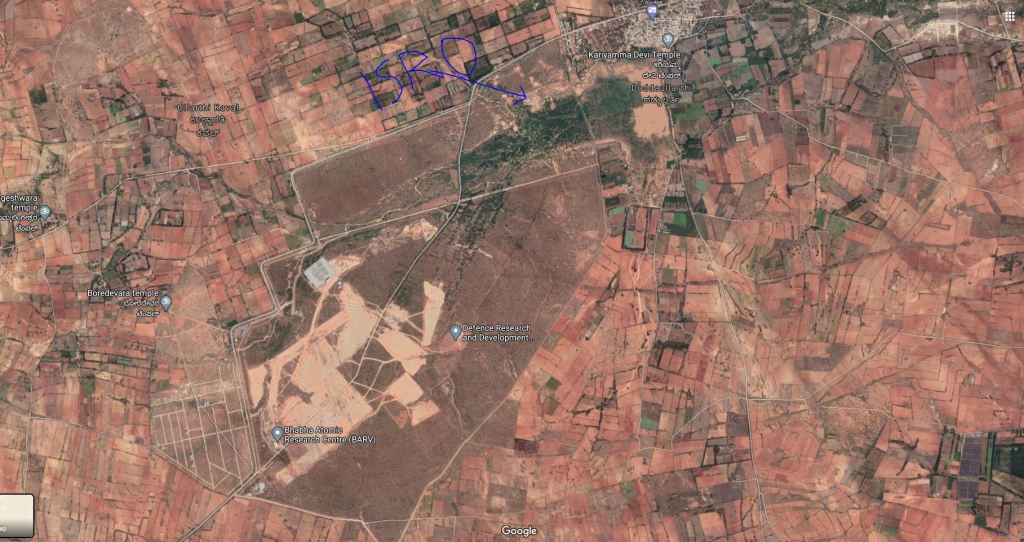
As usual, this news comes not from ISRO but from a tender notice posted on ISRO’s website. Based on this, I looked at the area on Google Maps. I found a few things that I shared on r/ISRO. As is usual, this is not a new discovery.
This is land allocated to ISRO in Science City. Hence, you can see the campuses for Indian Institute of Science (IISc), Defence Research and Development Organisation (DRDO) and even Bhaba Atomic Research Station (BARC).
Marked in blue is the ISRO Land, Chalakkere. Image Credit: Pradeep Mohandas
You can also see the plans that were shared for the construction of this land here. Essentially, the land where we did these tests will be built over by the HSFC.
Chandrayaan-3 tests
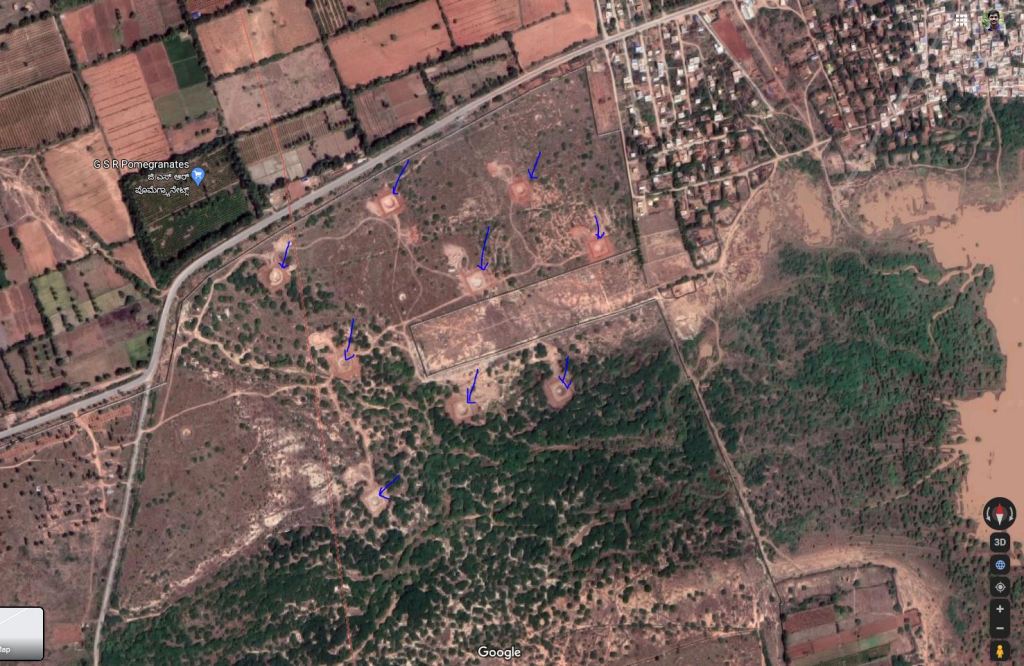
Marked with blue arrows are craters created at ISRO Land where testing was done for Chandrayaan 2 and 3. Image credit: Pradeep Mohandas
These craters are for what are called the Lander Sensor Performance Test (LSPT). LSPT-1 and LSPT-2 were conducted for Chandrayaan-2. The tender is for clearing the green swathes that you see. It is apparently full of a shrub called Bellary Jali which needs to be cleaned up before tests for Chandrayaan-3 can be conducted.
Details of LSPT-1 and LSPT-2 were shared in Upagrah Apr-Jun 2017 issue (archived in Google Docs by u/Ohsin). This is the in-house magazine for U R Rao Satellite Center (URSC).
The test involves flying a Beechcraft Super King Air B-200 belonging to the National Remote Sensing Center (NRSC) over the craters made for the purpose. The plane flew from 500 m to 7 km in altitude to simulate various landing conditions. They also flew early in the morning to get the same lighting conditions as on the landing site on the Moon.
RLV Landing Experiment near Chitradurga
There was mention of a Reusable Launch Vehicle (RLV) Landing Experiment at Chitradurga.
Snippet mentioning the RLV Landing Experiment in the ISRO Annual Report 2020-21.
Interesting term in the picture above is the pseudolite (pseudo-satellite).
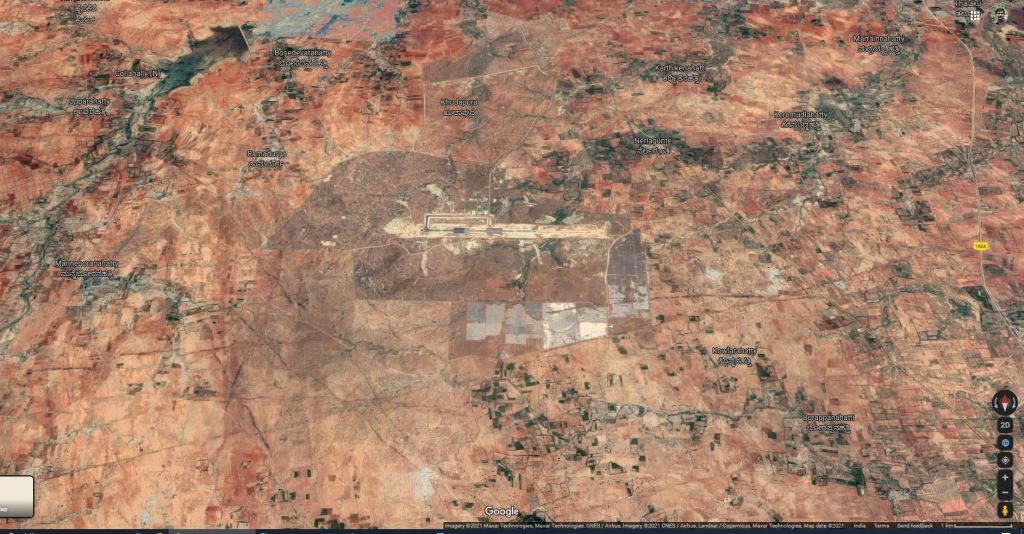
While exploring the surrounding of Challakere, I spotted this, which could be a possible runway to which the RLV will glide and land on.
Possible RLV landing site near Chitradurga – Chitradurga Aeronautical Test Range belonging to the Defence Research and Development Organisation (ATR-DRDO). Image Credit: Pradeep Mohandas
This blog post is a small effort to read documents and share with you the possible rabbit holes. Following them is up to you.
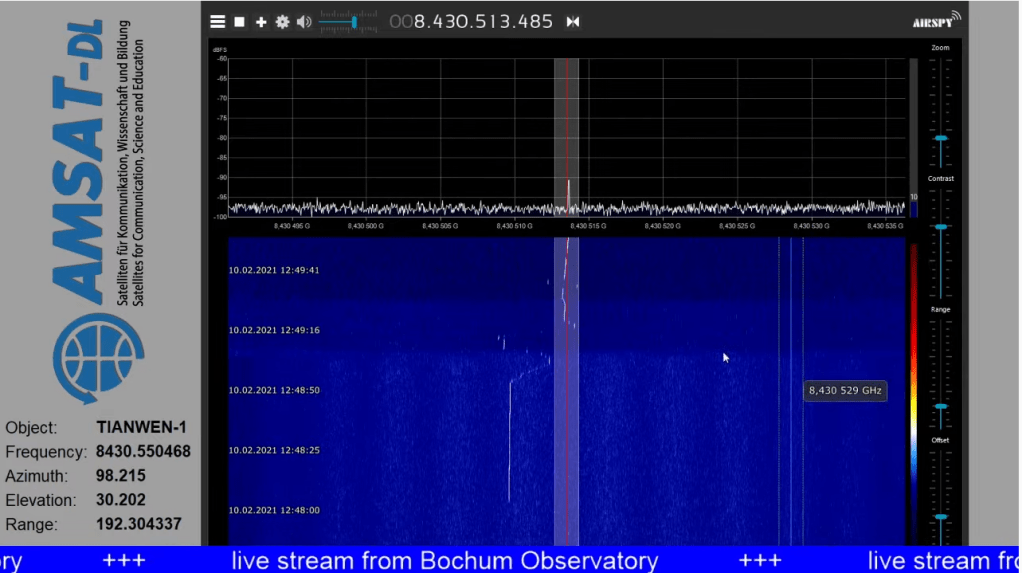
Tianwen-1 is the Chinese spacecraft that went into orbit around Mars on February 10, 2021. There was not going to be a live coverage of the event. Andrew Jones, a journalist tracking the Chinese space program tweeted that AMSAT-DL is covering the event on radio. This is where I followed the event.
Radio output from Tianwen-1 after it emerged from behind Mars. Photo is a screenshot of the AMSAT-DL YouTube live feed
The spacecraft re-emerged from behind Mars. I captured the image above from the live webcast. From the expected time being as expected, it was judged that the spacecraft had reached Mars orbit. Confirmation came from Chinese CCTV4 stating that the orbiter had reached orbit.
The Hope (Al-Amal) was designed, developed and controlled from the Mohammed bin Rashid Space Centre (MBRSC) in Dubai, UAE. It was built by MBRSC with 3 universities in the United States of America (USA), University of Colorado, Boulder, University of California, Berkely and Arizona State University. It was launched on 19 July, 2020 on Japan’s H-IIA launch vehicle. The UAE hopes to setup a human settlement on Mars by 2117.
The UAE went all in with the promotion of the mission.
Besides these promotions, they did a good job with a light show on the Burj Khalifa in the run up to the Mars Orbit Insertion. My favourite part of the show was the slice of Mars shown on the Burj. The light show showed the Emirati scientists involved in the program. They spoke to some of the personnel that worked on the mission. News was shared that more than 37% of their personnel were women. The average age of the personnel was 27.
The first acquisition of signal was at the Deep Space Network at Madrid. As we waited for Hope to emerge from behind Mars, the tension that scientists faced was similar to the tension that would have been faced at any space center anywhere in the world. On display, was a very basic human emotion. Waiting for the results of a mission that one has worked so hard on.
With the mission success, UAE became the 5th country or country group at Mars along with the United States of America, Europe, Russia and India.


 Parallel Spirals