Skyroot Aerospace unveiled the Dhawan 1 cryogenic engine today.
Today, on the occasion of 100th birth anniversary of renowned Indian Rocket Scientist- Dr.Satish Dhawan: Unveiling our fully Cryogenic Rocket Engine 'Dhawan-1':
1. 100% 3D Printed 2. 100% Cryo Propellants – LNG/LoX 3. 100% Made in India
Skyroot Aerospace is a commercial launch vehicle service provider company based in Hyderabad. They hope to build a fleet of three small satellite launch vehicles called Vikram 1, Vikram 2 and Vikram 3. They hope to launch Vikram 1 in December 2021.
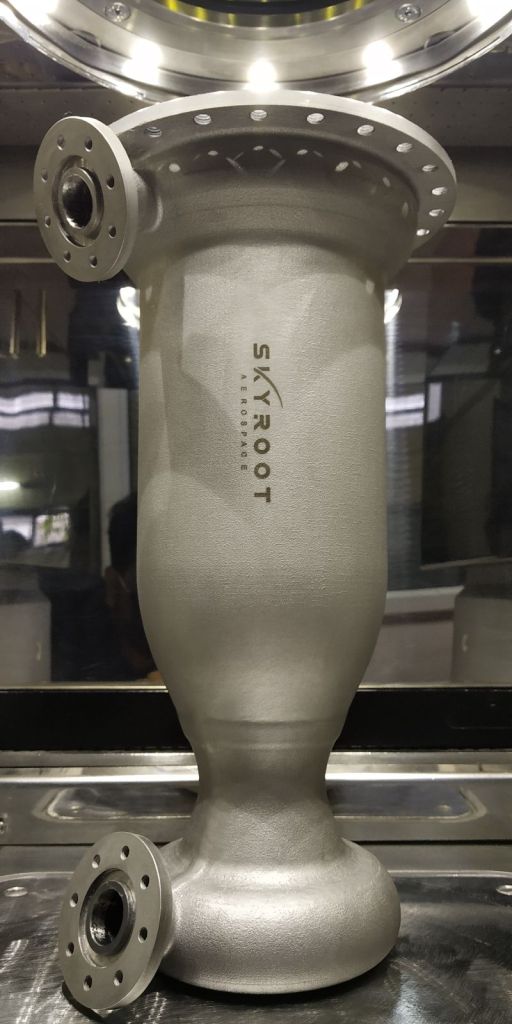
Dhawan 1. Image Credit: Skyroot Aerospace
Dhawan 1 is a cryogenic engine that uses liquefied natural gas (LNG) and liquid oxygen as cryogenic propellants. The company says that their engine is 100% 3D printed in India. This will form the last stage of the Vikram 2 rocket. Vikram 2 is capable of lofting 520 kg to Low Earth Orbit (LEO). Skyroot dedicated the engine to Prof. Satish Dhawan on his birth centenary.
Today is Prof. Satish Dhawan’s birth centenary. He was a fluid dynamics expert who was director of the Indian Institute of Science (IISc), Bengaluru before becoming Chairman, ISRO after the death of Dr. Vikram Sarabhai, the founder of the Indian space program. He is credited with building up India’s communication and remote sensing satellite systems as well as development of India’s workhorse PSLV.
India also has had a tough time working with cryogenic engines. It tried to procure cryogenic engines from Russia. This was blocked by the USA. Following this, India began developing an indigenous cryogenic engine in the 1990s. Following many failures atop the GSLV, it finally became successful only in 2014. ISRO has since developed a stable of cryogenic rocket engines. Given this history, Skyroot’s success is appreciable.
They received a lot of attention in August 2020, when they became the first Indian aerospace company to test their Raman engine. Raman is the upper stage bi-propellant liquid rocket engine used for Vikram 1. Vikram 1 is capable of lofting 315 kg to Low Earth Orbit (LEO). A few days back they also fired the ballistic evaluation model motors of their solid rocket engines. They have shared the videos on their YouTube channel.
Test firing their Raman rocket engine
Firing a scaled down version of their solid fuel engine
I am waiting to watch a static fire test of this cryogenic engine and also the first flight of Vikram 1. Good luck to Skyroot Aerospace.
Despite assurance from cryptocurrency exchange owners in various episodes of Paisa Vaisa, it seems that the news about the ban on trading of cryptocurrency refuses to die down. Following this Bloomberg story, however, I have decided to hit pause on any cryptocurrency investment.
A spacey afterlife, I had tweeted after I first saw the trailer of Cargo on YouTube.
Netflix trailer for Cargo
I have had a love affair with space since I was a teenager. But, I wasn’t the brave type of fellow who would enjoy being strapped to a rocket. So, I had settled for dreams of being an engineer on Earth who sent people out into space. If forced to leave Earth, I would definitely not be in the first few flights off Earth.
The only way for me to access space in those teenage years through the pages of a science fiction book. I have recently started reading Indian science fiction again by reading Gautam Bhatia’s The Wall. I thought this was a movie I could watch as part of that project.
Going to space after death! People seem to be going to and from the spacecraft without rockets. But, I wonder if the fear of sitting on a rocket will play a role after you die.
Death is a great segue to spirituality, my other interest. Hinduism views death as the first step in the reincarnation process. One dies. Then, one is re-born. The idea is to break this cycle of life, death and re-birth. My personal reading in spirituality has been centered around the Upanishads. I see them as a mental model to answer some of the difficult questions I have till science gives us more concrete answers.
Cargo combines space and death in a very innovative way.
References
As I watched the movie, I was looking up the movie on Wikipedia and Google to understand more of the space and spirituality references the movie uses. What follows are the ones that I found.
The connection to bulls as the mount used by Yama, the Hindu god of death is the logo for the Post Death Transition Services. It is well branded on the coffee mug that the protagonist uses.
The spaceship where they ‘transition’ human beings from one life to the next are called Pushpak. Pushpak is the first reference to a vimana in Hindu texts. This is a chariot built by Vishwakarma for Brahma, the Hindu god of creation. This is the vehicle that Ravana later stole from Kubera, the Hindu god of wealth who got it from Brahma. Vishwakarma is the divine architect and god of architects and engineers. Look at how technical and step-by-step the ‘transition’ is. Doff of the hat to Vishwakarma?
The lead is named Prahasta. Prahasta is the General of the Lankan army and Ravana’s maternal uncle. In the war with Rama, Prahasta is the general of the army leading the first wave. So, Prahasta in the movie, is one of the first six rakshasa-astronauts who fly the first Pushpak?
Prahasta’s science guy at Ground control is named Raman sir. Doff of the hat to C V Raman?
My take
Many of the Upanishads take the question-answer mode between two or multiple people to tackle deep philosophical questions. Many of them have a guru-disciple setting. I think the movie sets the spacecraft as a back drop to have a few question-answer mode between Yuvishka as the student and Prahasta as a guru.
I would consider everything else being nothing more than setting up the scene for this conversation.
I am not sure if the human-rakshasa agreement where humans agree to be led by rakshasas is a commentary on the present political climate?
I think there are more references and hooks that are present in the film that I may not get as I am not a full time movie goer.
Arup Dasgupta writes in The Wire Science about the muted Chandrayaan 2 anniversary. This is quite contrary to the claim of the 95% mission success that ISRO spoke of at the time of the loss of lander and rover.
I broadly agree with the point Dasgupta makes in the article but have a few reservations to share.
I think there have been many more publications of results than what Dasgupta claims but they are not centralized at any one place. This has been a pain point with ISRO. I have to depend on r/ISRO for helping me find where ISRO has published this information.
I summarized the findings from Chandrayaan 2 in Issue #3 of Pradeep’s Space Newsletter under the heading Chandrayaan 2 science papers where other than the Current Science articles Dasgupta mentions, there are papers submitted to the Lunar and Planetary Science Conference (LPSC). There may be more or perhaps COVID-19 intervened.
Speculation about the lander-rover, is that more news will be available with images from Chandrayaan 2 when they publish a paper about it. But the silence and reaction from ISRO about the failure of the lander-rover part of the mission has been childish.
Shanmuga Subramanian mentioned in the article above has also been continuing the search for Chandrayaan 2 lander-rover from data obtained from NASA’s Lunar Reconnaisance Orbiter (LRO) from subsequent passes over the crash site. He has also been continuing to search for impact debris of the Moon Impact Probe launched with Chandrayaan 1 in 2008. Talking of Chandrayaan 1, I will be posting here about their finding of rust on the lunar surface.
To end, I like to share VM’s post about why it’s a pain to try and follow what ISRO does. But, part of the love for our space agency is learning about ISRO using any means necessary.
I am thinking of investing a small amount of money in cryptocurrency. For the last three weeks, I have been listening to and reading articles about the situation in India. What follows is my summary.
I had forgotten about cryptocurrencies for the longest time since my initial fascination for it in 2017. The fascination hit me again when I listened to an episode of Paisa Vaisa.
Coldfusion on YouTube has a video about the ways in which the financial system today is using blockchain technology. Cryptocurrency is also built on top of blockchain technology. Some banks are buying cryptocurrency as a hedge against fiat currency while others are using it to save heavily on international transfers.
Blockchain is now mainstream
In 2018, RBI had banned banks from allowing their accounts to be used for purchase or sale of cryptocurrency. Combined with a paper by a Finance Secretary in the Ministry of Finance suggesting that cryptocurrency be banned, the public interpreted this to mean that cryptocurrency was illegal.
In the filings of Berkshire Hathaway, it was disclosed that they had sold banking stocks and had bought shares of a gold mining company. Robert Kiyosaki saw that as Warren Buffet losing confidence in fiat currency (the US dollar) and buying a stake in gold. In a podcast episode, Kiyosaki saw this as a validation of his position and a significant change in the market. He also makes a case for buying bitcoins on his blog, later in the day.
The Indian Rupee is not fully convertible with the US dollar. But, most international currencies are pegged to the dollar. Countries like Iran, China and Russia are trying to introduce their own cryptocurrencies in order to reduce their dependence on the US dollar. It is speculated that various central banks are purchasing cryptocurrency as a way to hedge their own position in the cryptocurrency market. In a globalized world, we could feel the impact at some point in the future. Maybe later than when it occurs elsewhere as our central bank protects the rupee.
People who fought the case in the Supreme Court against RBI’s ban say that the Government has stepped down it’s stance against cryptocurrency from wanting to ban it to wanting to regulate it.
Coindesk, a news organisation that reports on cryptocurrencies does talk about the limitations that India has in terms of cryptocurrencies. Mining or creating cryptocurrency is indirectly banned in India. The computers required to mine cryptocurrency are specific ones called ASIC machines. The import of these machines into India is banned. A few enthusiasts mine cryptocurrency using GPU. The Government further threatened miners by arresting a few of them. It seems that the remaining miners are planing to migrate to countries like Armenia.
The 2020 verdict however meant that cryptocurrency exchanges could now operate in India. This means that you can now buy using cryptocurrency by transferring money from an Indian bank account or a financial service provider. However, there is no regulation of cryptocurrency. Things now are working on good faith between exchanges and consumers who want to purchase cryptocurrency.
The exchanges want SEBI to be their regulator. They are already performing due diligence and complying to KYC requirements as mandated by SEBI. However, payments in cryptocurrency might require RBI regulation.
I do not see myself wanting to use cryptocurrency to make a payment. I wanted to hold the currency as a diversified asset that I can hold or one that I can accumulate over time just like one would hold gold or stocks.
If you are considering purchase of a cryptocurrency, please do not see this as professional advice. I am learning about this field as well. The Coindesk story that I mentioned above, does suggest that there is at least one cryptocurrency advisor whom you may want to consult if you plan to purchase in large amounts.
China, on Friday, launched a space plane into orbit. The launch took place on board the Long March 2F. The payload is called a Reusable Experimental Spacecraft.
I saw little to poor coverage of the mission in Indian media. I wanted to maintain a record here for my personal memory.
The launch was very secretive. There were movements that were caught before the launch by a group of China watchers that alluded to a launch on Friday.
My interest was piqued when Cosmic Penguin tweeted that two Chinese ships were en route to two spots on Earth. One was the northern Arabian Sea and another was off the coast of Uruguay. He tweeted this:
If someone can help with ideas, please do as such a secret mission might be launching very soon, maybe even within a week, if these 2 ships seems to stop by now. Thanks!
They were following the movement of two tracking ships, Yuan Wang 6 and Yuan Wang 3. The Yuan Wang 3 was of interest to me since it seems to be moving towards the northern Arabian Sea off the coast of Pakistan. Cosmic Penguin linked this to a possible launch from the Jiuquan Space Center. He also referenced Notice to Airmen (NOTAMs) that were posted online to suggest a launch time of 6 AM UTC.
Andrew Jones who covers China for Space News shared this picture on Twitter based on date from Europe’s Sentinel satellites. This seemed to show that a Long March 2F was scheduled for lift-off from Jiuquan.
Lots of activity at the launch complex for the CZ-2F at Jiuquan in the past few months. [Modified Copernicus Sentinel data 2019-2020]/Sentinel Hub] pic.twitter.com/Ye16D7DaVO
Long March 2F is a human spaceflight rated launch vehicle that was previously used by China to launch Shenzou and Tiangong, China’s human space vehicles. Hence, there was a lot of interest and curiosity about the launch.
The launch actually happened an hour after NOTAM period ended. China has been known to do this in the past.
Michael Thompson, a satellite hunter based in New Mexico, also suggested that the position of ships could be to see the de-orbit burn and then landing back at Jiuquan.
You can see the Yuan Wang 3’s position in the northern Arabian Sea near the line that the Reusable Experiment spacecraft may use as it goes for landing.
The experiment is expected to test the “reusability technologies”. Comparisons with X-37B operated by the United States Space Force are rife.
I would like to compare it with up and coming missions of the Reusable Launch Vehicle (RLV) whose Technology Demonstrator mission flew in 2016. In the 2016 mission after being launched by a HS9 solid booster rocket from Sriharikota.
The RLV was launched to an altitude of 65 km where it returned to simulate a landing on sea 425 km from Sriharikota. We are waiting for the RLV mission that will land on an airstrip that was expected to be held in 2020 but has been postponed due to COVID-19.
An additional matter of intrigue is provided by the apparent release of an object into orbit by the spacecraft ahead of its deorbit burn. US space surveillance catalogued the new object, designated NORAD ID 46395 (2020-063G COSPAR ID), assigning it to the Long March 2F launch.
The experimental spacecraft orbited in a 331 by 347-kilometer orbit inclined by 50.2 degrees. The new object is in a similarly-inclined 332 by 348-kilometer orbit.
Andrew Jones, Space News
Jones goes on to say that previous missions have launched these small ‘Banxing’ companion satellites.
I moved to Palakkad, my home town from Pune in the second last week of July. We drove our car from Pune to Palakkad. I will write separately about that experience. In this post, I would like to document for posterity the reasons for my decisions.
When we entered lock down in March 2020, my initial expectation was that India was much better off than other countries at that point in time. Hence, my expectation then was that if we stayed put at home, we would be safe. Things would run their course and we might return to normalcy by June, at the latest.
As things unraveled, I realized that this was a much longer journey than I had anticipated. Things could remain unchanged for much longer. Colleagues at office were going to their native place in the months of May and June 2020. So, in June 2020, I decided to go to our native place.
Kerala had instituted a system of granting passes to the people entering the state. My application for travel to Kerala in June 2020 was declined. Many of my colleagues from work who were from Kerala traveled to the state at this time. We resigned ourselves to the fact that we might be stuck in Pune.
My main concern in staying on in Pune was the lack of a support system. If my wife was infected and had to be hospitalized, I was not sure if I would be able to take care of our daughter by myself. I could have got my relatives over but I did not want to complicate things for others for my incompetency.
So, when Unlock 1.0 started, we decided to apply again. Kerala then moved from a pass system to a registration system. Hence, we applied and received a pass on July 21. We started in the morning of July 23 and reached Palakkad in the evening of July 24.
When I first stumble on a blog, I love to read the about me page.
WordPress sent me a notification when Narayan liked a post on my blog. His about me page is one of the most breath-taking page I’ve read in quite a while. I think anything more I write here is just keeping you away from reading that page.
I’ve had a writers block. I could record my podcast this week but couldn’t find anything to write.
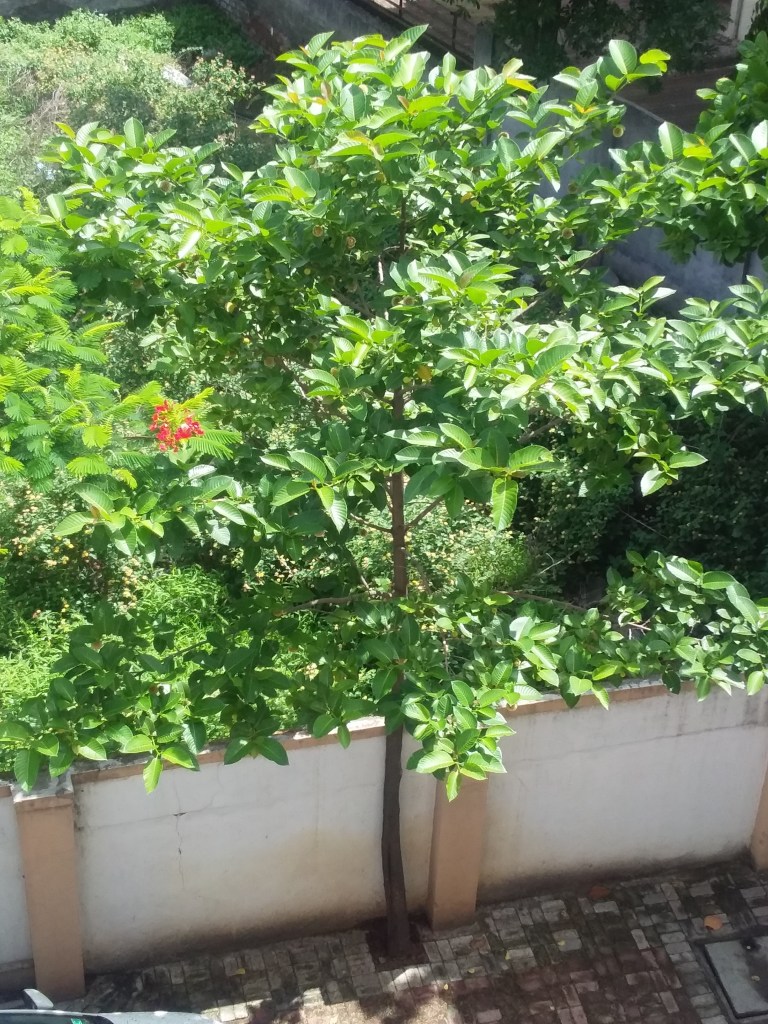
Besides the gulmohar tree in front of my balcony was another tree. My wife who correctly identified the gulmohar could not identify the other correctly. She first thought it was ramphal (wild sweetsop). But, as the tree bore fruit, she confessed to me that it was not ramphal.
The Kadambari tree in our compound. The gulmohar shared earlier can be seen photo bombing. Image Credit: Pradeep Mohandas
Sahil Khan fleeted a picture of the tree on Twitter. I asked him for the identity of the tree and he said it was the kadambari (burflower). So, what we thought of as a fruit was actually it’s flower!
I then read through the Wikipedia entry for the kadambari and I must say my inquisitiveness was piqued. This also led me to the eponymous romantic novel in Sanskrit.
Sharing suggestions for a See, Listen and Read each week so that you can See, Listen and Read better. This week I suggest watching HasGeek TV’s Run, Run, Run, listening to The Seen and The Unseen episode on journalism and reading Leo Babauta’s blog post on taking rest.

 Parallel Spirals