Way back in 2009, I had written an article for CNN-IBN Blog, about ISRO @ 40.
Almost ten years later, I had the opportunity to write for Tech2, the Science and Technology supplement to Firstpost of Network 18. I wrote for them about looking back at 2019 through the two RISAT missions, the ups and downs of the ASAT test, the euphoria of the first successful mission flight of the GSLV Mk III with Chandrayaan 2, the sense of loss we felt when we lost communication with the Vikram lander and the 50th launch of the PSLV. I also covered some of the funds that new private space comapanies (called NewSpace) raised during the year.
I first heard of coffee brewers when I read Mehul’s Twitter update that he was participating in a brewing competition and came in at no 3. Coffee brewing is basically the process of making coffee from the stage of coffee beans to a concoction that you can consume.
Today, we met at The Fat Labrador, a cafe situated in Bavdhan, Pune.
Coffee devices and brewing paraphernalia that we used today. Image Credit: Pradeep Mohandas
This is the second meetup of Pune’s Coffee Brewers Club. We started out with discussing coffee recipes that some of the brewers had arrived at ostensibly after a lot of experimentation with a lot of coffee devices. There was a lot of talk of mgs of coffee, minute-second readings of the time they allowed it to brew and broadly methods by which coffee was brewed (immersion and pour over).
After that introduction, Mehul spoke of the factors that affected a good coffee output: temperature, pressure and time. We then got to try both the methods using a pour over method and an Aeropress.
We tried tasting different beans that Mehul had carried with him from Mumbai. After a few rounds of this, we got to try out an espresso from a hand pressed espresso machine.
Mehul ended the session on how us newcomers could begin getting a glimpse into the world of coffee brewing. He suggested getting the coffee that is freshly roasted (3-4 days old roasted coffee). I was assured that Indian roasters do not usually sell stale coffee. This is to be consumed over the period of next 3-4 weeks for best effect.
He suggested beginning with a simple process of coffee brewing. Get fresh ground coffee put it in a cup of boiling water, let it brew for about 3-4 minutes and then consume. The next step would be to have an aeropress to make the coffee. Aeropress is considered a very versatile, cheap and easy to carry device that does most of the functions that a coffee brewer is looking at and hence quite highly recommended. It comes at a price range of about three to four thousand.
The next step up is getting a simple grinder. Mehul had got his off AliExpress for about INR 900. When we reach a place where we can’t turn the grinder anymore, we reach the zero setting. As we turn, the grinder churns out coarser coffee. If you plan to go ahead, you can invest in better grinders as they turn out more consistent and get control over the size of the coarseness of the coffee beans. Prefer manual over electronics.
The next investment is in a measuring pad. The cheapest one is off Amazon that costs INR 200-300. This helps to measure the amount of coffee beans you take. This too gets complicated with higher price where a timer gets added on which helps you measure brewing time.
The next investment suggested for your upward spiral into the world of coffee brewing is a goose-neck kettle. This is useful to control the way in which water is poured on the ground coffee beans. These comes with insertable thermometers that helps you control the temperature of water that is used for your coffee.
I am not sure whether I am going to personally follow through with coffee brewing beyond say South Indian filter coffee. However, I’ll let these notes remain for future reference. I also got hold of ground filter coffee powder from the Fat Labrador that I will try out. I had a good filter coffee and Bombay Masala sandwich after the meetup.
Great to meet Mehul after a long time and nice to meet fellow coffee enthusiasts in a new city. If you find any errors in the notes above, they are most likely mine, and request you to leave them in the comment section to help me fix them.
(added later) Mehul shared links on the Pune CBC WhatsApp group for some of the products he recommended. Sharing here for the sense of completion:
I have been keeping a bullet journal (BuJo) again since I moved to Pune in July. Although, I still have not completely migrated from mind to BuJo, I have been lately trying to figure out how to keep a diary within my BuJo.
Ryder Carroll posted an online tutorial today on YouTube about how to do this. From the website, where there is a companion blog post, Ryder goes into why he thinks we should journal, that I think is worth sharing here:
It’s often hard to understand what we’re feeling, or why we feel the way we do. Though we can’t will ourselves to change the way we feel, we can change the way we think. Journaling provides a powerful way to unpack our mind and our hearts. There, with it all laid out on the page, we’re granted the clarity, context, and distance that we often lack when things get rough. It can shift our perspective enough to change our mind, and with it, the way we feel.
Journaling can also be a great way for you to explore ideas, and deepen your appreciation for the good things that come and go so quickly. By putting pen to paper, you get to relive the good times and preserve them in loving detail so that you may revisit them for years to come.
They were prophets, Larry and Sergey. When, in their famous 1998 grad-school paper “The Anatomy of a Large-Scale Hypertextual Web Search Engine,” they introduced Google to the world, they warned that if the search engine were ever to leave the “academic realm” and become a business, it would be corrupted. It would become “a black art” and “be advertising oriented.” That’s exactly what happened — not just to Google but to the internet as a whole. The white-robed wizards of Silicon Valley now ply the black arts of algorithmic witchcraft for power and money. They wanted most of all to be Gandalf, but they became Saruman.
Via Om. Om describes Carr as a Google nemesis. We need more nemesis’. Larry Page and Sergey Brin recently stepped down from Alphabet,the company that owned Google.
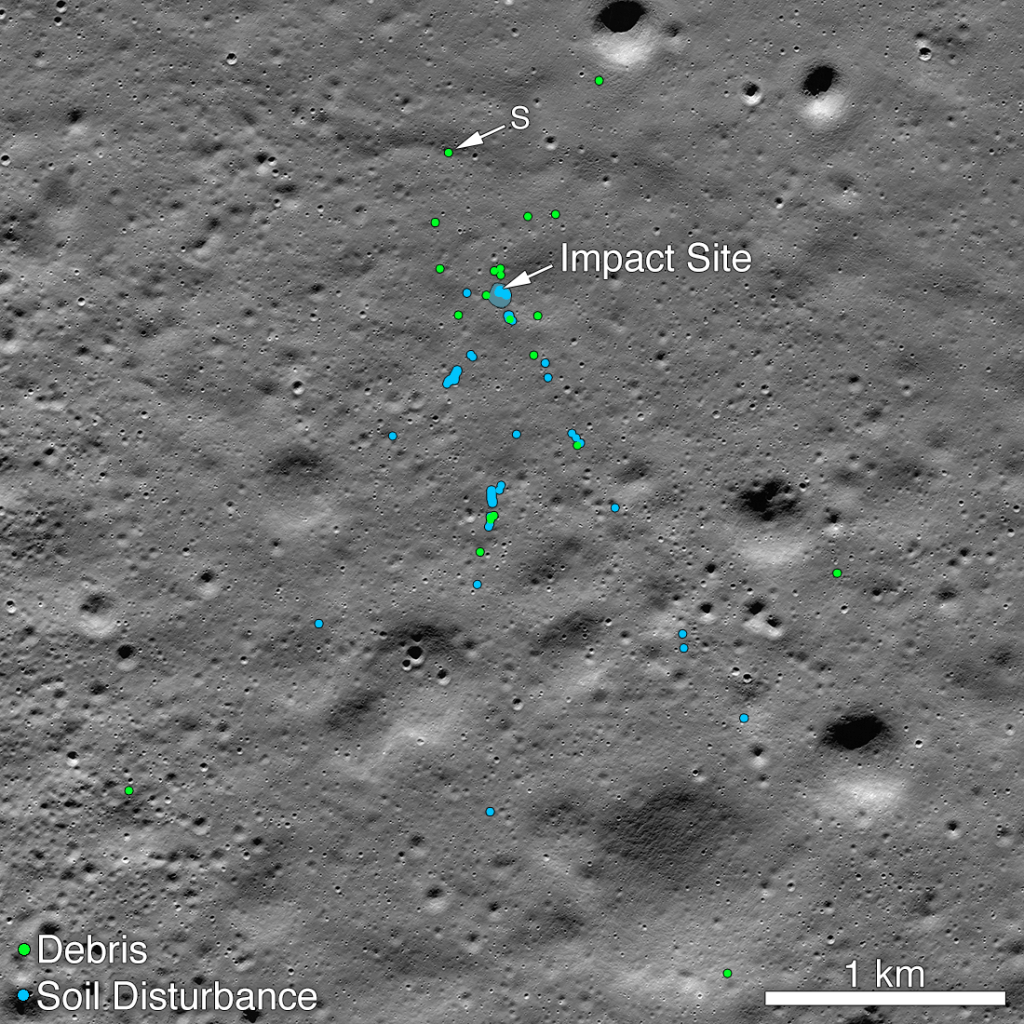
NASA’s Lunar Reconnaisance Orbiter (LRO) payload, Lunar Reconnaisance Orbiter Camera (LRO-C) released news early morning on December 3, 2019 that they had located wreckage of Vikram, the lander on India’s Chandrayaan 2 mission. The post credited the find to a Chennai based techie, Shanmuga Subramanian.
Vikram impact point and associated debris field. Green dots indicate spacecraft debris (confirmed or likely). Blue dots are locating disturbed soil, likely where small bits of the spacecraft churned up the regolith. “S” indicates debris identified by Shanmuga Subramanian. Portion of NAC mosaic made from images M1328074531L/R and M1328081572L/R acquired 11 November [NASA/GSFC/Arizona State University].
Shanmuga located the wreckage by comparing images released by LRO-C on September 26 (but taken on September 17) with the ones released earlier. He alerted NASA and ISRO about his find via Twitter. NASA’s LROC team then imaged the area again in October and November to confirm the debris. He got no response from ISRO as per news reports.
On the next day, ISRO’s Chairman in a statement to the press said that they had already located the lander on the day after the crash. ISRO’s statements from the period said that while the lander was located, efforts were on to establish communication with it. NASA’s Deep Space Network (DSN) continued efforts to hail Vikram after the crash.
As a scientific organisation, ISRO should know that until they publish, they cannot claim a discovery. The Chairman’s reference to the statement published on the ISRO website only says that they have located the lander. LROC’s success here is locating the debris and publishing the same with image data.
Media reports then claimed that the lander was intact. This was based on a statement received from someone within ISRO. I don’t think news organisations would publish something like this without an inside source. This points to the fact that ISRO did not know the condition in which the Lander was in.
The text released with the LROC image states that the lander wreckage is found 750 meters from the landing site. In Parliament, ISRO submitted a report stating that Vikram hard landed within 500 meters from the designated landing site. This is an aberration. Sankaranarayanan Viswanathan analysed NASA’s own orbital data and released it on Reddit that the site maybe 520 meters from the designated landing site. This seems closer to ISRO’s report than the LROC team’s finding.
This is a nice finish for the articles I write on the Chandrayaan 2 lander, the last of which you can find here. This allows scientists to study the debris to understand Vikram’s last few minutes on the Moon that could help scientists better design Chandrayaan 3’s lander.
I do hope ISRO proactively releases information like this and encourage citizen scientists like Shanmuga. We need more not less of this.
We bought Jupiter home yesterday on December 2, 2019.
Pradeep taking delivery of the Activa
The Contenders
We were thinking of buying a scooter for Dhanya to help her get our daughter to school, do errands locally and give her some independent mobility. The scooters we considered were the TVS Jupiter and Honda Activa.
Shopping Experience
I really enjoyed the shopping experience I was offered at TVS Century showroom on Alandi Road, Pune. The salesperson showed us the available alternatives, answered queries patiently and made useful suggestions as per our requirement. Only then did he take us through the cost and financing options. Dhanya also enjoyed her test drive of the vehicle and after the showroom visit, we were quite keen on owning a Jupiter.
The experience at the Shanti Honda showroom was the polar opposite. The salesperson asked us what we were looking for. He brought his cost sheet and began explaining what we would be paying for the two wheeler. He then explained financing options. He lost interest when we said we would be self financing the vehicle. We asked for a test drive which he offered reluctantly.
The Verdict
We asked friends and our parents for feedback on both vehicles. As we kept hearing the feedback, we were disheartened that we might not be able to choose a Jupiter. It seems to come with a history of niggling problems and sub-par after sales service that takes the years off the vehicle. Although many people felt the Jupiter was a better riding experience not everyone agreed on whether it was a good vehicle to own. As I was buying this with my own hard earned money, I went with the safer option of buying a Honda Activa.
The Delivery
As I said above, we took delivery of the Honda Activa yesterday on December 2, 2019. The Jupiter has us so captivated, that in our conversations with each other we were never able to say Activa. We kept referring to it as Jupiter. Hence, we decided to name her Jupiter so that it fixes what we call it.
We took her to the Ayyappa Temple at Dhanori. We got a Vahana Pooja done and took her home.
I’ve written hereearlier about Cal Newport and his book, Digital Minimalism. The book calls for lower if not zero use of social media. In the post, he shares an article published in The Atlantic, titled, “The Dark Psychology of Social Networks.” by Jonathan Haidt and Tobias Rose-Stockwell.
Whereas Newport suggests zero to no social media use, Haidt and Rose-Stockwell call for regulation on the part of social media companies. Newport thinks this is highly unlikely as this implies a direct hit at their bottom line.
I love this particular paragraph from Newport’s blog post that succintly summarises Digital Minalism on how social media design changed and how it affects our response:
In Digital Minimalism, I argued that our relationship with social media was transformed when the major platforms updated their designs to make these services less about checking on other peoples’ status, and more about checking incoming “social approval indicators,” which arrive in the form of likes, retweets, shares, hearts, streaks and tags.
Read the blog post and follow his blog if #nosurf is something you enjoy reading about and then go ahead and read the article by Jonathan Haidt and Tobias Rose-Stockwell on The Atlantic.


 Parallel Spirals