Gurcharan Das writes on the role of Dharma for individuals and for a competitive free market economy.
Author: Pradeep
-
Time Machine with Neelesh Misra
I just took advantage of the fact that I was down with a fever-cough-cold combination to listen to Time Machine with Neelesh Misra. I stumbled on to the show while looking for something to listen to whilst lying bored in bed.
Mystical retelling of the Mahabharata and Ramayana like those of Ashok Banker’s Prince of Ayodhya and Ten Kings are finding favour with a growing audience, it is sometimes lovely to hear these mythic story in their original. Neelesh Misra narrates stories written by members of his writer’s group called Mandali in this series on Saavn. The story telling is compelling with sound effects that we would have imagined as kids listening to the tale from our grandmothers lending the dramatic touch. Misra made me feel that in losing the art of storytelling, we have lost something significant in our busy life.
I shared it both with my wife and my brother and thought I should share it with you as well. If reading is not your thing, maybe listening to these stories might bring back fond memories.
-
The Life-Changing Magic of Tidying Up
You would not think that you need a book to learn how to tidy up. When your mother asks you to tidy your room, you tidy the room. When you think back, you had not paid enough attention to remember how you learnt to tidy the way you did. You either picked it up from here and there – mostly from your parents and then improved over the years if you paid any attention or it became worse.
I picked up the book The Life-Changing Magic of Tidying Up: The Japanese Art of Decluttering and Organizing
from the Kindle store after watching a couple of videos of it’s author, Marie Kondo. I first saw the video on Talks @ Google and two NHK videos featuring her work with two clients(#1 & #2).
The English translation of the Japanese book is a pleasant easy read. The book takes you through all the steps in a clear and concise manner, if you want to try the method for a few days. I read the book in totem before deciding to try it out. My parents had just moved out of home and left it to me and my wife.
After reading the book, I spent the afternoon explaining KonMarie’s whole process to my wife. We disposed a lot of clothes and began to try folding clothes as explained in the book. My wife though, kept tidying the way she always went about doing it. After a few more tries, I reverted as well. I think the book is best read by someone who actually tidies the home. It’s probably good to watch the #1 or #2 video that I pointed above to you before reading the book. Else it’s just another book read this year and you keep tidying the way you always did.
-
Intercontinental Space Weather Balloon Network
I read on Spaceweather.com today morning about an intercontinental network of space weather balloon released by the website in collaboration with Earth to Sky. The data is released on the website.

The Intercontinental Space Weather Balloon Network. Image Credit: Spaceweather.com It would be lovely to get a few balloons from India as well besides the ones being launched from TIFR’s National Balloon Facility in Hyderabad. It would be a fun lear
-
Integral Humanism
September 25th was the centennial birth anniversary of Pandit Deendayal Upadhyaya. I had heard the name mentioned and was curious to know who he was. A cursory reading of the Wikipedia article on him pointed out that it was his philosophy that the Bharatiya Jan Sangh and later the Bharatiya Janata Party followed. His philosophy was called Integral Humanism.
The text that forms the basis of the philosophy is a 1965 text of the same name and can be found on the BJP’s website here. I read the text on Sunday and quite agree with the analysis provided on The Wire.
-
Satish Dhawan
On the day prior to PSLV’s launch, FactorDaily has a near 2 minute video on the man who succeeded Vikram Sarabhai, laid the foundations for India’s rocketry programme including the PSLV, started the Earth observation and communications satellite programme and after whom India’s space port, Sriharikota is named – Satish Dhawan.
-
Middle Management
C Gopinath writes in The Hindu Business Line on the lack of attention on mid-level management in relation to the news related to Wells Fargo. I found this paragraph to be instructive and applicable to many organisations in India today:
The problem lies in a managerial culture that has eviscerated the role of the middle manager. Mid-level managers are key to an organisation, translating the policies of the top to operational systems and procedures, and in reverse, interpreting and communicating issues and market intelligence from the bottom. Thanks to new ERP systems and misplaced process re-engineering, the role of the middle manager has been castrated. ‘Yes managers’ have come to occupy those positions. They tell their bosses only what the top wants to hear.
-
At the doorstep of the 30s
There are many resources for people in their 30s online. Sandeep Maheshwari has this video of the ultimate goal of one’s life and is addressed to an audience in their 30s.
-
Digibank
When we mention digital banking today, what comes to mind are mobile apps and internet banking facility provided by our bankers. DBS, a bank from Singapore, changed that by launching Digibank. It applies the term to banking from end to end.
I read about digibank first on Twitter via ads while a tweet from @sengupta made me want to try it out:
Finally 1 bank that’s nailed the entire app only banking experience- Digibank by DBS. An MVP that makes sense with an experience that works.
— Aditya Sengupta (@Sengupta) May 10, 2016
It kept the whole concept vague when it launched. When you download their app, you realise the badassity of the idea. When you first download their app, you get to use it as a wallet, like you would use Paytm’s offering. It then offers you a steep incentive to upgrade this into an account by paying a steep 7% interest when you convert the wallet into an account. Then you can walk in to any Café Coffee Day coffee shop and confirm your identity via a biometric authentication process through the Aadhar database.
The first hindrance it removes is the tedious task of visiting a bank with a form filled up
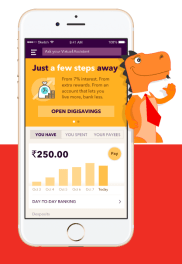 online and KYC documents. Here you just walk in to a Café Coffee Day outlet that is open from 11 AM to 11 PM with your mobile phone that has a code on it! The bank also saves tremendously on manpower costs. For the customer, visiting a less formal atmosphere like a coffee shop is less of a hassle than visiting a bank branch during business hours. He/she also probably saves a holiday.
The second hindrance it removes is all the paperwork. eAadhar enables authentication of a customer without him having to take any documents at all. With the data that the customer fed into the app and by taking required permissions, the bank can probably just download the information from the eAadhar platform and the Income Tax website. Imagine the paper that can be saved by saving the paper used for the accounting opening form and the photocopies you had to get for a traditional bank.
The third hindrance it removes is the use of a smart assistance to remove waiting for banks to open to get your problems resolved. If the inbuilt smart assistant does not resolve your problem, it gets transferred to a real person. Technology and AI can actually handle most issues that customers approach a bank with.
That said, being a new thing, there will be teething issues and problems that need to be resolved. My authentication did not work. I don’t know what was the problem. But I was happy that when I wanted to close my account, they did it quite quickly and then sent me an email once that was done.
However, this is how I hope banking will be done in the future. From your device and from your homes.

 from the Kindle store after watching a couple of videos of it’s author,
  Parallel Spirals