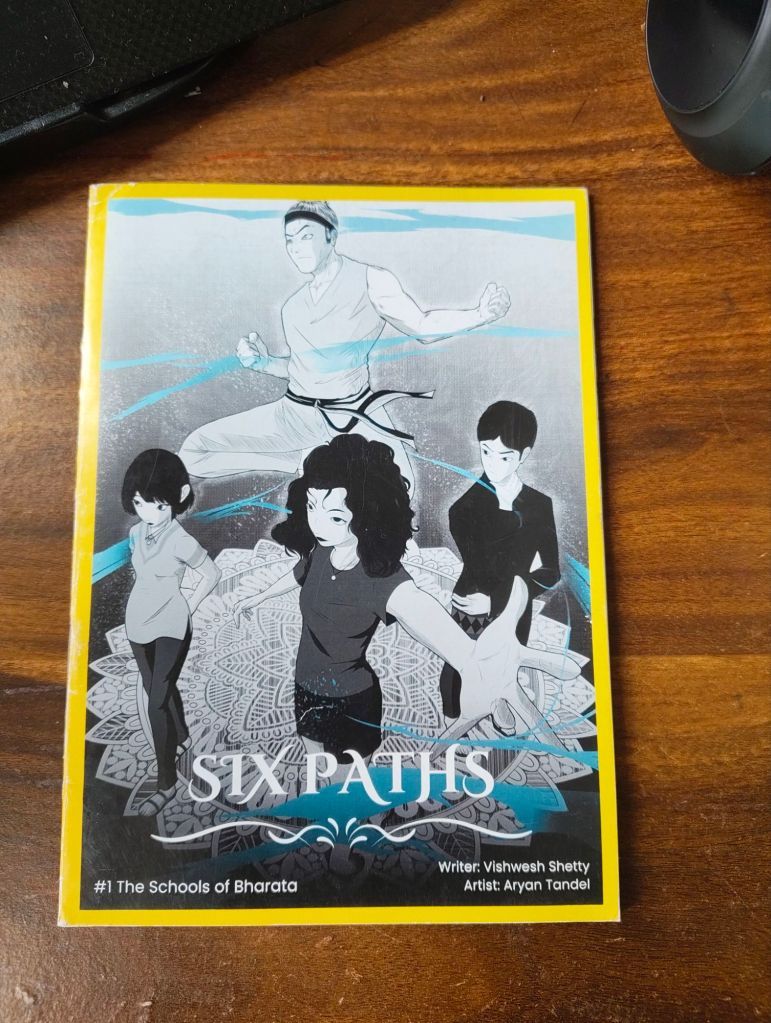
I finished book 1 of the Schools of Bharata series. I liked the storyline but don’t understand why the characters look the way they do. It isn’t written like a manga, although that seems to be the inspiration. But, this is a great effort for the first series.
However, even now, we don’t receive the connections we seek and the answers we want. We get what they want to sell. Look at the book recommendations you’re served, even after years of ‘learning’ who you are. Then remember the person at the old neighbourhood bookstore who could glance at you and hand you something that changed your life. Rare now, but unforgettable.
The post also provides a section of geology-inspired vocabulary to use.
When I was little I used to listen to Malayalam folktales from my grandmother. I was wondering who would provide a similar experience for my children. I am happy to see storytelling creators emerge who bring forth such storytelling on a public platform.
“One of things happening in culture that I think we can all feel intuitively is that increasingly media mediums are playable. I don’t mean ‘gamification’, and I don’t simply mean ‘engagement’ (but metrics inside of systems are certainly part of it). But the sense that people – Gen Z and Gen A, are literate in exploring systems. They poke at the rules, bend them, maybe even break them and see how the system responds far more than millennials did. We played the game, but didn’t fully appreciate that culture is an emergent property of a system’s design.”
“gamification (In my opinion) is mostly about obedience theatre.”
“Gamification is used to make you feel like you’re playing when you’re really just complying.”
“Code writes the rules. Rules shape incentives. Incentives shape behaviour. And behaviour becomes culture.”
“This is why playability matters. Not because everything is a game, but because we are all beginning to think like players, and this changes how we should understand agency inside of systems.”
“There’s a lot more we can say about both of these challenges, but in short they make doing solarpunk both harder and more necessary. The more cyberpunk the world gets, the more useful solarpunks become. The more material reality is buried under layers of digital abstraction, the better it feels to actually get your hands dirty.”
“Almost nobody is visiting homepage after homepage. Readers almost universally read content from a central feed of information.”
“Email newsletters are, at their heart, another version of this model. By subscribing to a publisher’s newsletter, you’re adding their content to your reverse-chronological feed of information.”
“If AI lives in the browser, as it does in products like Dia (and soon in Chrome), you can query not just one information source, but every information source you visit through that browser.”
“publishers are better off considering how they might embrace emerging standards like Model Context Protocol (MCP) into their offerings so that their information can be consumed.”
I spent most time this week with work. I ended up not doing anything I expected to be able to do this week.
For the coming week, my in-laws are coming, I am going to Mumbai to get a passport, and I want to take a look at all the things I missed in the last few weeks of engaging with work.
Watched
I believe the title is misleading, but don’t let that stop you from watching this video. My main point is to view the world as a stack of layers. This is what he refers to as wrappers (in a 3D sense). I have unfurled these wrappers into layers to make it easy for you to see.
The biggest risk is taken by business people who connect a product or service with customers. As you move away from the customer, the risk (risk is the wrong word, but no synonym fits better) decreases. We can see this with the changes AI is introducing at this layer. Similarly, the best earning potential is often found at this level, but it also comes with the highest potential for loss.
This made me reflect on which layer I prefer to work in. I’ve found that I might excel in support roles more than main roles. Even when I watch something, I’m more interested in the support character’s work than the main character, who often gets all the attention.
I studied mechanical engineering, which plays an important role at many basic layers. You can’t ship without a ship. However, this doesn’t always create the most value (or money) for the customer. If you are in this layer you feel like you are being exploited. Without it, businesses would struggle. But, without a good or service being sold to a customer at the highest layer, you would struggle.
Money flows down. When you’re squeezed by a layer above, it’s hard to earn more than the person in the layer above you. To earn more, you have to provide more value to the layer above you. The closer you are to the customer, the higher you earn for the value you provide.
Many things can push you to choose a layer to work at. Your circumstances, your attitude, or what you learnt. If you want to earn more, you must learn to be of service in the layer above you.
I did not watch, read or listen to anything besides this. I am hoping to return to a more normal cadence of writing, reading, watching, and listening by the end of the September quarter.
I have been more focussed on work this week. This week was much better for all of us health-wise as all of us were sick in Week 20.
Writing
I did a lot of writing offline. But, I did not get any online writing done.
Reading
I did not get any reading (listening or reading) done.
The rains have begun in Pune, much earlier than predicted. We got caught up in one such torrential downpour on Monday. Other than that we have mostly been enjoying the rains from home or office.
Most of my online presence has been on Instagram. I had wanted to be on blogs, but I have not got a block of time on which to focus and read a blog post.
We are waiting for our kid’s schools to re-open after the summer vacation.
I am expecting next week also to be work focussed. I expect to continue writing offline and do not expect to write online. I am planning to return to the gym from Monday.
I missed posting Weekly Notes 17, 18, and 19. I had daughter’s birthday, and parents visiting in these weeks. I did not read or write much.
Operation Sindoor also happened in the interim. X turned out to be the place to get most information during this period and I relapsed to browsing it continuously in this period.
I also got back on Instagram to try and get some solutions for things around the house.
I have a huge backlog of things to read (especially blog posts) and watch. I am hoping to get off social media and get back to the old web, as planned in the beginning of the year.
In short, we will get back to normal programming and perhaps more blog posts here from this week.
In his post, he suggests that ISRO needs to become Batman, because:
Because unlike most superheroes, Batman possesses no innate powers or alien technology. His strength comes from intellect, strategy, and a secret lair filled with gear he developed himself. He transformed through gadgets, resilience, and vision.
He suggests ISRO needs a batcave and calls the private industry as Robin. So, I wanted to try and extend the comparisons.
I think the Indian Government (Central or State) can be Alfred. The Wikipedia page on Alfred says:
Alfred is depicted as Batman’s meticulous, disciplined, loyal and tireless confidante, butler, legal guardian, best friend, aide-de-camp, …
I think the Government must play the role of a confidante, best friend, and legal guardian to both Batman and Robin. Robin may need more help in this regard now. Batman has matured a bit in this role now.
I think NewSpace India Ltd would be the Wayne Corporation. NSIL should ideally play the role of funding for ISRO and private companies. It should ideally play the role of keeping the flywheel of the Indian space programme going. I felt that NSIL was a more natural place to host the INR 1,000 crore Venture Capital Fund than IN-SPACe.
This whole last week has been lazy. I did not write Weekly Notes 15. I did not write poetry to participate in Global Poetry Writing Month. My practice of writing a blog post nearly every day faltered. And I realised this only on Wednesday.
This was a lost in deep thought lazy. So, this Weekly Note is going to be really long. It will cover the ground for Week 15 and Week 16. This is 7 April to 18 April 2025.
I mentioned in Weekly Notes 9/2025, that I had got rid of social media apps on my phone. This week I have been consuming content off the social internet, mostly reading on my RSS feed. I have also been clicking on the links to see how the page reads on people’s own websites.
Reading
Roam Research had sent out a newsletter post on 6 April 2025, after a long hiatus. I was happy to read it. Hence, when I went on X, I looked for any posts from Conor White-Sullivan, it’s co-founder and found this post from 19 March 2025. These are quotes from that post:
If your AI won’t help you break the law, it doesn’t belong to you, it belongs to those who make its laws.
I read this wonderful essay, Where We are Headed? by Dean W Ball, whom I subscribed to but has now gone and joined the US Government. Some interesting points from that post:
It had a nice introduction of what are agents:
Agents will be LLMs configured in such a way that they can plan, reason, and execute intellectual labor. They will be able to use, modify, and build software tools, obtain information from the internet, and communicate with both humans (using email, messaging apps, and chatbot interfaces) and with other agents.
And some very frightening scenarios:
Imagine you hired a bright junior employee who was willing to work for you for, say, $10,000 per month. But next year, he’ll do it for $1,000, and the year after that, $100. These are the economics of this industry.
There was an important insight as to how to know if your task can be taken over by an agentic AI:
As you go about your day, occasionally stop and think to yourself, “would it be easy to cheaply verify that I am doing this task correctly?” The answers vary, but I suspect you’ll find that the answer is often “yes.” This has implications for what the near-term economic consequences of agents are likely to be.
danah boyd wrote about five attitudes to climate change that talks about the breaking up of the worldview from two opposing ones to at least five complicated ones. The world is certainly more complicated than simple.
I think one of the reasons why I gave pause to writing on the blog was a feeling of being alone in thinking that we need to write blog posts again. Many things I read this week surrounded that theme.
Jay’s post had a lot of thought on this on the occasion of sixteen years of blogging. Here are some that resonated with me:
2015 was a major inflection point. In my memory, it’s the last gasp of the old web that everyone is now nostalgic for. Blogs lived alongside social media platforms. People still clicked links. You could drive traffic to what you were building off platform.
I have struggled to differentiate the blog from other media that look similar but you really know they are not (like Substack). I think Jay has some good writing about what a blog is in 2025.
It’s understandable. Platforms offer built-in audiences, easier monetisation, and the dopamine hit of instant feedback. But there’s a trade-off: you’re building a presence on rented land. You’re publishing into someone else’s box.
A blog in 2025 should be a destination.
I really loved these two lines:
They don’t just distribute—they accumulate. They hold time, build presence and concretise thought.
Each post sits within a web of references, tags, dates, and links—forming a layered geography of thought over time.
Blogs are also enshittification-proof:
The only person responsible for enshittifying this website is me.
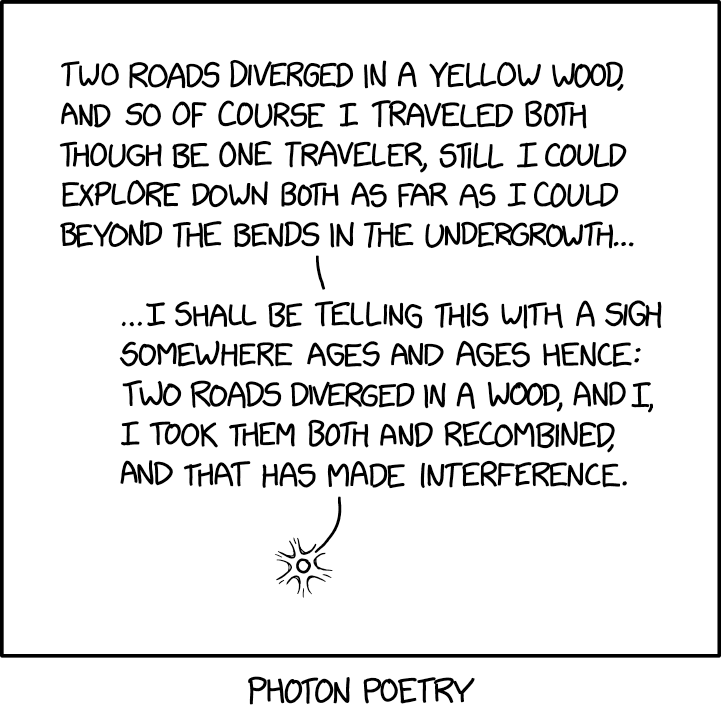
With XKCD 3076 (Roads Both Taken), I felt like Randall Munroe also participated in the Global or National Poetry Writing Month.
I also liked his summary that appears in the RSS feed but not on the website:
When you worry that you’re missing out on something by not making both choices simultaneously by quantum superposition, that’s called phomo.
These <big box> stores come into towns, destroy their local businesses, move out when profits start to dip, and the residents are left without a supermarket, grocer, or pharmacy.
Is a similar phenomenon happening in India? I think we are seeing waves of big box retail, quick commerce, etc. happening simultaneously that we don’t have the time to even think about the impact they have.
You can be a creator anywhere on the internet these days, but there’s only a small handful of places where you actually own your own content. Your own website is one of them.
This is a blog post summarizing many of her talks that she gave around this idea.
I loved reading Tom Johnson’s notes and questions about Johnathan Warner’s book More than Words. I particularly liked this insight:
Much of this type of writing (professional writing) is ripe for AI automation.
I am seeing this happening in my workplace and in my work flow.
Jay (mentioned above) has a blog post that looks at various physical AI tools. He thinks that these type of AI tools must have a definite end date. He calls it the Tamaguchi Imperative:
“I’m going to call this The Tamagotchi Imperative: We must design for the end of the relationship.
That means:
Communicating Lifespans: Be clear about how long the model or service will run.
Narrative Endings: Give the agent an arc. Let it conclude.
Gradual Fade-out: Let responsiveness or features decline over time, gently, so the user reboots the model themselves without coercion.
Memory Archiving: Let users export their interaction history.
Succession Planning: Help users move to new models and new personalities with continuity.”
Search engines — the window into the web for many people — top their results with pages containing thousands of words of auto-generated nothingness, perfectly optimized for search engine prominence and to pull in money via ads and affiliate links while simultaneously devoid of any useful information.
Social networks have become “the web” for many people who rarely venture outside of their tall and increasingly reinforced walls. As Tom Eastman once put it, the web has rotted into “five giant websites, each filled with screenshots of the other four”.
Watching
I finished watching The Good Wife. I am now watching the spin-off The Good Fight. I have reached Season 3, Episode 9.
I am watching Bosch Legacy‘s Season 3 as and when it releases.
This book and the sci-fi book this is inspired by are on my to be read list. This tsundoku is now becoming truly unmanageable.
Another book that I have added in my to be read list. Only issue is that I can’t find this list.
 Parallel Spirals