Category: Space

  • My First Sidewalk Astronomy event

    I first read of sidewalk astronomy in 2007 when I read about the work done by John Dobson and the San Francisco Sidewalk Astronomers . I have been wanting to do it and the dream died a quiet death as I began working. Lucky for me that someone else had also been thinking of doing the same and set up a page on Facebook for the event which was to be held across Mumbai.

    Sidewalk Astronomy involves setting up a telescope on a sidewalk with the idea of showing the public the night sky through the telescope. Since these events happen in a city and we’re faced with bright city lights that drown out the fainter objects, this event seeks generally to look at brighter objects – usually the Moon, the planets and if one is lucky, a few bright stars.

    The first sidewalk astronomy event in Mumbai was to be held at various locations – Nariman Point, Worli Sea Face, Shivaji Park, Bandra and Thane. I went to the Shivaji Park event to volunteer.

    The event was slated to begin at 7 o’clock. At half past six, the venue was clouded out. I was joined here by Henna and Arpit Gada. Henna was organising the event across Mumbai and Thane. Phone calls at this point seemed to suggest that other venues too were clouded out. We took a round around Shivaji Park to look for a nice place to setup the telescope. We ended up selecting a spot opposite the Cafe Coffee Day at Shivaji Park.

    We got curious eyeballs as we began setting up the telescope at the spot. People walked upto us and asked if there was a special astronomical event that we were out to observe or if we were doing a specific research. An old couple had also come reading about the event published in Daily News & Analysis, the newspaper. Unfortunately, it was still clouded out.

    We had spotted the Moon a couple of times as we walked around Shivaji Park as it played hide and seek. We spotted glimpses of the Moon and began showing late evening walkers the Moon through a pair of binoculars. We had setup a telescope but it was too rickety to show anything through. We used three pairs of binoculars to show the Moon.

    As we began reaching out to people, asking passersby if they wanted to see the Moon, we were helped by a few people who had come to see and had seen the Moon. I was tasked with seeing to it that nobody robbed the binoculars and began counting the number of people who were watching. I lost track at a 110 where a huge crowd of people came in and there were small lines.

    That number may seem small but we were doing this between 8 o’clock and 9 o’clock at night as India was batting in the finals of the T20 World Cup that was going on. We’d also chosen a less crowded spot since this was everyone’s first experience.

    People who watched the Moon through the binoculars loved it and expressed interest in wanting to do it more regularly. We promised to come back in May if we could before the Monsoons. It was a wonderful experience for many. Struggling with the binoculars, their weight, then getting a grip and then learning to focus and then the wonderful sight of the Moon. Some even spotted Jupiter which was hanging around near the Moon this night and were curious to know what object that was. A few people enquired about getting binoculars and costs and where one could get them. Some were reliving their childhood experiences of going out with Khagol Mandal and similar amateur astronomy groups in and around Mumbai. A couple even went home and got their kids back to the spot to see through the binoculars. We got a few people who were quite afraid of even taking a peep through the binoculars and then wouldn’t leave it after they saw the Moon through the binoculars.

    This is the real joy of astronomy. Sharing a sight with people who miss this. I wish we had spots within the city that were as dark as villages so that people get a chance to see galaxies and planets that are now invisible. But, for now, people wanting these sights have to travel quite far to catch a glimpse of some of the wonders of our universe.

  • On Solar System Studies and a look at Planetary Exploration

    I had leave on account of Mahashivratri today and also heard of a public lecture on “Solar System Studies and Planetary Exploration“. Being a holiday, I decided to go down all the way to Colaba for the evening. A hop on the local and a lovely bumpy ride on a rickety seat along the dockyard and through the military establishments of south Mumbai brought me to TIFR.

    The public lecture was organised by the TIFR Alumni Association (TAA). If you were an ex-student of TIFR and are interested in joining the TAA, do contact them since they are a new body and are still trying to track down alumni. The talk was organised on the occasion of National Science Day celebrated in India on February 28.

    https://www.flickr.com/photos/pradx/12818200845/player/ecf75e29a5
    Image: Presentation. Image Credit: Pradeep Mohandas

    Prof. J N Goswami is an alumni of TIFR and currently the Director of the Physical Research Lab , known as the cradle of space sciences in India. He was part of the Chandrayaan-I programme and is an advisor to the Mars Orbiter Mission and Chandrayaan-II.

    Prof. Goswami’s primary interest is in the area of solar system studies. His talk was mostly based on this topic. He just dwelled for a little bit on the Planetary Exploration aspects. I would have, personally, have been more interested in the reverse. His talk wasn’t all dry though and it did expose me to an aspect of space exploration that I have not been following attentively.

    Prof. Goswami began with a standard model of solar system formation. Referencing yesterday’s Kepler announcement he said that there was a need to have a standard model as against one just for our solar system. The model progresses from protostellar cloud to a fully formed solar system in about a few billion years. He said there were three forms of solar system studies – analytical, lab work and remote sensing. His talk considered lab work on meteorites. After explaining the geologies of the “pristine” and the “processed” meteorites he spoke of how studying the radioisotopic decomposition was used to determine a round figure for the time when the solar system was formed. He cited various studies and these seem to be continuing to the present date with increasing precision. A notable Indian contribution was a publication by Wadhwa M in Nature in 2010 that puts the age of the solar system at 4568.2 Ma. Prof. Goswami then went through various studies done at PRL and in labs in America and Europe to improve on this date by considering various radioisotopes.

    He said that PRL also was building nascent capability in looking for exosolar planets. He said that we needed crazy people to take risks for such projects. He said that PRL backed one such guy and they now have an exosolar planet search facility at Mt. Abu Observatory.

    Prof. Goswami is one of the few persons who worked with some of the Apollo moon samples which were sent to India. He says that a very influential person spoke to him for about 3 hours to get him to work on the Chandrayaan project. The person, whom Prof. Goswami admired and respected led him to abandon work on the solar system studies which he has now returned to at PRL to work on the Chandrayaan project.

    Prof. Goswami said Indian Planetary Exploration programme is limited by its launch vehicle capability. Currently, with the GSLV still proving itself, ISRO can only claim reach upto Mars and the Moon and passing asteroids.

    Prof. Goswami says that involving foreign partners in Chandrayaan was driven by the fact that India then faced economic sanctions that prevented the transfer of technology. ISRO hence invited foreign payloads on-board the project. On the discovery of water on the Moon, he says that it was always there and that we did not bother looking. Hence, when Moon Mineralogy Mapper found water in the 2.8 spectrum range, they asked for references from the Deep Impact and Cassini probes. These probes used the Moon as a way to calibrate their mass spectrometers. He said that they just did not look beyond the 2.6 spectrum range else these probes could have discovered the water as well. He stressed that the data had been in public domain for years but still no one looked! Having a re-look confirmed data from these probes as well as in the Apollo samples even ones which were in the possession of PRL. In the QnA a member of the audience asked about the Moon Impact Probe water discovery. Prof. Goswami said that the decision to not allow sufficient time for de-gassing the probe before it was sent in to impact the lunar surface would have raised doubts on the claim if they were made. He says the same instrument will be carried on the Chandrayaan-II for more studies.

    https://www.flickr.com/photos/pradx/12818206895/player/16578177e0
    Image: Chandrayaan’s achievements. Image Credit: Pradeep Mohandas

    He says Chandrayaan achieved a lot. The major discovery was the water and hydroxyl molecules attached to lunar surface material. Besides this the probe also studied and obtained new results related to reflected solar wind components, mini-magnetospheres, sub-surface ice layers below permanently shadowed craters, water molecule in the lunar atmosphere, new rock types, composition of lunar surface and confirmed the basic concept (global magma ocean) of lunar evolution. The probe also provided a 3D map of the lunar surface and radiation environment of lunar space.

    He said that the Mars Orbiter Mission was so well on course to Mars that it might not need a planned course correction. I couldn’t clarify if he was talking of the one in April or an interim course correction.

    https://www.flickr.com/photos/pradx/12818637184/player/092dcb2107
    Image: Prof. Goswami during the QnA session. Image Credit: Pradeep Mohandas

    The crowd there seemed to stick mainly to his studies of solar system formation, which was expected. He did not speak much about the planetary exploration project. He was much more fun in the QnA and was very good at analogies and I have to wonder why he spoke differently during his presentation and during his QnA.
  • The Cryogenic Engines of the GSLV

     was searching for information sources that I could use to write the Wikipedia article on the GSLV. My last bit of work on that article was on improving the history of the GSLV. I am happy to notice that the recent success of the GSLV has also cleaned up that article visually. Now, I was looking at the cryogenic stage to improve that section of the article.

    I noticed that a link had been added to the indigenous cryogenic engine called the CE-7.5. I think that was the name given to the Russian cryogenic engine, KVD-1 supllied to India and not the indigenous one. I could be wrong. However, the Indian cryogenic engine has been called CUS-12 here. I could not find similar places where the indigenous engine has been called the CE-7.5. I left a note on the talk page of the article to see if anyone else could find any reference.

    Another thing to notice is that Indian engines are usually named after the propellant loading. This is true for the S-139, L-110 and also the CUS-12, which is loaded with 12.8 tonnes of propellant. CE-7.5 just rings odd to me.

    This brought me back to the Russian engine. These are the KVD-1s. These are modified versions of the RD-56 engines that the Russians developed for their N-1 moon rocket. The KVD-1 were never actually test-flown before they were sold to power the third stage of the GSLV. GSLV hence acted as a test bed for these. As per this, it also seems that the Russians used this to validate their design and to prove to themselves, that the designs actually flew. Hence, they too were quite happy with the success of the first three flights (one was a partial success though ISRO claims it as a success) of the GSLV.

    An interesting paper [PDF] published in the AIAA in 2006 provided better information and details. These are a better source of information since these are by the people from the institution that actually designed this engine. The paper is in itself worth a blog post and I will perhaps read it in its entirety before writing here again. For the purposes of this post, the paper clarified that the KVD-1 was a modified version of and not a rename of the RD-56. The two are quite different. The KVD-1 was developed specifically to power the upper stage of launch vehicles, hence suited to the need of the GSLV. It may also be worth your while to read up on gas generator cycles – especially the staged combustion cycle.

  • ISRO’s Naughty Boy puts India in the Cryo Club

    The “naughty boy” reference in the title of this post is how the Mission Director, GSLV K Sivan called the GSLV. He said the naughty boy had finally obeyed the flight path and delivered the GSAT-14 into orbit.

    Today’s success is a big deal for India. India has been trying to build launch vehicles capable of launching communication satellites since the 1990s. They initially thought they would buy the technology from the Soviet Union. It’s collapse and faced by pressure from the US, India’s then ISRO Chairman, Prof U R Rao decided to embark on India’s indigenous cryogenic programme called the Cryogenic Upper Stage Project (CUSP). The launch today is the final culmination of that project started in 1994. As the current ISRO Chairman rightly said, “20 years of efforts in realising an indigenous engine and stage has now fructified”.

    Today’s success was built on the hard work of a lot of people in industry and in ISRO. The problems that have been plaguing the project in the last 5 years include three flight failures. The team had undergone a gruelling review from several boards and had made several design changes and run several tests. The failures as the LPSC Director said after the launch were painful.

    I must admit that I was really tense before the telecast started. The telecast began at 1530 hrs (IST) on Doordarshan instead of the publicised 1552 hrs (IST). Seeing the sombre faces of those present there did not ease my tension. My tension persisted till about the cryogenic engine ignition.

    Unlike ordinary telecasts that are met with quiet claps at each stage separation event, people were actually up on their feet after the second stage separation. The first smiles and applause broke out as the cryogenic engine lit up as planned. As the ignition was sustained, that is, more claps broke out. A few smiles appeared on the people’s faces 300 seconds into the flight of the cryogenic stage. As the stage efficiently provided enough velocity to the put the satellite into orbit, everyone in the Mission Control Center was on their feet and with their faces glued to the screen. I had not seen so much tension in the room even during the Mars mission!

    I personally would rate this success a higher one than even the Mars mission. Success in this critical technology enables India’s space programme to indigenously launch communication satellites, launch interplanetary missions like the Chandrayaan-II and perhaps even the second Mars mission and opens the ground for heavier science missions that India has not considered yet.

    While this was an important success, the improvements need to continue and the GSLV needs to show more consistency in its success rate in the future before it can be trusted with more important missions like Chandrayaan-II. If the GSLV Mk-III mission slated for March-April 2014 succeeds, India will gain capability in launching all classes of satellites it builds by the end of this decade.

    There are more tests in the road ahead, but tonight we celebrate another important milestone  in the Indian Space Programme. I had a nice medu-wada sambhar, the fuel that powers ISRO in the evening to celebrate.

  • Red Letter day for the GSLV

    January 5, 2014 is a really important day in Indian Space History. On this day, the GSLV on its eighth launch, is scheduled for lift off at 1618 hrs (IST).

    The 29 hour countdown to the lift-off started today morning at 1118 hrs (IST). At the time of writing this post, things are proceeding smoothly. ISRO has been updating through their website and via their new Twitter and Facebook accounts.

    This is a critical test for the vehicle as a whole. I had elaborated on some of the improvements that ISRO has made to this vehicle, the GSLV Mk-II, in a previous post. The success of this launch would set the agenda and the time table for India’s communication satellite launches, interplanetary missions and the human space flight programme.

    In fact, most of the media reports have also concentrated on the vehicle and largely ignored reporting on the payload, the GSAT-14. Besides the usual C-band and Ku-band transponders, it is carrying a fibre optic gyro, active pixel sun sensor, Ka band propogation experiments and thermal control coating experiments. What these things are not explained even in the ISRO brochure.

    The Doordarshan telecast and webcast begins rather at 1552 hrs (IST). It does seem rather too precise, does it not?

    I am not going to try and live-blog this launch. I prefer to write here after I experience all the excitement there is and write here rather calmly.

    Best wishes to ISRO and Godspeed GSLV-D5 and GSAT-14.

  • An Indian on the Moon?

    It was Jeff Foust who first alerted me to this news story via Twitter.

    Indian report claims ISRO and Indian defense ministry have signed an MOU to study a human lunar mission: http://t.co/Z1qO4e39kV

    — Jeff Foust (@jeff_foust) December 27, 2013

     He himself seemed surprised by this report as were space enthusiasts like me. As he says..

    That report is interesting as India has deprioritized human spaceflight in recent years; even robotic Moon missions lower priority vs Mars.

    — Jeff Foust (@jeff_foust) December 27, 2013

    We just don’t have all the components in place to attempt human spaceflight yet – most notably, a human rated launch vehicle. Work has been on-going on the Crew Module which is likely to be first tested on a test-flight of the GSLV Mk-III according to a recent op-ed written by ISRO Chairman K Radhakrishnan in the Deccan Chronicle. The article goes on to state that this vehicle will commence demonstration flights in 2016.

    Today, ISRO has refuted the claims made by their colleagues in the Armed Forces Medical Wing. The Armed Forces Medical Wing officials seemed to provide very detailed and descriptive answers on what they had on hand and what they hoped to do with the data.

    It seems that 2014 will be an interesting year. Srinivas Laxman (a friend) wrote this for the Times of India. The story essentially says that even if the Air Force is ready, ISRO just isn’t. It will be interesting to see this story play out and see if ISRO gets a shot in the arm for its human space flight programme as a result of this tussle. This makes the flight of the GSLV-D5 this Sunday even more important, as a stepping stone to success.

  • GSLV-D5 Preparations On!

    The GSLV D5 is scheduled for launch on January 5, 2013 at around 1618 hrs. (IST). Preparations are afoot at the Vehicle Assembly Building where each of the stage of the rocket is being assembled to form the GSLV.  A Mission Readiness Review on December 27 will confirm the time and date of launch, as per reports.

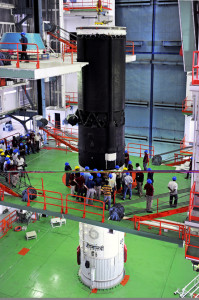
    Integrating the indigenous cryogenic stage to the GSLV. Image Credit: ISRO

    The most challenging part of this mission is the indigenous cryogenic stage. The 8 page brochure includes one whole page for the various design improvements that ISRO has undertaken for this mission. The changes have been made in the fuel booster turbo pump of the cryogenic engine that was believed to be the cause of the failure of the GSLV D3 in April 2010. Improvements have also been made to the aerodynamics of the launch vehicle and the wire tunnel that runs from the payload bay right down to the first stage. These were believed to be the cause of the failure of the GSLV-D4 which was destroyed by range officer after the vehicle veered out of control. ISRO has also instituted more tests than it had generally carried out for launch vehicle missions, which it prefers to do in-situ during missions.

    An interesting addition to this mission is a video imaging system to keep watch of the lower shroud movement. It was this shroud that is suspected to be the culprit in snapping of the control wires that led to the failure of the GSLV-D4 mission. The Russians were blamed for this. It will be interesting to learn of lessons learnt from this mission.

    They have also changed and are using a newer stage for this mission. As the countdown clock was running for the same mission on August 19, the second stage had popped a leak. A review found that the older tank used for the stage had cracked due to ageing. I can imagine many tanks wasting away without use as the GSLV launches keep getting delayed.

    The development and success of the GSLV is critical for India. Several of its space missions have been scaled down due to the lack of reliability of this vehicle system. This along with the Mk-III are critical for self sufficiency in launching our geostationary satellites, future interplanetary missions and even the human space-flight programme. I wish good luck to the GSLV team.

  • ISRO’s Enhanced Social Media Presence

    I would cordially like to welcome ISRO to the world of social media. It now has an official presence on Facebook and Twitter.

    They’ve already had their first official Facebook page on the Mars mission since October, 2013. The page has already got more than 3 lakh followers. They’ve also done a very good job of providing real time updates and engaging with an Indian audience. This, in itself, is worthy of praise. They’ve now taken the step of extending that to the official ISRO level.

    It does come in the background of some steps they’ve taken that I wish they would not have taken.

    They have opened on the official pages with notes on the progress of the GSLV D5. They now have an official launch time – January 5, 2014 at 1618 hrs (IST) and some stunning pictures of the GSLV at the Vehicle Assembly Building at Sriharikota.

  • ISRO on Social Media Misrepresentations

    Note: I wrote this on my earlier blog hosted as https://parallelspirals.wordpress.com. I recovered the text from the WayBack Machine. This post appeared on December 17, 2013 as per the permalink. I’m trying to collect here again all my old writings spread on various blogs.

    Update: ISRO posted this on their Facebook page earlier on Tuesday which seems to imply that they’re planning to expand their presence on Facebook and Twitter. If true, these fake profiles seem to have done more for public outreach than India’s space enthusiasts have achieved thus far. Kudos to the people behind the fake profiles!

    I have congratulated ISRO’s social media presence with respect to the Mars Orbiter Mission. Their official page is linked to from the ISRO website. This press release tells me that ISRO is yet to understand social media much like many Indians, myself included.

    There have been a multitude of unofficial ISRO accounts on the agency as well as it’s various missions, ostensibly trying to ape similar efforts by NASA. These may be well meaning individuals trying to inform the world about ISRO through a channel it is not present on using information from ISRO press releases and news stories. I myself did this when Chandrayaan 1 launched in 2008.

    The critical difference, in my opinion, is being open about the fact that the account or the page is not an official ISRO page. I did so on my Chandrayaan 1 representation.

    I think one does not go after these people with a legal notice. At least, not until one has sent them a warning.

  • Yutu is on the Surface of the Moon and Playing Around

    Last time, I left you with the Chang’e 3 lander on the surface of the Moon and we were expecting the deployment of the rover on the surface of the Moon. It has been 24 hours since the last update.

    Since the Chinese refuse to let us know in plain English what they plan to do, I decided to look for an update after they have completed everything. Twitter has been quite efficient at delivering in a time bound manner some of the awesome highlights of the mission. A blog post, I think is a more reflective affair and needs more time.

    Around now, while India’s Mars Orbiter spacecraft is 10 times the distance from the Moon, China’s rover Yutu (Jade Rabbit) has been deployed on the lunar surface. Also, the rover and the lander have taken pictures of each other.

    There is this very cool video of the landing of the Chang’e 3. Emily Lakdawalla on the Planetary Society blog [Disclosure: I am a member of the Society] has animated gifs of the rover getting off the lander and colour photos that the lander and rover took off each other. Her posts also links to several other resources and people talking of the landing. Nasaspaceflight.com seems particularly active with people trying to figure out and put together this landing story for the English audience. Stephen Clark at SpaceFlight Now has a more general update.

    Indian media has been covering the story for the angle of peaceful exploration of the Moon. Articles don’t seem to have conveyed the excitement that has gone with this landing owing to the rate at which China has posted videos and pictures on this mission. Which is sad. Interestingly also, very few people have raised comparison with India’s Chandrayaan-II and if India lost in this race (despite both countries refusing the fact that they are in a race, it makes writing about these things more fun, when healthy competition exists). India’s lunar landing is now targeted at 2016-17.

    Now, let’s wait for the science from the Chang’e 3.