I know of at least two of my friends in the Wikimedia world (@busydot and @psubhashish) who attended this summit. But, I share this post more for some of the keen insights into the recent protest movements and their political transformations (look at the India Against Corruption movement and it’s political avatar, the Aam Aadmi Party) and their use of social media for their narrative.
Category: Uncategorized
-
2014
The year 2014 was a year for review, taking stock and then boldly going where many have gone before. I would never have guessed at the beginning of the year of the scale of changes that swept through my life in this year.
I got married.
I reduced the vast areas of interest to geography, space and digital sciences besides having a professional interest in banking and financial services. I pruned out my various memberships to reflect this change in my professional affiliations and hobbies. I continue that process in 2015.
I went on my first international trip to Malaysia.
-
Malaysia
Our first trip to together after Marriage was our first trip abroad to Malaysia. We flew from Kochi to Kuala Lumpur, thence to Langkawi and then back to Kochi from December 10 to 16. We had a wonderful time.
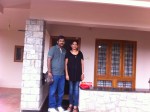
Getting ready to leave… 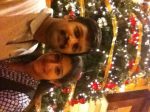
With the Christmas tree in the lobby of the Hotel Grand Seasons in Kuala Lumpur 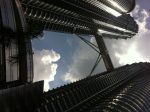
Outside the Petronas Tower, tourist stop in Kuala Lumpur 
In one of the those trips 
Langkawi Island 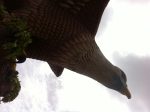
Under the Eagle 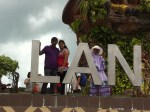
Touristy Photos on Langkawi Island -
Running and Cattle
I have started running a small distance every alternate day in March. I set a very slow speed and run. It was embarrassing for me earlier to run this way. For one people looked at you in an odd way. It was not encouraged unless you were running for sports on sports day or running between wickets. Now, though, trends have changed. Everyone runs. People look at you in an odd way because you’re not running.
People of all ages equipped with their mobiles, their fancy running shoes and gadgets hooked to themselves run and sweat it out in the early morning. I walk most of my rounds and finish with a nice jog.
I start rather awkwardly. Once I begin catching a certain pace, I find it hard to maitain it. I feel a constant push to run faster. My lungs and heart begin to start pumping expecting this. I use my breath to control this urge and both seem disappointed. The run ends rather awkwardly too. The disappointment of the hearts and the lungs translates into me catching my breath and panting when I finish. I sweat profusely. For those brief minutes in the middle, though, I feel exhilaration.
I am avoiding pushing myself to run a greater distance this month. In April, I will increase my distance a bit longer. And if I feel like writing about it here, I probably might.
**
In the evening the wild cows grazing on the side of Vihar Lake descend to the gates of the NITIE complex. These cows seem to enjoy harassing shopkeepers that have sprung up around the gate. This is the old gate though. The new one has been pushed back. The cows and bulls graze on gunny sacks of potatoes and onions outside provision stores. Probably for religious reasons, some even feed them.
I can imagine the cattle being stunned when they see so many people in what was once their grazing grounds. Where did these guys come from, their eyes ask, if you ever look at them.
-
M H Chalmers’ Walks
This post originally appeared on http://pradx.posterous.com on December 25, 2011. Found the post using the Wayback Machine.
While exploring the website of the Geographical Society of India – I found these gems in what is written as the history of the Geographical Society. An English gentleman, M H Chalmers, then an employee of the East Indian Railways gave three talks on what he titles as “walks”. I do not know if he means them literally or not, but these were given to the Calcutta Geographical Society back in 1934.
They are:
- “A Walking Tour from India to England” by M. H. Chalmers on January 13, 1934
- “A Walking Tour through Kashmir and Middle Tibet” by M. H. Chalmers on April 9, 1934
- “A March through the Sacred Shrines of the Himalayas” by M. H. Chalmers on 21 April 1934
I would love to read a copy of these talks or see some of illustrated pictures that Chalmers showed off at these talks. Even more, I would love to meet others in the area around Bharuch in Gujarat who love to share such stories. Perhaps you can do something similar in your town too?
-
Jyotish – Indian Astrology?
This article originally appeared on my blog http://lifeofpradeep.wordpress.com. I recovered the post using Wayback Machine.
I recently went through the talks by Dr. N Gopalakrishnan of the Indian Institute of Scientific Heritage (IISH) on the topic of Jyotish on YouTube in Malayalam. I have been listening to some of the talks he has given on the Bhagwad Gita on Amrita TV and admire him for having an opinion and expressing it clearly. He also has consistently maintained what he’s said over several talks – made some mis-quotes. I wanted to put down some notes before I forget the talk.
Jyotish is not to be compared with astrology as put up in the West. Jyotish is one of the 6 literatures (called Vedangas) presented below the Vedas. Jyotish is the 6th Vedanga. It is composed of three parts – astronomy, mathematics and prediction. Of these, the sections on astronomy and mathematics are pure sciences and is borne out by modern astronomy and mathematics. As an example, the fact that the Earth is spherical, that the Earth rotates around its axis, the fact that the Earth is tilted at 24 degrees (as against the current value of 23 degrees 26 minutes – which he misquotes as 56 minutes – which is still fantastic given that this measurement was made in 700 AD or so), the diameter of the Earth and so on. He further clarifies that the word graha is not to be interpreted as planets – but as “holders”. Given this change in interpretation, he says clarifies many things. He suggests that the word taragraha (that which a star holds, by virtue of gravitation and such) is the correct word for planet.
The part where talks about predictions. He say that this is absolutely not based on Science. The grahas have been given attributes. There does not seem to be any plausible scientific reason for the wide range of attributes given. For Jyotish, he says the question is not whether it is scientific or not. He says that it is not scientific. The question to be asked here is whether it is useful or not. Dr. Gopalakrishna suggests that if we find it useful, we must use it and discard it if we don’t. Do either very freely.
Dr. Gopalakrishna says that a true Jyotisha will take some time to calculate and understand some of the science and mathematical aspects of Jyotish and hence, one must not believe the ones who profess instant calculations. The birth chart prepared in Jyotish is a fairly accurate representation of the position of the Moon at the time of birth and location of the birth and accordingly the placement of the grahas. He suggests comparison with the star charts used by National Physical Laboratory. These calculations, he claims, take in the region of 10-15 minutes unless done with the help of a computer – which helps determine location and time and generates ephimeris. However, it is after this that the non-scientific prediction part starts.
This non-scientific prediction seems to get better with lots and lots of practise in many people that Dr. Gopalakrishnan has known. In a select few, the practise has become so much that only what they say happens (this section seemed exaggerated to me).
In the question and answer section, various questions were raised off him. The most interesting one was how to select a Jyotisha given the Doctor’s suggestion that many of them were just out there to earn money of falsehood. He suggests people at high ranks with a great educational qualification. He suggests that to get a good Jyotisha one must try as hard as trying to get a good doctor to treat one’s ailment.
I am interested in reading counter-points to some of his arguments. There are a few slips in the facts that he states. But his talk does seem logical, when presented like this.
-
Visit to the temple built by a sweet shop owner
I finally managed to graduate from my bachelors course in Mechanical Engineering. As congratulations poured in, some of my close relatives also let me know of their prayers and their expectations of my fulfilling them. The first one that I heard of was -“the most famous Ganapati temple in Pune”. Although this relative told me the name of this temple, I could not remember it no matter how hard I tried. Even while writing the title of this post, I could not remember the name of the temple without referring to my searches for the temple on Google.
While asking friends about the temple I continuously asked about the “temple built by a sweet owner” and they got it and named the temple. Despite several repetitions, I was not able to remember the name of the Dagadusheth Halwai Ganapati Temple.The temple was built by a sweet shop owner, on the advice of the guru a year after the death of a son.
I decided to go on Sunday – for no foreseeable reason. In the morning, I woke up later than I wanted to and then left for the bus stand after a breakfast of upma.I went to the Maitri Park stop and hoped to catch Shivneri (an air-conditioned bus that travels between Pune and Mumbai at 15 minute intervals). I looked for the ticket counter when a co-passenger suggested that I talk to the conductor and buy a ticket from him. Chance encounter – good advise. I asked the conductor if it was possible to buy the ticket directly – when he said yes, I leapt in.
The early morning wake up, even though it was late, meant that I wanted some sleep. The air conditioned environs and an empty co-passengers seat meant I could sleep well. I woke up once or twice but had good sleep all the way till Pune. There, aided by Google Maps, I got off at Shivajinagar, Pune and took a rickshaw to the temple.
The auto rickshaw driver was helpful to give me directions to get to the temple as I got off. I took one picture of the sideways of the temple – a multi-storeyed structure with intricate stone and wood work. It almost seemed like a Palace. But, the temple looked totally out of place in its locality. It also has an open structure whereby the idol is seen from the road and is open to a 180 degrees field of view. The queue was small probably because it was late morning on a Sunday and the hawkers didn’t trouble you and the persons who kept your shoe were kind and polite. As I walked in, prayed and sat down for some time soaking in the surroundings, I think I liked this open structure compared to the closed and fortress like Siddhivinayak. The temple is known to be very powerful and you felt it when you sat there. I wasn’t able to sit cross-legged or did not try. There were kind devotees who shared laddus. Inside, there was no push for you to pray fast and move. Everyone prayed at their own speed and in their own styles.
I enjoyed the temple and will probably go there every time I visit Pune.
-
PSLV C-16 mission successful
Dr Kasturirangan, former ISRO Chairman described today’s successful PSLV-C16 mission the best. “Thank you for a wonderful though tense 18 minutes”. At the end of the 18 minutes, all the stages of the PSLV hadperformed very well and placed in orbit 3 satellites – RESOURCESAT-2, YOUTHSAT and XSat.
This, the first launch of 2011 was done under some tremendous pressures to get it right. This Forbes article that came out a day ago best summarizes the trouble that ISRO has had beginning all the way from the failed GSLV launch in April 2010. The only positive in the last one year has been the PSLV launch. This put extra pressure on the PSLV team to perform well.
Today morning began with this report in the Times of India regarding the GSLV failure of December, 2010. The report implicates a design flaw in the GSLV’s payload fairing which caused the fairing to deform and caused the connectors to snap. This led to a loss of computer control of the four strap-on boosters of the GSLV which caused it to veer off track. The vehicle disintegrated even as the Range Safety Officer destroyed the vehicle for purposes of safety. I thought this could not be a great way to start a launch day! However, these words spoken by Madhavan Nair made sense: “A successful flight of the GSLV is not an impossibility”. Now that we had a fix on what the problem was, it could be corrected and we could have a GSLV flight later this year or early next year.
I was as tense as ever and was surfing the channels and keeping a watch on my twitter account and looking at webcasts which many people had requested a link to. The webcast seemed down although Doordarshan flashed a message about the time when the transmission from Sriharikota would begin – 9:40 am. As the message flashed, the webcast came back online even though it was running through news reports.
As the national channel of Doordarshan went through the documentary about the testing and integrations of the PSLV and the satellites, I kept tweeting the minutes to lift-off at ten minute intervals. By this time I was really tense! The PSLV stood majestically on the launch pad. Close to 14 minutes, the Automatic Launch Sequence was started and the rocket went completely under computer control. 3 minutes…the tension in my living room seemed comparable to the tension in the mission control. The former ISRO chiefs and Russian and Singaporean delegates looked anxiously and seemed to talk to avoid tension of silence. The check out was being read in the south Indian accent in the background – perhaps to provide some comic relief.
As the countdown started 10 … 9 … 8 ……. 3 … 2… 1, the mood in my living room and mission control went into silence as the PSLV rose in splendour and rose above the launch pad. I remembered the GSLV launch and was praying that the PSLV would not lose altitude and fall into the Bay. But, it rose and rose until it went into a cloud bank and erupted out as a round of applause went throughout the room as the Air-lit strap-on boosters fired on cue. Throughout its major timeline events – Stage 1 seperation, Stage 2 ignition, heat shield seperation, Stage 2 seperation, Stage 3 ignition, Stage 3 seperation, Stage 4 ignition, RESOURCESAT-2 deployment and YOUTHSAT and XSat deployments, the mission almost followed the mission plan.
It was all smiles in the Mission Control and at home, as ISRO Chairman K Radhakrishnan congratulated his team members and immediately went to meet M G K Menon and Kasturirangan who had smiles on their faces. Afterward, as the Minister of State spoke or the former ISRO Chairmen spoke or as the Directors of the Center and the PSLV Mission Director spoke, there was a huge smile and a great sense of relief in everyone’s faces. Conspicuous by his absence was former ISRO Chairman Madhavan Nair who was the first Mission Director of the PSLV.
As they began to break up, the clamor from my brother grew because he wanted to play on the computer. I just felt relief. I am sure this was a great confidence booster for ISRO. I hope they will use this boost to work positively towards the other 3 launches scheduled for this year and the various other projects that ISRO has jam packed throughout 2011. There is now a huge backlog for ISRO to clear. And as Kasturirangan said, Thank You, ISRO for a wonderful and tense 18 minutes today morning.
-
Chai and Why?: Genetricks
Today was the first time that I went to Ruparel College for a session of Chai and Why?, TIFR’s public outreach programme (fascinatingly, they have a Facebook page but nothing on their own website!). This one was titled, “GENETrICkS” and was given by Sonal on developmental genetics.
After a description of basic genetics and the wonderful play of the genes that gives rise to the field of developmental genetics Sonal went into the fascinating “fluorescent revolution in biology”. What this did was make her study of genes much easier. She also described the brainbow mouse which is definitely worth searching and reading through.
The TIFR team also announced the up and coming Chai and Whys. The next one is titled “Mathematics and Origami”. This is on May 1 which has this phrase inserted –
and in practical applications such as unfolding space telescopes and solar sails
which makes me really itch and want to go!
 Parallel Spirals