Towards the end of 2015, I slowly began to loose interest in reading religious texts. They seemed repetitive to the extent I began to wonder that if the texts were so similar, what was there to fight about. D introduced me to Sandeep Maheshwari, an entrepreneur from Delhi who gave talks inspiring students. The first video of Sandeep that I watched was “Last Life-Changing Seminar” on YouTube.
Till then the only things I used to watch on YouTube are TED talks and Talks at Google. The Life-Changing Seminar was the first Hindi video that I heard from start to end. The full hour or so.
Slowly, Sandeep’s videos started to move towards the spiritual. This started, in my opinion with a how-to video on basic meditation. He understood that not everyone was interested in the spiritual and hence started a separate channel on YouTube for his spiritual stuff. This is the channel that interests me. His inspirational video and videos related to personal excellence continue. The first few times I watched the spiritual videos, I spent them trying to pin down what teaching he followed. I wanted to categorise them so that I could then read the books myself.
While I am still getting the hang of the basic meditation video through daily practice, I have continued watching his videos on his spirituality channel. Slowly, I concentrated more on what he was saying than trying to classify his talk. His spiritual talk, also in Hindi, seek to clarify and are linked to examples befitting the twenty first century.
These talks helped revive my own spiritual interest, helped clear my understanding and understand some things much better in Hindi than while reading some texts in English.
Prabhat Patnaik writes a useful critique of the Left in this thoughtful piece in The Hindu.
What is true, however, is that even the Indian communists, despite being opposed to globalisation and associated neo-liberal policies, have not charted a concrete alternative development strategy. Their opposition has taken the form of identifying particular parties as neo-liberal and having no truck with them, which has hampered united struggles for the defence of secularism and democracy. But uniting with others in struggles, on platforms, and even in government, against the Hindutva and semi-fascist forces and on the basis of a concrete alternative agenda to neo-liberalism, will serve the people better.
We need a good Left and a Right in politics to have a more balanced world. Also, waiting to see such a useful critique of the Right.
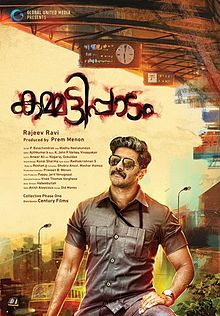
Kammattipaadam is a Malayalam movie starring Dulquer Salman that looks at the story of urban development and the communities it marginalises. The story runs through the life of the lead character, Krishnan, played by Dulquer Salman and how Kammattipaadam where he grew up also grows or is developed.
Poster of the movie, Kammattipaadam. Image Source: Wikipedia
Kammattipaadam is a place outside the Kochi-Ernakulam twin cities. Krishnan’s childhood is spent in village surroundings with his parents and the generation engaged in farming. As Krishnan grows farming sees a decline and they become part of the outskirts of Ernakulam. Here, in his teenage years, Krishnan takes on criminal activities like others from his community and income group as farming is no longer seen as a viable means to make a livelihood. He stabs a police officer and is sent to jail. When he returns as an adult, he sees that his Kammattipaadam has changed.
Kammattipaadam is now a suburb with small houses replacing farm land. Builders buying old hutments in bulk and building buildings to house the burgeoning population now coming to Ernakulam and Kochi. The crime moves up from petty crimes and spirit business to extortion in communities who stand up to builder lobby that seek to clear people without adequate compensation for the land. The same criminals seem to learn the folly of their ways too late and lose their own land are themselves displaced. The compensation makes up for the price of land but does not make up for the loss of livelihoods.
Moving from farming, many of the people displaced take up plying vehicles, running small businesses and somehow surviving while others take to even more serious crimes like murder. Some who learn the folly of their ways are also not allowed to move out as the past comes back to haunt them.
The movie itself is a rare crime-drama film in Malayalam with realistic portrayals from various actors. The film does not seek to answer how to fix the issues that it raises but rather holds up a mirror to the urban community to show that this is probably how the buildings that you live in was built up – on the blood and toil of communities and people who were extorted and murdered to fulfil the whims of early developers who were driven by the greed of money.
It could be that this was not the case, but the movie makes you curious about how your urban sprawl grew, what was there before and the people who once called that land home.
A company in the US, Planetary Resources has started making efforts to mine asteroids or large meteorites in space. I believe Indian companies, especially mining companies which are having a hard time getting government clearances must look at space mining quite seriously. This would be a chance to save the environments in the locations that these mines are located on Earth without moving people out and also will push mineral exploration into space. Also, by the time that they get clearances to mine in India, they could probably build, launch, mine and return back to Earth with minerals and possibly sell them on Earth. This is a good possible study for the MBA types to find out which is cheaper – waiting and getting clearances or launching two spacecrafts into orbit for the purpose of asteroid/meteorite mining.
Wikipedia’s article on Asteroid mining has this to say on the possibilites of minerals present on asteroids and meteorites:
Given this range of options, I thought I should also design a bare bones, un-researched article on one asteroid mining scenario.
Rudimentary Asteroid mining scenario
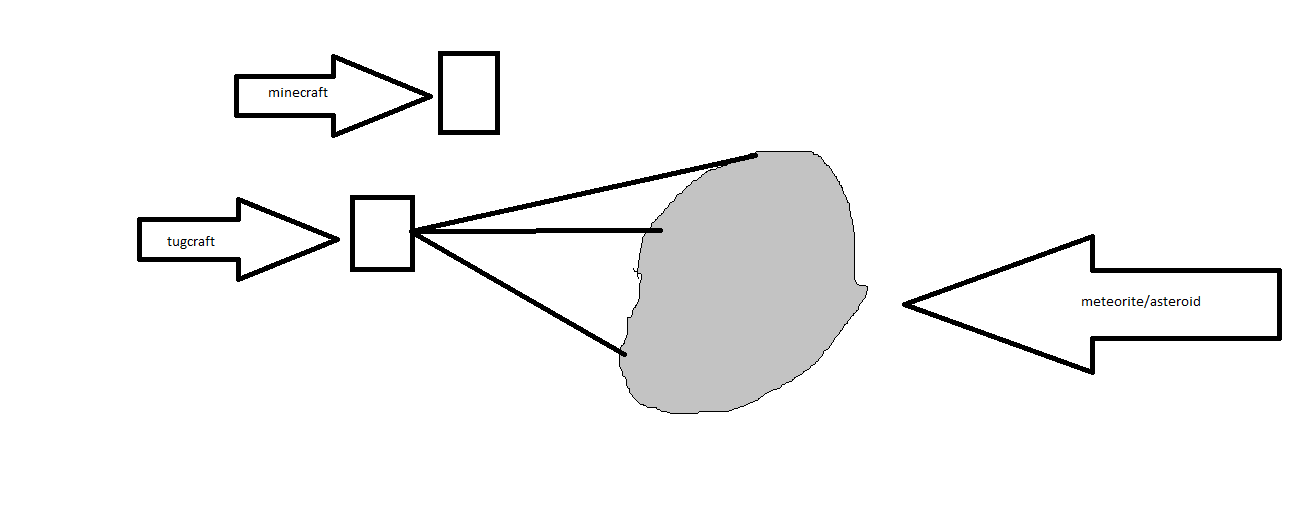
My concept works on two spacecraft scenario. One is a longer lasting Tug-craft. The second is a frequent Earth returning Mine-craft.
Earth based asteroid monitoring systems will be used for the twin purposes of keeping an eye on incoming asteroids that could hit Earth called Near Earth Objects as well as potential targets for a tug-craft in orbit. Looking at timelines of spacecraft that cater to the International Space Station or that go to the Moon, we currently can get a spacecraft into Low Earth Orbit and then from there to a specified target (between the ISS to the Moon) in 1 to 5 days. We can also decently estimate their trajectories and velocities to get a handle on where we should send our tug-craft to intercept the asteroids/meteorites and also whether we can send them to intercept points in the time available to us.
For the purposes of this idea, let’s consider that an asteroid passes near the Moon. A tug-craft could either be launched from Earth or a spacecraft already in orbit can be redirected to the target. Let’s say that the tug-craft reaches the intercept point in 5 days. As the asteroid approaches, the tug-craft makes adjustments to it’s orbit, makes more precise calculation of the incoming asteroid’s velocity with respect to itself and begins mapping the mineralogical possibilities that the asteroid/meteorite offers. The tug-craft then uses tugs (metallic or composite rope like structures) to drill and latch onto and slowdown the speeding asteroid using its on-board thruster. It also uses on-board remote sensing instruments and spectrometers to estimated the mineralogical content and location on the asteroid. In my example, I provide for three tugs to pull the asteroid into a mining-parking orbit with the tug-craft dictating the orbit.
This itself would require a minimum of two test flights and a few more flights to improve and perfect asteroid catching techniques. It would be something akin to catching a bullet. It would require continuous improvements or kaizen method to get better and more cost effective in the longer run. But there will be millions of objects to test it on even in the Near Earth space.
The mine-craft’s work is a bit more straight forward, given that the target’s location is known. It only uses data from the tug-craft to understand location of the deposits and begins to mine the asteroid. The raw minerals are collected and returned to Earth. Earth-based mining techniques may not work in space and may require re-working the mining design. The recent launch of expandable spacecrafts would come in handy to increase the amount of material the spacecrafts can bring back to Earth.
The only part of this that we have not worked out fully with is tugging the asteroid and mining the asteroid. Test flights would be needed to test out both systems in parts of space where it keeps away from Earth during such tests. I think these systems could be ready to for deployment after research in the next 5-10 years.
My name is Pradeep Mohandas. I currently work in a public sector bank. I am a mechanical engineer by education and am interested in reading books, making maps, contributing to Wikimedia, making stuff, walking, keeping myself updated with events in the worlds of high energy physics and aerospace engineering.
I hope to write here occasionally about the interests that I have mentioned above. While this is a short blurb, my posts here will be mostly long form writing.
I had written here about planting our Tulsi Plant. After several repeated efforts to keep it alive, it has not survived.
We’ve tried keeping it at different locations, observing various ritualistic rules, changing the soil mixture but to no avail. I had thought that getting the Tulsi plant right would be the first step towards building a home garden in our balcony but the plans are suspended for now as we try and figure out how to plant and grow the Tulsi.
Ruskin Bond wasn’t the first book I read or the book that got me reading but after my engineering, he’s one author along with Murakami who helped me handle my solitude. Interview in the Mint by Elizabeth Kuruvilla.
There are moments when I wonder if I had done such and such a thing at such and such a time, how my life would have changed. I realize the importance of doing that thing at that time but never actually do it. That is what makes me average. People who know what to do and then who have the gumption to actually do it are the people who are successful.
Human beings associate magic with things they do not understand. It is for a category of things that are not so spectacular so as to be associated with God.
We logically conclude as above based on very limited understanding and with techniques that have not matured enough yet to give us a complete picture.
But, one by one, we understand things that are magical. Hence, the category of magic is for me, a vision of the things we need to understand and the things we need to create.
In our fast driven world, one of the spaces that needs the slow movement and quickly, is the services industry. There is need for fast and efficient service in the services industry but these need to be limited to work that can be done by robots rather than human beings.
Human beings are slow by default. Only a rare few can deliver the quick service that has become an expectation today. This becomes even rarer when there are no support systems in place to provide the speed in service even when the service provider sometimes wants to.
My post today is only to urge you, the customer, to show a little more patience and a little more empathy. The person providing you the service is also a human being and bound to have feelings, have his own issues and also trying to make a living.
If you are not getting a service at the speed that you demand, try to understand why. It will take you only a few more moments of your precious time and will lead to a much better understanding of the service that you sometime take for granted. You only realize the value of the service rendered once it is gone.
Lower your expectations. Show a little more empathy.

 Parallel Spirals
