Tag: Mars Orbiter Mission

  • The Mars Orbiter Mission story

    Imran Khan has directed a short movie on the Mars Orbiter Mission and is now available on YouTube (trailer).

    The video helped me relive September 24, 2014 again. On that day, I watched Mars Orbit Insertion from Mumbai while my fiance (and now my wife) watched with her sister in Kerala. On that day, she didn’t understand the importance of the crucial Mars Orbit Mission maneuver. But, she got it only today after watching the video with me today.

    Must watch whether you follow space and definitely if you have a partner with whom you want to communicate the enthusiasm for space exploration.

  • Public Talk by Dr Seetha

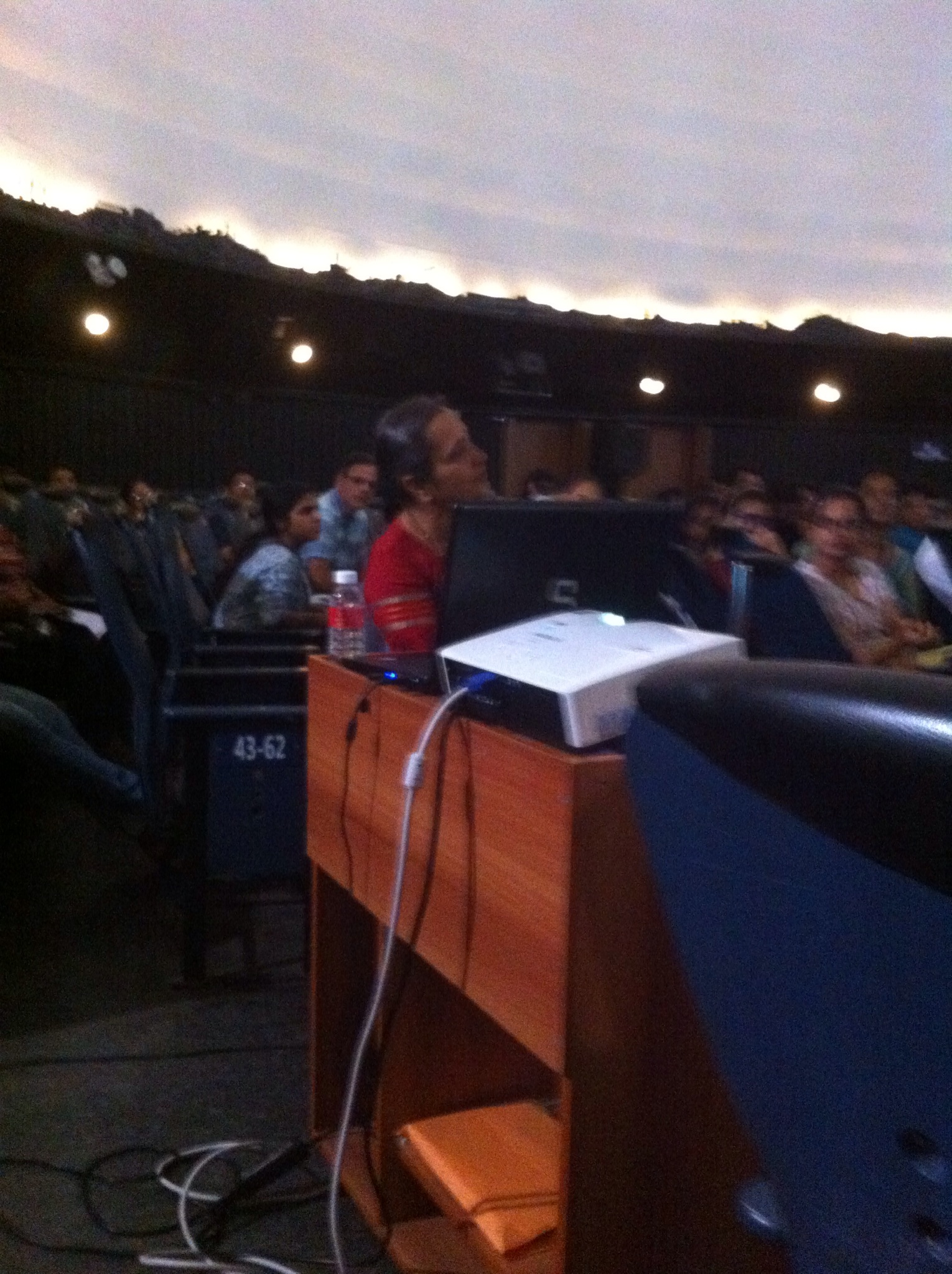
    Last Saturday I was at Nehru Planetarium, Mumbai’s Sky Theatre listening to a talk by ISRO’s Dr Seetha. She was working with the Mars Orbiter Mission and from my understanding on the Mars Colour Camera project. She is also a principal investigator on the Astrosat Project.

    IMG_0686.JPG
    Image: Dr. Seetha giving her talk at Nehru Planetarium, Mumbai. Image Credit: Pradeep Mohandas, released under a CC-BY license.


    Nehru Planetarium director Arvind Paranjpaye introduced Dr. Seetha who comes from a background in astronomy and who was working on the instrumentation of telescopes at the Kavalur Observatory. She moved to ISRO once it began the Planetary Sciences Division at PRL, Ahmedabad. She was among a group of scientists who moved from astronomy to space division within ISRO, a fact that was thus far unbeknownst to me.

    She spoke of some of the challenges faced by the ISRO team whilst putting together the Mars mission – the usual facts about the need for the longer coast phase for the PSLV, the need for additional ocean based terminals provided for by the Shipping Corporation of India, the re-starting of engines and of-course the Mars Orbiter insertion. She spoke of how the once in 26 month opening comes for a mission to Mars works and also answered specific questions on spacecraft instrumentation redundancy and radiation and thermal shielding. There were a few request for apps. She said the spacecraft may have enough fuel now to do a 1 year mission even though though it was designed for a 6 month mission thanks to the inserted orbit. She asked the audience to follow the mission via Facebook and Twitter for more exciting picture releases and perhaps even a few science results from the other instruments.

    I hope ISRO does send more of its scientists to talk to the public in gigs such as this. She said she understood that there was public was restless about the speed at which the pics were getting released via Facebook and Twitter but said that the speed was slow down a bit as the scientists get down to the science. In a private conversation with her, I got a chance to thank her for the better quality of pics that were now being made available. She said that better technology enabled this.

  • India at Mars

    Short version: India’s Mars Orbiter Mission spacecraft successfully fired it’s Liquid Apogee Motor (LAM) today to correct its trajectory and also served as a test for the LAM which had been sleeping for about 298 days now whilst the spacecraft sped in the general direction of where Mars would be. As of 9:30 AM today, MOM is in Mars’ sphere of gravitational influence, it test fired and trajectory corrected at 2:30 PM today. Long version below.

    It was 2:30 PM today when ISRO tweeted that the MOM may currently be firing its LAM to perform a test to check if it’s still working and also execute a very small trajectory correction so that the spacecraft will be set up to park into Mars orbit come the morning of September 24. About 15 minutes after that, ISRO announced to the world that they had fired the engines successfully for nearly 4 seconds.

    ByJG5vxCYAA7xvw


    Image: ISRO flashed this image on Twitter with the caption, “Test Firing of Liquid Engine: Guided by wisdom, Executed by youth”. link to the orignial pic

    I was really sceptical about ISRO’s prospects of doing a Mars mission. They worked really hard and pulled through extra shifts to ensure that a spacecraft would be ready in time for the Mars launch window in 2013. Little news items were strewn around showing progress that ISRO made that showed that ISRO was working towards the goal of launching in 2013 but nothing quite indicated that they were ready to launch. As the launch window approached, they quickly got the spacecraft off Earth on a smaller launch vehicle than one would anticipate being used for a Mars mission anywhere else in the world.

    The modified PSLV, a workhorse adaptable launch vehicle performed excellently delivering the spacecraft to its intended orbit. The spacecraft then performed orbit raising manoeuvres and slowly headed out towards the heliocentric orbit. As the spacecraft pushed off towards Mars, my skepticism slowly waned away.

    For a technology demonstrator mission, the most critical part of the mission is to show that the fundamental building blocks work and can function. With today’s LAM firing, I think that ISRO proved a very crucial component of the mission design. Skepticism kept me away from posting anything here for a very long time. I have to say that I am now very hopeful that we can do this. I seek nothing more than a gentle nudge that puts the spacecraft in an elliptical orbit around Mars.

    Critics of this mission have been plenty and have criticised each component of this mission design. ISRO has answered its critics thus far by action, something I think that many Indians would do well to ape.

  • First Trajectory Correction Maneuver of Mars Orbiter Mission tomorrow

    Tomorrow, as I will be celebrating my brother’s birthday, the Mars Orbiter spacecraft will perform the first of the four trajectory corrections on its path to Mars.

    A Facebook update posted just now revealed that the spacecraft will fire its 22 N thrusters for about 44 seconds at 6:30 am (IST).

    Best wishes to ISRO and birthday wishes to my brother 

    :)
  • Mars Orbiter moves out of Earth

    The Earth’s gravity has an effect on objects that passes through a giant sphere assumed to be 9.25 lakh kilometer in radius. This is known as the Earth’s Sphere of Influence. This distance is of interest to us tonight because the Mars Orbiter spacecraft will cross this milestone early tomorrow morning (December 4, 2013) at 1:15 AM IST.

    It has already become the farthest Indian object in outer space and slated to go further out as it heads to Mars. Out of the Earth’s sphere of influence, the principal gravity acting on the spacecraft will mostly be the Sun. This pushes the orbiter along the heliocentric trajectory towards Mars.

    One of the many milestones that MOM crosses en route to Mars. ISRO is certainly doing its best on Facebook to keep the activity alive and kicking on this 10 month long journey to the Red Planet.

  • Journalists get a peek at the Mars Orbiter Mission

    Journalists from India (AFAIK) got a peek into the Mars Orbiter Mission spacecraft on Wednesday. The PTI copy was meticulous but dry. Pallava Bagla at NDTV still insists on calling it Mangalyaan. The other interesting pieces appeared in The Hindu and The Times of India respectively. Might also be worth looking at the links to see pictures of the spacecraft. I wish ISRO put up some pics as well so that poor bloggers like me sitting at home can post them on the blog without having to worry about copyright violations.

    The Mars Orbiter Mission, as ISRO calls it, has come through a rather demanding timeline in terms of space projects to enable it to launch during the October-November 2013 launch window that has opened up to Mars as it closes on its opposition to Earth.  At the previous such opportunity in 2011, the Russians launched the long pending Phobos-Grunt mission to Mars. China piggybacked on the mission with its own small spacecraft the YH-1.

    India also hopes to send a relatively small spacecraft to Mars. The Orbiter will launch on ISRO’s dependable rocket, PSLV using extended strap-ons. The launch itself will be set against the dramatic backdrop of the North-Eastern monsoon and the beginning of the cyclone season in the Bay of Bengal.

    As per press reports, the spacecraft will move to Sriharikota from the ISRO Satellite Center on September 27. This will be after a “national review” which is to be held on September 19. The spacecraft will be integrated on the PSLV-C25, being currently assembled at the Satish Dhawan Space Center, Sriharikota. This PSLV-XL will have slightly larger strap-on motors. The spacecraft will fly from Sriharikota and will use the help of two civilians ships in the south Pacific ocean en-route to the red planet. The spacecraft will take one year to reach Mars. In September 2014, the spacecraft will perform the critical Mars orbit injection maneuver. The first signals from the spacecraft will be received by the NASA Deep Space Network at Canberra, Australia.

    As we prepare, September will be a month of action for ISRO. As it works on the spacecraft to ensure that it is space-worthy, two civilian ships will be sent to the south Pacific ocean on September 15, 2013 from Visakhapatnam. These will help during the phase after launch and whilst the spacecraft will be headed to Mars.

    This page maintained by NASA lists mission failures of the Mission to Mars is a good indicator on why it is a good idea to leave no gaps in mission planning to Mars. Spacecrafts have wide open areas for failure – reaching Earth orbit, the coast to Mars, reaching Mars orbit and perhaps even whilst the orbiter is in orbit. One can but hope.

    Here’s wishing India’s Mars Orbiter Mission Godspeed on its journey to Mars.