Shri Krishna Jayanthi is celebrated as the day when Krishna was born. This falls on the day of Rohini Nakshatram in the month of Chingam, as per the Malayalam calendar. This fell on August 23, 2019.
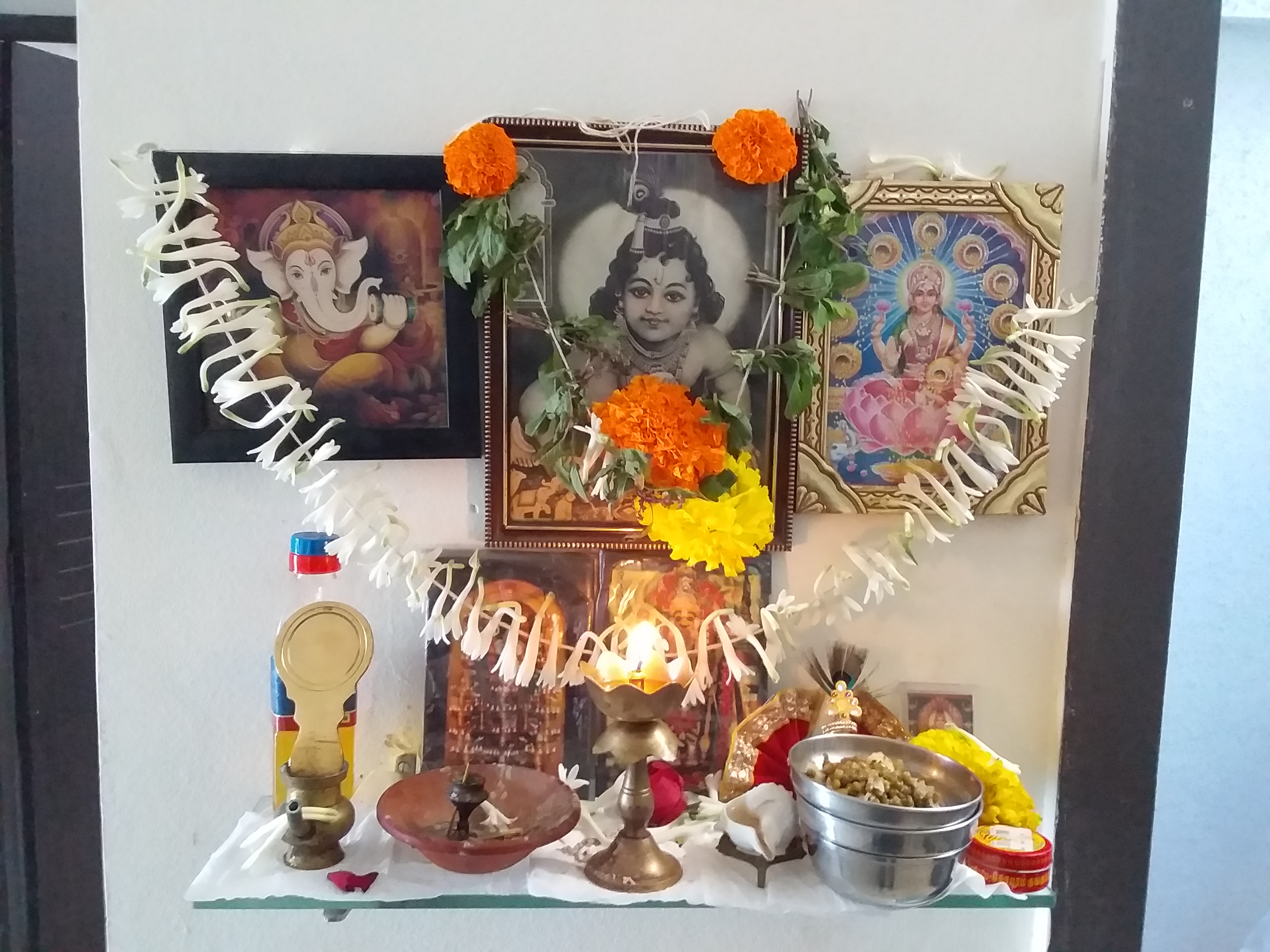
We celebrate this day by decorating the pooja room, undertake fasts, offer Prasad like Appam and Palpayasam , chant the Vishnu Sahasranamam and play devotional songs. Shri Krishna Jayanthi is also known as Ashtami-Rohini, Janmashtami or Gokulashtami.
Our pooja place decorated for Shri Krishna Jayanthi. Credit: Pradeep Mohandas
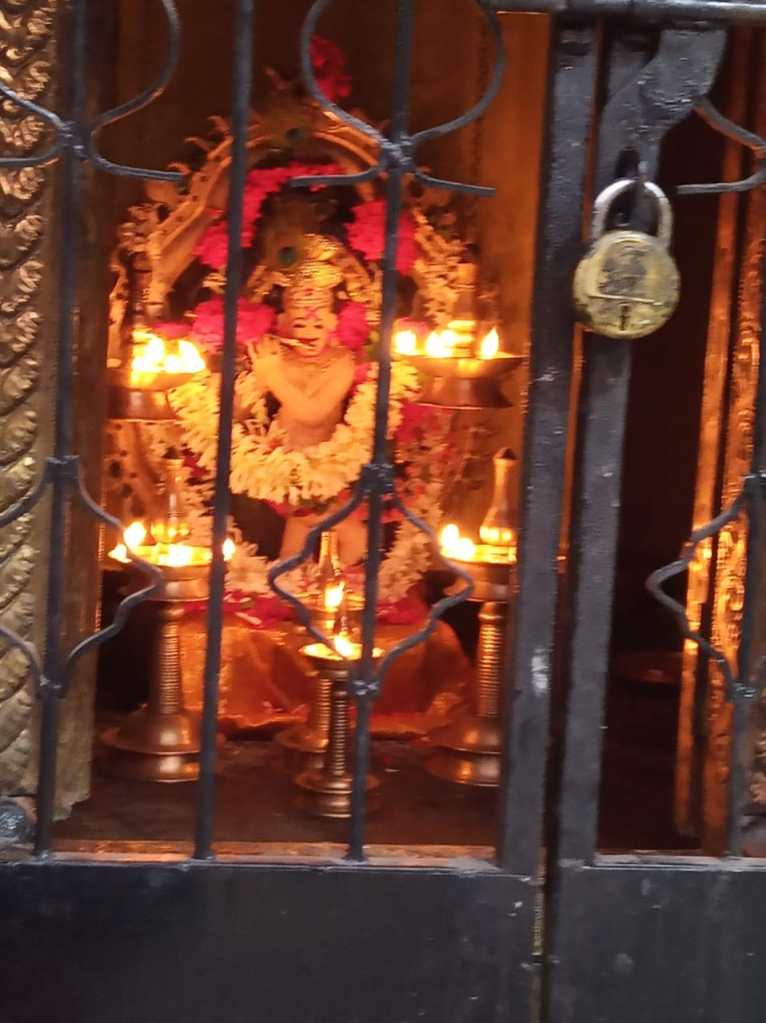
It was a working day for Pradeep ettan. After he returned from office, we went together to visit the Ayyappan temple at Dhanori. The statue of Krishna was beautifully decorated with sandalwood.
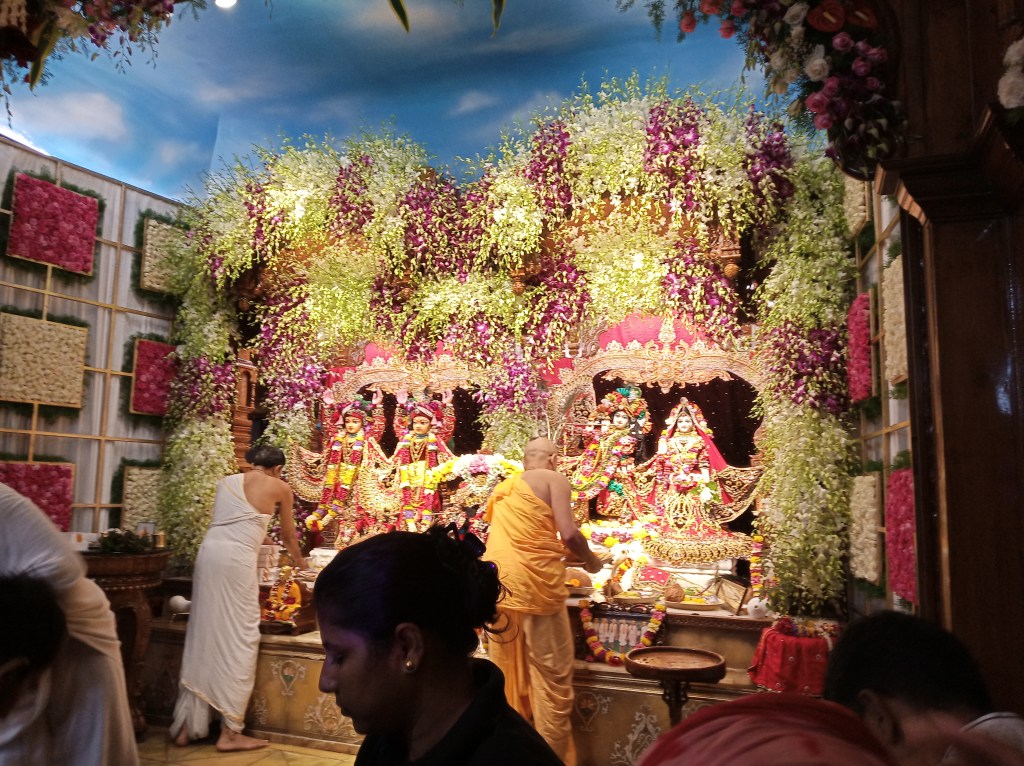
The Sanctum Sanctorum at the Ayyappa Temple, Dhanori, Pune. Credit: Dhanya VallatSanctum Sanctorum of the ISKCON Temple, Camp, Pune. Credit: Dhanya Vallat
From
there we went to the ISKCON temple in Camp, Pune. The temple had created a
carnival like atmosphere and depicted the life of Krishna in life size
displays. The statue and sanctum sanctorum was beautifully decorated with
colourful flowers.
The Chandrayaan 2 spacecraft entered into an orbit around the Moon on August 20, 2019 at 09:02 AM (IST).
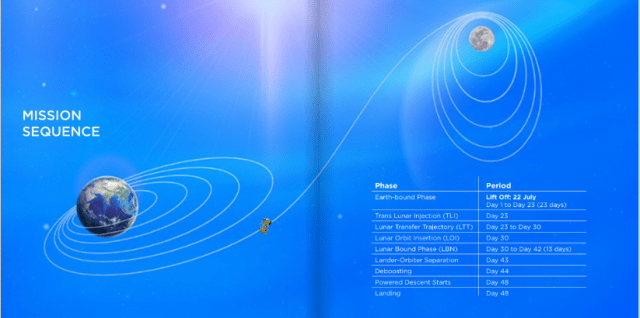
This was a result of a lunar orbit insertion (LOI) manoeuvre the spacecraft performed that lasted about 1738 seconds. The spacecraft was in Earth orbit and used it’s gravity to be propelled towards the Moon. As the spacecraft reached close to the Moon it used its on-board motor to perform a breaking to decrease its speed (this was demonstrated in Mission Mangal) and allowed itself to be captured by the Moon’s gravitational force.
The spacecraft entered into a 114 km x 18,072 km orbit around the Moon. This means that the spacecraft’s closest distance from the Moon (caller perilune) is 114 km and it’s farthest distance (called the apolune) is 18,072 km. The next day it performed another similar manoeuvre to reduce its speed and moved into an 118 km x 4,412 km orbit. This is the opposite of what it did in Earth orbit and will continue till it achieves a circular orbit of 100 km.
The Chandrayaan 2 spacecraft is now in its Lunar Bound Phase. Image: ISRO Launch Kit
Moon as viewed by Chandrayaan-2 LI4 Camera on 21 August 2019 19:03 UT
Today, ISRO released pictures taken by the LI4 camera on board the Vikram lander of the Chandrayaan 2 spacecraft. LI4 probably stands for Landing Imager 4. It should be one of the cameras on the lander that would be used to guide the lander to the surface of the Moon.
The next manoeuvre is slated for August 28, early in the morning. You can follow the updates of Chandrayaan 2 directly from the ISRO website page.
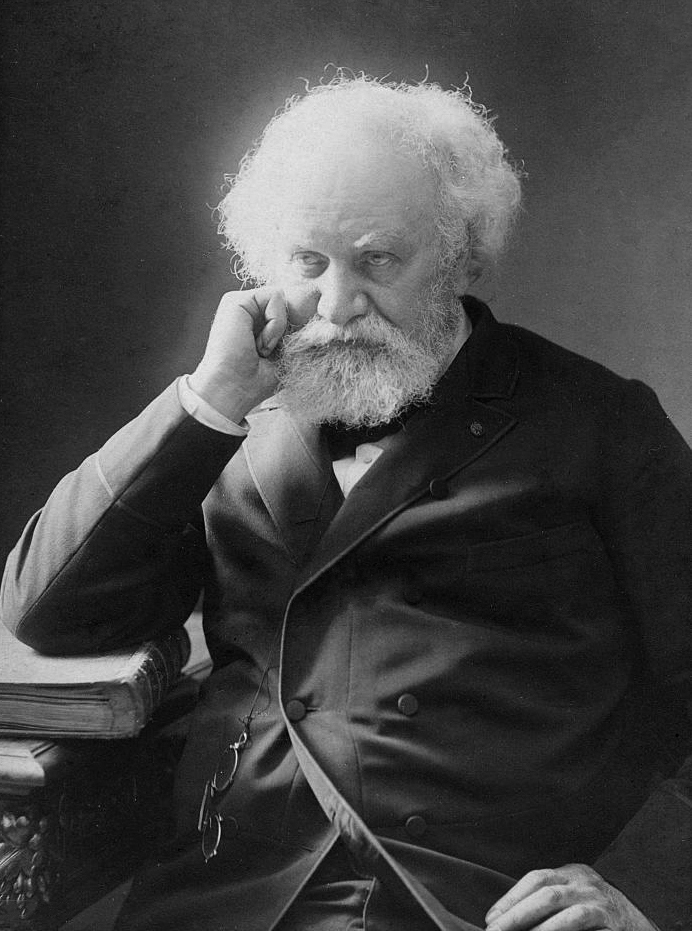
The first evidence of helium was observed on August 18, 1868, as a bright yellow line with a wavelength of 587.49 nanometers in the spectrum of the chromosphere of the Sun. The line was detected by French astronomer Jules Janssen during a total solar eclipse in Guntur, India.
The source of the information is an article in the Journal of the British Astronomical Association by R K Kochhar in 1991 ( Kochhar, R. K. (1991). “French astronomers in India during the 17th – 19th centuries“. Journal of the British Astronomical Association. 101 (2): 95–100)
The article is also a study of the work done in India by the French at the dawn of the field of astrophysics in the middle of the 19th century. Pierre Jules Cesar Janssen (1824 – 1907) had come to India to observe the total solar eclipse on August 18, 1868. Gustav Kirchoff’s work on using the solar spectrum to understand the chemical composition of the Sun was applied using a spectroscope.
The spectrometer separates elements of the electromagnetic spectrum and identifies elements by matching the spectrum to the wavelength of each element.
During the eclipse, Janssen was observing the solar prominence. These are gases that are blown off the Sun but still connected to the Sun’s surface. While studying these gases with a spectroscope, Janssen observed hydrogen gas but also observed light in another spectrum which did not correspond to any known element at the time. The observed spectrum was so bright, in fact, that Janssen thought that he did not have to wait for an eclipse to observe them again.
He was stationed at Guntoor from August 18 to September 4 when he observed the same spectral line each day. To continue studying the Sun on a daily basis, he built an instrument called a spectrohelioscope that he used to observe the Sun from Shimla.
His spectrohelioscope was used by other observers till 1891 when it was superseded by a spectroheliograph. Edward Frankland named this new element Helium after Helios, the Greek word for the Sun. When Janssen returned to France, he became Director of a new astrophysical observatory that the French government had built in Meudon, on the outskirts of Paris. He was President of the French Astronomical Society from 1895 to 1897.
I have been listening to IVM Podcast’s The Seen and the Unseen podcast hosted by Amit Varma since about the last year or so. The important I learnt in lesson in this episode that the usual tags of left and right politics do not apply to Indian politics. Indian politics can be better understood based on the ideologies of identity and statism.
The cover art of the Episode 131 of The Seen and The Unseen
Amit’s earlies episodes espouses the classical liberal ideologies and are based on the idea of individual freedom. While the explanation made theoretical sense, it didn’t quite apply when I analysed many macroeconomic issues to try and understand why the government acted in the way it did. Hence, Amit’s episodes were critical of any government that was at the Center.
This particular episode presented a better political lens to understand the Indian political landscape. The episode is based on the book Ideology and Identity by Pradeep K Chhibber and Rahul Verma. Rahul Verma explains the terms ideology, identity and statism. He then takes us through Indian history post-independence as seen through the lens of identity and statism and explains how this bifurcation of Indian history makes more sense than the western right-wing and left-wing narrative.
The episode held several insights for me. That India had a rich “conservative” tradition but this was hidden from English readers like me. These traditions existed in the vernacular press in Hindi, Marathi etc. An earlier episode began digging at some of the features of the conservative tradition in India which seems to have been so different from the conservative traditions in other countries. It has been a fascinating listen for me.
I haven’t read the book but would definitely suggest listening to this episode if you want to decide either way about getting their book.
I went to PVR Cinemas at Pune’s Phoenix Marketcity Mall to watch Mission Mangal on Friday, August 15, 2019. Being a self-professed space geek, I expected the movie to be a cringe-show. It was.
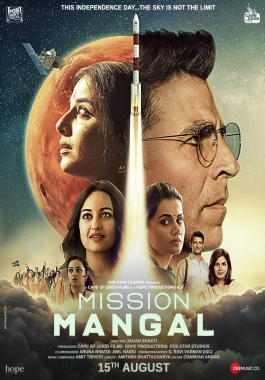
Poster of Mission Mangal
Mission Mangal (2019) is a Bollywood movie inspired by the Mars Orbiter Mission (MOM). The mission involved the Indian Space Research Organisation (ISRO) flying a mission to Mars. The mission, a technology demonstrator, succeeded on it’s first attempt. The movie carries a disclaimer at the start of the movie which says that it is a fictionalised account.
The on-film depiction of ISRO is no where near it’s original. I don’t think a scientist in ISRO are insecure in their knowledge that they would feel threatened by a person who got his experience working in NASA and who returns to serve his country. This is the description of the villain of the movie. I think MOM borrowed and learnt a lot from NASA for the actual mission. MOM’s first signal acquisition was in fact from NASA’s Deep Space Network in Australia. I don’t think the movie really needed a villain.
The other issue that bothered me a lot is the need for a hero. Akshay Kumar is no where near the scientist that ISRO has. His imitation of talking to former President Abdul Kalam in Tamil was the lowest point of the film, in my opinion.
The Polar Satellite Launch Vehicle (PSLV) was made much more muscular and eye-candy than it actually is. There were a lot of holds on that American launch pad. Bollywood also made it into a two stage launch vehicle rather than the four stage rocket it is. I loved the sound and capture of the lift-off which reminded me so much of the Shuttle launches. India countsdown in minutes and seconds and not from 100 seconds.
There are struggles of the women scientist in ISRO. Tackling pressure at home, managing family, managing expectations of mother-in-laws, difficulty in getting a flat because of belonging to a certain religion and live-in-relationships. I would have been happier if these stereotypes would not all be pushed throughout the film. Also, I didn’t miss the stereotype of a woman who could not drive on road handling navigation for an interplanetary mission.
So, with all those things that I didn’t like in the movie, it still pulled through because it manages something that I think ISRO fails at communicating. How difficult it is to get funding for a mission. What parameters are considered and how difficult it is to plan a mission. It also attempted to explain orbital mechanics. The movie takes a dig at superstitious practices that ISRO itself follows. Akshay Kumar’s only positive show in the movie seems to be standing up as a rational person to some superstitious practices in the Mission Control Room.
I still think that the movie is a good starting point for a movie based on a scientific mission. For that, it is worth seeing. As I said at the beginning, I cringed a lot while watching the movie.
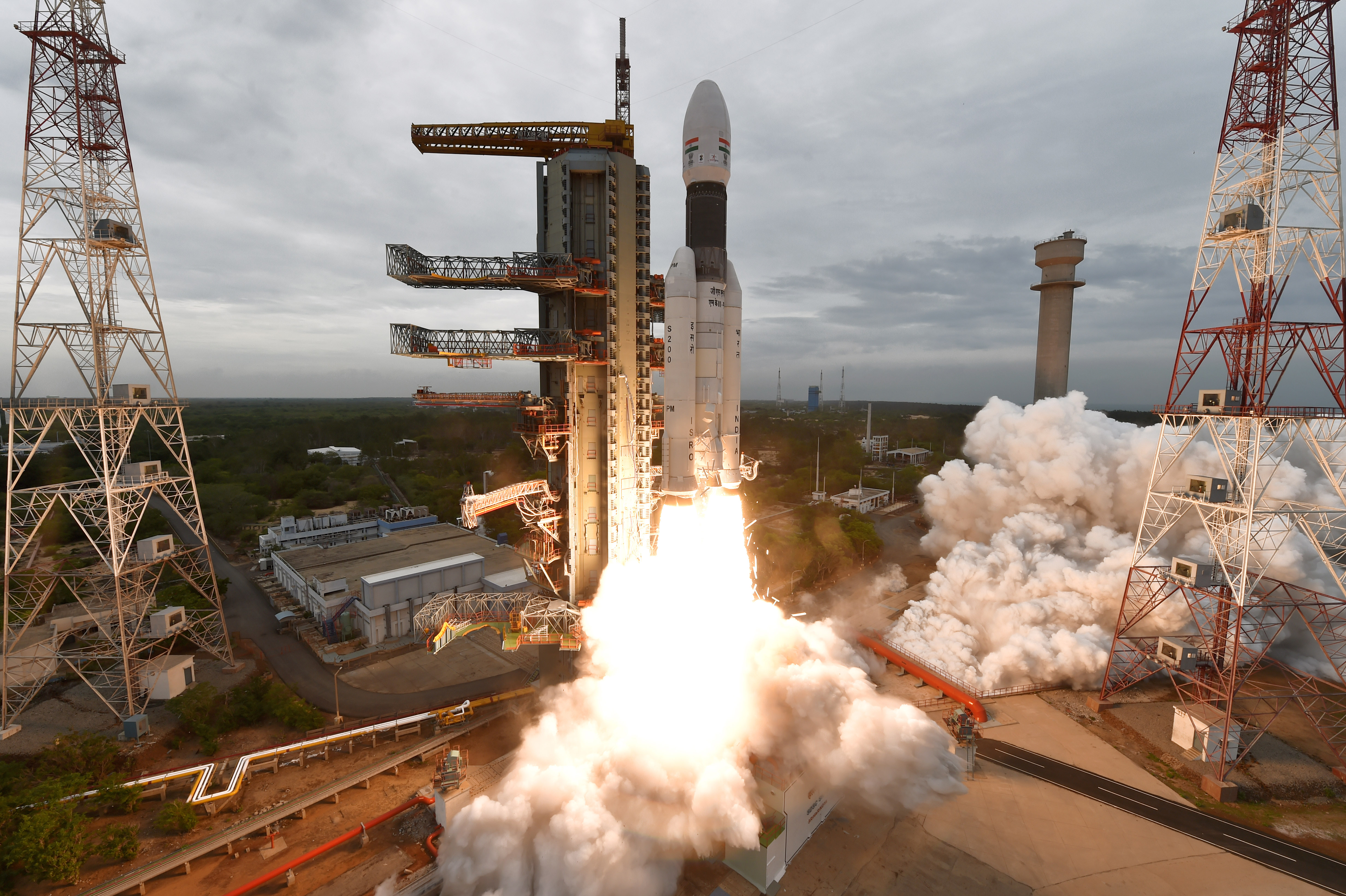
Chandrayaan 2, India’s second mission to the Moon lifted off from Sriharikota on July 22, 2019. The spacecraft was launched on board India’s GSLV Mk-3 rocket on it’s maiden non-development flight.
GSLV Mk 3 lifts-off with Chandrayaan 2. Image Courtesy: ISRO
It came after a launch scrub surrounding which there was lack of information and a lot of speculation. I watched the launch with my grandmother in Mumbai.
Since the launch, the spacecraft which currently has an orbiter and lander attached to each other performed 5 orbit raising manoeuvres on the way to the Moon.
India adopted this gradual orbit raising manoeuvre in order to balance the limitation of the spacecraft and the launch vehicle. A lower mass of the spacecraft would enable the launch vehicle to place the spacecraft into lunar orbiter but it would then not be able to carry any meaningful payload. The launch vehicle had only enough power to place Chandrayaan 2 in a geosynchronous transfer orbit.
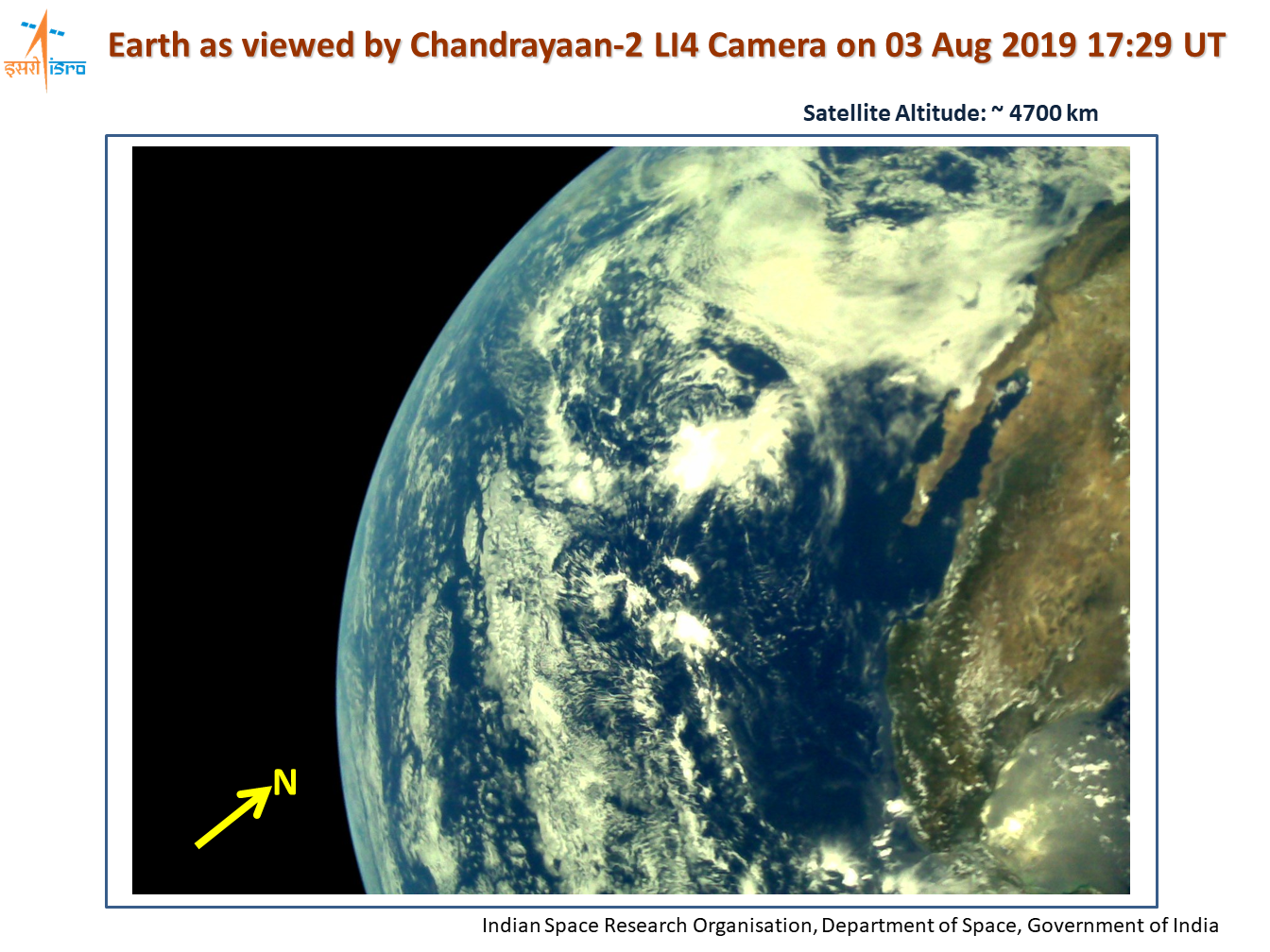
Image of Earth taken by the LI 4 camera on board Chandrayaan 2. Image Courtesy: ISRO
After the 5th orbit raising manoeuvre, the spacecraft will push off towards the Moon called Trans Lunar Insertion on August 14. Afterwards, the spacecraft will perform one more burn called the Lunar Orbit Insertion on August 20 that will let the spacecraft be captured by Moon’s gravity.
I have been following the works of travel blogger Shivya Nath since I found India Untravelled on Google. I wanted to go to Spiti and was looking for places to stay there and this was one experience that I wanted to have. She used to run the site that discovered these homestays before she sold that company to become a digital nomad. Not going to Spiti remains one unchecked item in my bucket list.
I picked up her book hoping to regain my bearings and rediscover my love for travel once again. I was going through a particularly difficult phase at work and hence, even reading the book got postponed for a really long time. I bought the book on September 18, 2018. I made slow progress but it’s finally done.
My travels have mostly been with family. I have travelled solo very few times.
Shivya talks about two journeys in the book. One, were her journeys solo to different parts of the country and across the globe. Another, is the parallel personal journey of overcoming restrictions of society and the ones that she herself placed and overcoming these to become a digital nomad and a travel blogger that she is today.
Her journeys across the world are well covered on her eponymous blog, The Shooting Star. But, I’d recommend the book more for reading about her parallel personal journey. For anyone who travels, one knows that this is a given as we travel more and more. But, it is still wonderful to uncover. Resistance from parents, hesitation before taking the entrepreneurial jump, worries about safety while travelling solo, meeting strange people in strange lands, discovering the things that matter to us the most and perhaps most importantly chasing the dreams and turning them into reality. It is this part of the book that I really enjoyed.
Brett McKay wrote on the Art of Manliness blog on the difference between Social Media and the Social Internet and the difference between the two. While the former was the keep of billion dollar industries the latter is the creation of individual people. Lately, I have found myself coming to my website to share things rather than keep them in silos maintained by corporations. Data is the new oil, if you haven’t already heard.
Brett’s blog post is a good starting point if you want to begin moving away from Social Media again towards the Social Internet.
Social Media are websites owned by corporations that monetize what you share and become multi-billion dollar corporations richer. Social Internet is the network of sites owned by individuals or even small businesses that put out content and are shared by people like you and me.
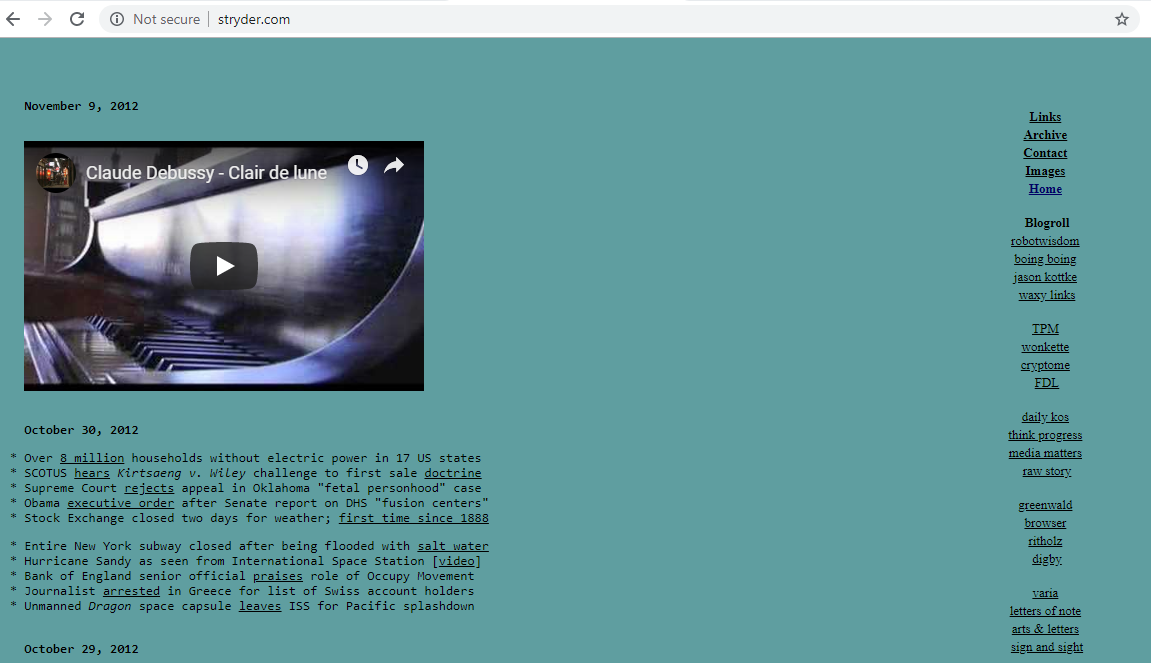
If you have browsed the web before 2007 in India, you would have worked your way through Yahoo! search engine, through various email threads on Yahoo! groups and found like minded people sharing web pages using links. When blogs burst on to the scene, you would always keep an eye on the about page and for the “blog roll” on the side of the blog to find new blogs. If you were on the blog roll of someone famous, you would get a lot of web traffic. This is how you organically grew your website.
stryder.com was a website that I visited often for such web links and blog rolls. Image Credit: Pradeep Mohandas
The onset of websites like Facebook and Twitter were the onset of Social Media. These websites earned money by showing us targeted advertisements based on the things we liked, shared and searched on their website. Getting us to stay on their websites for longer (even not having to open web links on a browser) means they can watch user behaviour for a longer time. Data is the new oil. Wired ($) has a personal guide to Personal Data Collection that tells you how your personal data is collected and used. However, they do offer a convenience in use and sharing that Social Internet has never reached.
The Social Internet was built on RSS feeds. Not the Rashtriya Swayamsevak Sangh but Really Simple Syndication. Google Reader made it a breeze to subscribe and read blog posts and even listen to podcasts. But, Google pulled the switch on the project and RSS feeds have been difficult to follow ever since. I currently use Feedly for blog posts, Spotify for podcasts and Thunderbird for feeds and email offline. What I would really love is a mobile version of Thunderbird that I could use to read and write emails, read my blog posts, listen to my podcasts and play videos from the channels I have subscribed to. One app to do it all would mean so many saved apps downloads and my data would be safe with a non-profit like Mozilla Foundation where we would have more control on our own data.
I know reading this sounds like I am scared of Social Media but the fact is that I use it as much as other people but I am slowly beginning to realise that we need control of the data that we create. I believe that awareness that your data is being used by Corporations to make more dollars is a good first step.
Ayn was sitting at the console today. She got a notification for a
Longreads story on the beginning of the Quantum Computing on the
Moon. She opened the notification to read the story.
Quantum Computing came to the Moon with the Indian company, Pradnya Labs. Pradnya Labs was founded by Pradeep in 2020 after he quit his banking career. He started it for teaching Artificial Intelligence and Machine Learning to his peers. He found that more money was to be made by teaching others than the application of these skills in an industry that youngsters were getting into than someone who lacked experience in the field.
Pradeep turned out to be a much better teacher than an employee or a worker in India’s software industry. Pradnya Labs then expanded into digital literacy drives for the elderly. This Pradnya Labs saw as Corporate Social Responsibility as the company grew big in Southern India and went public in 2024. However, students who left Pradeep came back to join him in India as teachers. Along with them came two important people – Shruti and Sriram.
Shruti worked with Microsoft in the US and was working with its Quantum Computing division. Sriram came from Tesla and came from its famous Batteries Division. In a famous meeting held in a tea shop in Palakkad, they encouraged Pradeep to foray into Quantum Computing. First, they held classes for Quantum Computing core processes.
Pradeep learnt that Quantum Computers would not sit in people’s hands like ordinary computers. These would be installed in the cloud and would communicate with people’s devices through broadband. From the profits that Pradnya Labs made up to 2025 and raising money from family and friends, Pradnya Labs founded it Quantum Computing Division with Shruti heading the same.
In 2026, Pradnya Labs produced the first quantum computer, called Adi. Pradeep thought that putting these quantum computers in the sothern pole of Lunar craters would provide them with natural cooling. The Aitkens basin was identified. He spoke with Indian Space Research Organisation (ISRO) Chairman, Pavan. Pavan was not sure if Pradeep had a working idea and hence called his colleague at the Indian Institute for Information Technology (IIIT) Hyderabad, Mukunth for setting up a demonstration. Adi was setup with the quantum computer built at IIIT and was test run. Adi outperformed the IIIT-Q by 15 seconds.
Pavan asked Pradeep how they hoped to communicate with the Moon? Pradeep said a relay satellite would be placed near the Moon and would re-send the signal to Earth. Although, Pavan was not fully convinced, he agreed to place one Adi on the Moon’s Aitkens basin.
Meanwhile, Sriram was working away in a nearby lab in Hyderabad to build Tesla style battery packs within which the quantum computer could be carried to the Lunar South pole. He added a communications module. The body of the Adi-packs were tested in ISRO labs in Bengaluru. After they came through successfully, the first Adi-packs were launched to the Aitkens crater in 2025.
Through 2026, ISRO, IIIT and Pradnya Labs tested the relay system and found that the speed that Adi got was lost in communication with Earth. Dwitiya was launched in December 2026. Developed in the Pradnya Q Labs in Coimbatore, Dwitiya was faster than IIIT-Q by 83 seconds. ISRO launched a Dwitiya pack to the Aitkens basin in 2027. Happy with the results, Pradnya Labs got orders for Dwitiyas themselves as well as for time for use on the Lunar Dwitiyas.
Meanwhile Sriram got in touch with his former boss at Tesla and through him got Pradeep to talk to Elon Musk. Pradeep asked Musk for a redesign of their Starlink satellites to provide a way to receive data from the Moon and relay it to Earth. Working through 2027 and 2028, the Starlink 2.5 satellites were launched by SpaceX in 2029. These provided improved speed, better data crunching and faster applications. With the advent of this, many of the other service providers in India started gaining an equal footing.
Pradnya Labs’ profits soared. In 2030, Isha Ambani of Jio approached Pradeep with a new idea. She wanted Jio to build satellites that would relay the information from the lunar Dwitiyas back to Earth. Pradeep shared that they were working on Tritiya. One Tritiya would launch next year. But, one demonstration at the Pradnya Labs Quantum Computer simulator meant she paid for the construction of three more Tritiyas exclusively for use of Jio. In addition, she also paid Exseed Space for the construction of 25 Jiosats that would relay the information for users in the Indian subcontinent.
A total of five Tritiyas were launched to lunar surface at the Aitkens basin. Two were used for scientific data crunching for science institutions in India. Three were used by Jio. They said the three lunar data centers took care of half their data center needs on Earth.
It was one of the
Tritiya that had predicted that an asteroid was to hit Earth in 2040.
Ayn was one of the few human beings that left on the spacecraft one
year before impact was predicted. Today was the day when the asteroid
would hit Earth.


 Parallel Spirals
