I missed posting the Weekly Notes for the twenty-fifth and twenty-sixth Weekly Notes.
OTT
I’ve watched:
Trishanku (Malayalam)
Ayisha (Malayalam)
The Net (English)
The Vortex (French)
Live (Malayalam)
The Sinner (English)
Writing
I had a lot of end of the quarter deliverables at work that I completed. This was at the cost of some other thinking and writing. After a brief pause because of fever, I got back to writing excited by the Chandrayaan 3 launch date confirmation. I wrote:
There is no sane way to process the amount of information that we are hit with every day. Trying to consume it all only left me with no time for family, friends, etc. So, I went back to digital subscriptions for The Hindu, Frontline, The Scroll, and The News Minute.
I read The Hindu for a general awareness of stories. I read Frontline for some in-depth reading of certain stories. I read The News Minute for coverage related to Kerala. I read the Scroll for some of the book excerpts and investigative news coverage.
For stuff related to work (technical writing) and interests (Space and Zettelkasten), I follow people on social media specific to these interests.
I have been trying it out for a month and so far, it seems to be helping.
Suhasini Haidar, writing for The Hindu, talks about the upcoming visit of Indian Prime Minister Narendra Modi to France. A key paragraph to highlight in the article:
India and France are also hoping to strengthen ties over collaboration in space that dates back to the 1960s. Apart from collaborations in launching satellites, the two sides are also looking at training astronauts and partnerships in space industrial engineering, it is learnt.
France provided inputs on solid fuel technology to ISRO with the Centaures rocket in the 1970s. Working together on the Viking liquid engine, under an arrangement with the European Society for Propulsion (SEP), provided valuable inputs to develop India’s workhorse Vikas engine in the 1980s. The French helped in setting up the Liquid Propulsion Systems Center (LPSC) at Mahendragiri, Tamil Nadu.
Arianespace has provided launch service for various Indian communication satellites, as India struggled with mastering cryogenic technology. ISRO and CNES has worked together on two satellites related to climate studies, Megha-Tropiques and SARAL. A future collaborative mission, Trishna, is slated for launch in 2024.
India and France can play an important role in space science. I would love to see a continuation of co-operation of Earth observation satellites that are built to study Earth’s climatic systems. I believe that collaboration with France particularly with the mission to Venus would be a shot in the arm for the Indian Venus Mission, called Shukrayaan. France has experience with working on the Vega missions with the Soviet Union.
The study of Mars is a rosy colonization dream today. The study of Venus provides an understanding of where the Earth could be headed because of global warming and climate change. I think there must be as many if not more missions to Venus as there are missions to Mars today.
France is also a signatory of the Artemis Accords, and along with Australia is trying to look for an international arrangements to govern access to and resources on the Moon. This is an essential middle path that India must try to support. Global supply chains are important to keep mission costs low.
India must try to book cheaper slots on the Ariane 6. There is a 6 ton and higher category of satellites that Indian launch vehicles can currently not support. India must also try to get more French companies to try to fly on Indian launch vehicles. There could be an opportunity coming up during the period of transition between Ariane V and Ariane 6.
At the industry level, I believe there are opportunities to collaborate in data sharing and data analysis. Indian space startups could try to provide satellite, satellite sub-systems, and propulsion systems to French startups.
The wari passed through Pune last week, just like it did every month. As always, it disrupted life in the city but people have been used to it for centuries. The wari reminds me to look up about the lives and teachings of the saints of Maharashtra.
A surprisingly large number of these saints had their samadhi in places close to Pune. This added to my fascination to learn about them and to understand their teachings. When we had visited our pediatrician last week, he had mentioned that my daughter’s school name was a name for Sant Tukaram, part of the Warkari tradition. We get similar reminders about the existence of these saints in various parts of Pune.
Mani Rao wrote in Scroll about a chat that she had with Priya Sarukkai Chabria, the editor of the e-journal, Poetry at Sangam, which was going to shut after beginning in 2013. Among the various questions was about the fact that the e-journal contained English translations present in the e-journal from various Indian languages, besides poetry in the English language.
I did not find mention of poems in Malayalam but did find poems in Marathi. Poetry at Sangam had English translations of poetry in Marathi by Anjali Purohit, Jerry Pinto, and Neela Bhagwat. The translation of a riddle in the Bharoods of Sant Eknath (1533-1599) specifically caught my eye. And thereafter, I read each one of them.
Contradiction is the sign of Natha’s home Where the water is parched with thirst.
The pot goes in, surrounded by water Water submerges in water.
Today I saw the strangest sight: Water flowing backwards from the eves to the ridge. The farmer sowed the field and The field swallowed up the guard.
The cooking pot was eaten and the rice thrown away God slaughtered in sacrifice before the goat.
Says Eka, Janardan’s path is antithetical He that understands this is a true follower.
I am also trying to place them in my understanding of Indian philosophy and the various philosophical darsanas. As I understand them, these are songs called abhangs which explain Vedantic philosophy in the format of songs made famous by the bhakti saints. Vedanta seems to have moved from explanations through debate with other philosophical systems to explanations in terms of analogies to this form.
The Weekly Notes seems to be the only blog post that I have been consistent with recently. All the other writings are cooling their heels in my draft folder. Many of the things that I began recording here have fallen to the way side and recollecting them has not been important.
I had a section for what I read or listened to this week. I have mostly been re-reading Ryder Carroll’s The Bullet Journal Method. I am reading it keeping in mind the stuff I read of Scott P Scheper on his ANTInet. This is to sharpen the Zettlekasten system inside my bullet journal.
I had a section on badminton and cycling. All the equipment related to these pursuits have begun gathering dust in different corners of the house.
I am embarking on a couple of courses related to the work that I do as a technical writer that will keep me occupied at home during the monsoon.
I had written on this blog about the practice of using my Bullet Journal as my zettelkasten on 19 May 2020. I had forgotten about it in the haze of the pandemic. I re-discovered the post as I was linking my thinking (h/t Nick Milo) in the past week or so.
In the Spirals section of my weekly notes last week, I mention the Antinet and the zettelkasten videos I had been watching on YouTube.
So, after binging on many videos in the last two to three weeks, I seem to have gotten exactly at the point I was at when I wrote my post on 19 May 2020. Before I forget the lessons I learnt, let me summarize the points I made in that blog post again.
I use many digital tools and hence my data is stuck on many different platforms (like Evernote, Roam Research, etc.)
Moving a zettelkasten into a bullet journal reduces the clutter of index cards.
Threading in zettelkasten reminded me about a video about threading in the bullet journal.
Index in a bullet journal is the master collection. Similar to an index card in the zettelkasten.
Collection threading is done by writing the reference of the page number next to the page number in the next collection.
Notebook threading is done by using book number + page number next to the page number.
I have been writing my notes about podcasts, YouTube videos, books, articles, etc. in my bullet journal since I started keeping one. These can be considered as bibliography notes or quick notes.
What would make my bullet journal into my zettelkasten would be to introduce progressive summarization that Tiago Forte talks about in his book, Building a Second Brain.
Another thing needed is to introduce a way to review the content in the bullet journal in a periodic manner and link my thinking.
A thing I noticed that the spirals I go down are naturally linked to each other. This focus reduces the need of too much categorization naturally. I can look through instances by using the index without the need to opening or delving too deep into any particular notebook.
I just put together a quick list of resources around the theme of taking and organizing notes – so it's an initial list of pointers to some parts of the PKM/TfT landscape off the top of my head:https://t.co/iIY0Mh7uq4
Happy to add stuff! H/T to @abhinav for prompting this 🙂
FP was mentioned by Curly Analog in one of his videos. This may be a good video to begin going down the Zettelkasten playlist FP has created on YouTube. Detailed notes on his blog begin from Lesson #1.
FP mentions that he backs up his notes digitally. Presently, he does them on Obsidian.
Frontline has a nice interview with Ananyo Bhattacharya, who is the author of The Man from the Future, a book about John von Neumann. I plan to get this book.
I argue that another of von Neumann’s contributions to computing, specifically his insistence on putting everything into the public domain and preventing the computer from being patented, has also had an enormous impact. He is the godfather of the open source movement, which is incredibly important today.
Ananyo Bhattacharya, Frontline
Some of the smartest people in technology say they are worried that AI is worse than pandemics and nuclear weapons. What I worry about is not AI extinguishing humans, but our humanity.
Across India, there’s a new kind of tourism that’s seeing a boom- astrotourism. Amateur astronomers, citizens building telescopes, hobbyists, and private companies are organizing dark sky tourism with nightly sky watching and fun daytime experiences.
Lovely article on the Malayalam alternative rock band, Avial written in October 2018. Covers how the band got together and how many of their iconic songs came about.https://t.co/QAIpJgur30
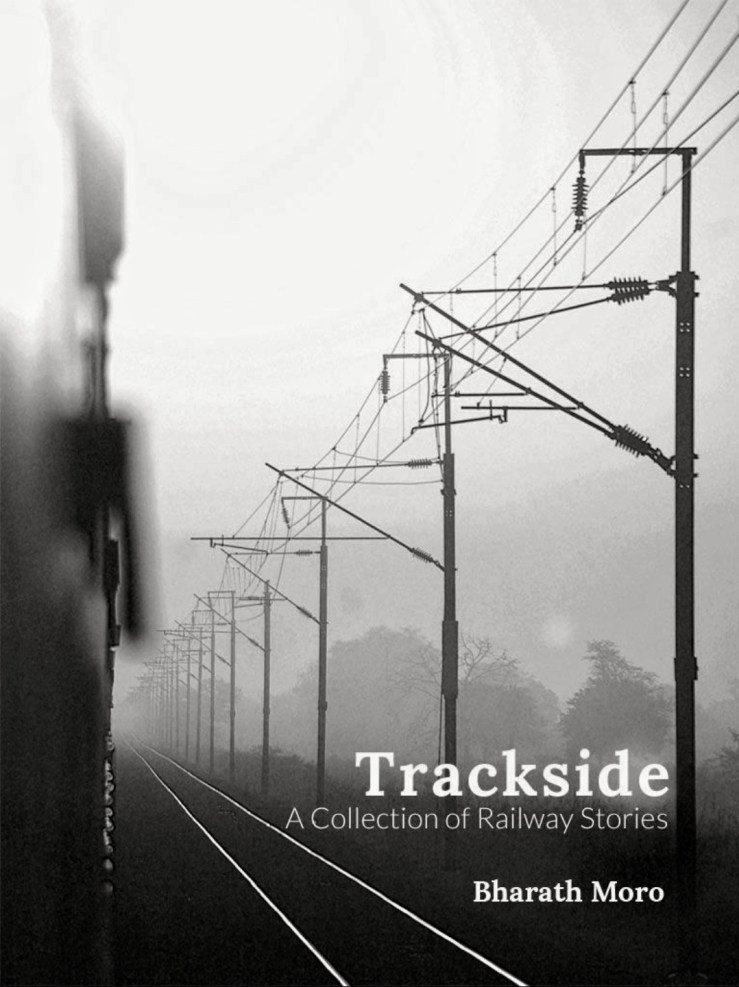
This book came out in March 2013. I purchased it in September 2013 on my Kindle then. I follow the author of this book on Twitter and probably learned about the book from there.
I was in a reading rut after my son was born. I could listen to audiobooks on Audible but couldn’t pay attention when I read any book (physical or digital). I wanted to break this rut. So, I went back to my Kindle device and searched back to the first book I purchased on the Kindle. It turned out to be this book.
Cover of the book, Trackside: A Collection of Railway Stories, by Bharath Moro
I loved some of the descriptions that he uses to describe the trains and railway buildings. He gave me the vocabulary to talk about sights that I see in my travels.
The red and cream locomotive screams into the platform with its assortment of coaches bobbing wildly.
Chapter 1: In Favour of Koraput and Bodinayakannur
Unlike the disjointed feeling one gets after a long flight, the railways allows for a gradual takeover. The landscape keeps changing, the houses seem different after a while, the food on the platform becomes less palatable (or the reverse) and the tea tastes better (or worse). And, by the time you arrive, you haven’t so much arrived as you have assimilated the destination.
Chapter 1: In Favour of Koraput and Bodinayakannur
The quaint old structures that used to house the station master’s office and booking counters have been demolished and replaced by banal, CPWD type boxy buildings, painted in a hideous urine yellow hue.
Chapter 7 : Dispatches from the Cauvery Delta
The book was an absorbing read and got me unstuck from my reading rut.
I have been seriously thinking about the rent vs. own debate. I currently live in a rented house. I visit people who enjoy their rented lives and am happy that I also rent. I also visit people who own their own homes and feel I had the freedom to do the things in my house that they can do at their own home.
One of the reasons that this is a debate is because of the cost of housing.
I read a blog post by Ashish on his blog, Econ for Everybody, called Not Quite As Simple As One Would Like It To Be. He begins by arguing that optimal regulation, although difficult, is the best solution to the problem of regulation. He says:
You’ll meet economists who tell you that housing can only be solved by removing as much regulation as possible. You’ll meet other economists who tell you that public housing is the only solution to the problem. And you’ll get bloggers like me, who will tell you that the truth lies somewhere in the middle.
The pandemic created a situation where the people expected an increase in prices as supply chains were disrupted. Weber says that the pandemic created a temporary monopoly, that allowed corporates to raise prices higher than the rise in cost of raw materials, without fear of losing market share. Weber calls this seller’s inflation. She suggests regulation of prices as a way to control this inflation.
One of the places she applied this theory was to regulate the price of natural gas in Germany:
She presented a detailed scheme for regulating the price of natural gas in Germany: households and businesses would be guaranteed a limited supply at an affordable, government-controlled price. Anything they burned in excess of that quota would be subject to the soaring market price. (Producers of natural gas would receive government subsidies to make up for the lost profits.)
Zachary Carter, The New Yorker, What if we’re Thinking about Inflation all Wrong?
I think what we’re seeing in the real estate market in India could be the result of seller’s inflation. Although, too much regulation in India runs into trouble with issues of state capacity and ego-maniacal regulators, I think it could be done to help first time home owners. I am not an economist and would not venture to suggest a detailed policy proposal. I am only suggesting this as a possible solution.
The Pradhan Mantri Awas Yojana does do part of this by providing a government subsidy to first time home-owners. But, it does not feel like enough because it does not regulate the price of the sold unit, which keeps on soaring.
The Hitchiker’s Guide to the Galaxy – Douglas Adams (Audible)
The Bullet Journal Method – Ryder Carroll (Kindle)
I finished listening to Pacific Edge by Kim Stanley Robinson and reading Trackside by Bharath Moro. I have updated the books list on the blog, accordingly. I was stuck in a reading rut for a long time. Trackside helped me break out of it.
I have also started reading The Hindu e-paper and Frontline magazine again. I am sharing articles that I like on my Twitter and Mastodon feeds. I might add them here in future editions of the Weekly Notes.
OTT
I watched:
Fubar (English)
High Crime (English)
Kathal (Hindi)
The Mother (English)
Mother’s Day (English)
Ponniyin Selvan 2 (Tamil)
Pachuvum Athbhutha Vilakkum (Malayalam)
Neelavelicham (Malayalam)
Enthadaa Saji (Malayalam)
Pakalum Paathiravum (Malayalam)
Pookkaalam (Malayalam)
Spirals
Spirals are what you would call rabbit holes today. Perhaps they are much more deeper? I hope this section clarifies what I meant by the title of this blog, Parallel Spirals?
Commonplace Books
I have mentioned Megan Rhiannon’s videos in the YouTube section of my previous post. She integrates her planner, commonplace book, etc. into one document. She includes stickers and cut-outs in her commonplace book. This got me interested into commonplace books. I watched many videos on this, but these made sense:
Jared Henderson on Commonplace Books
Ryan Holiday’s method is touched upon here. But he has other videos on this as well.
I discovered another person who used a notebook instead of a phone for a period of time, while searching about commonplace books. The last time this came up on my radar was on Weekly Notes 02/2023.
Religion
I had gone through some reading on Indian philosophical traditions last year. The YouTube algorithm suggested a video about the Kashmir Shaivism’s poet Lal Ded. I enjoyed the videos from the Let’s Talk Religion YouTube channel. Watching Acharya Prashant’s interview had diverted my focus towards Vedanta. Three specific videos on the Let’s Talk Religion spends time on the three schools under Vedanta that caught my attention.
Shankara and Advaita Vedanta
Ramanuja and Vishistadvaita Vedanta
Madhva and Dvaita Vedanta
Nikhil Kamat
I enjoyed watching all episodes of the podcast hosted by Nikhil Kamat. But, I liked this episode the most.
Ep #4 WTF is ChatGPT?
I think Varun Mayya’s explanation (of which there is a clip) of how ChatGPT works may be better than Cal Newport’s explanation.
Antinet/Analog Zettelkasten
I found Scott P. Scheper’s YouTube channel through watching Morgan’s YouTube channel. She has been explaining how to setup a physical Zettelkasten to her mother and mentioned Scott’s YouTube channel as an inspiration.
Morgan explaining her physical Zettelkasten method
I found Scott’s method more thorough. But, before I got there I went through videos by Nicole van der Hooven for more ideas on digital Zettelkastens. Her video on why she personally used Obsidian over Roam, has had me open Obsidian after a very long time:
Obsidian over Roam
I even sampled Tiago Forte’s video on visual note-taking and signed up for Milanote. I might use it to write my first sci-fi novel.
Tiago Forte on Milanote
This brings us back to Scott:
First video on a playlist on how to put together an analog Zettelkasten. I downloaded his free PDF which gave me a better idea than many of his YouTube videos.
Graphene
An editorial written by a former Defence Secretary Ajay Kumar in The Hindu sent me down the materials spiral. I was once (around 2007-08) interested in material sciences. I watched a few videos on NPTEL on material sciences and specifically on graphene and Carbon nanotubes.
NPTEL on Graphene
WordPress
I attended the 20th anniversary celebrations of WordPress in Pune. I had thought that I joined WordPress in November 2006, but it seems that I had actually joined WordPress in June 2006.
I was on Blogger before I was here. I had started blogging around 2005, if memory serves me correctly. But, as you can see above, I could be wrong.



 Parallel Spirals