Tag: 2013

  • The Age of the GSLV Mk III

    India’s GSLV Programme has always been tumultuous. It began in the 1990s in a bid to become self-reliant in launching communications satellite. Indian satellites were being launched primarily on the European Ariane-V launch vehicles. These are an expensive affair.

    The story seems to be that India, unable to develop its own cryogenic engine fast enough, purchased them from Russia. It then build modified versions of the PSLV first stage solid fuel and second stage liquid fuelled engine to build the GSLV Mk-I. Sanctions imposed on India after the nuclear tests in Pokhran and US pressure allowed India to obtain only 7 Russian cryogenic engines in the late 1990s. Of these 6 engines have been used flying the successful GSLV-D2 and GSLV-F01; and GSLV-D1, GSLV-F02, GSLV-F04 and GSLV-D4, all of which ended up being failures. In the meanwhile, India having developed its own cryogenic engine tested it flying the GSLV-D3, which was a failure. India now hopes to test the cryogenic engine again for the GSLV-D5 in January, 2014.

    The GSLV programme reminds me of the ASLV programme or at least my reading of that programme. Of the four flights, only one was successful. The five stage all solid fuel carrier rocket lofted 150 kg to LEO is said to be India’s “rites of passage” into the launch vehicle technology. I see the GSLV as a similar rites of passage into the heavy lift capability. I think the ASLV was dumped faster than the GSLV because we didn’t have that much time or money to waste. ISRO is slightly better off today and we’re looking for a success with the indigenous cryogenic technology design, a breakthrough we’ve not had yet, before we move on. Like ASLV was moved on to the PSLV.

    The learnings from the GSLV Mk-II programme, in my opinion, will power the Mk-III programme’s success. The first experimental launch is planned to be done in 2014.
  • SpaceX’s Historic Launch Success

    SpaceX successfully delivered SES-8 communication satellite into a geostationary orbit today. I did not pay too much attention in the build up to this launch. It was Michael Belfiore’s blog post that woke me up to the significance of this launch.

    In Indian terms, there is nothing much to compare with since India does not commercially launch communication satellites into orbit. GSLV cost for the last launch was pegged at ₹180 crores. SpaceX’s current launch cost to the customer is said to be $60 million compared to $260 million which is said to be the current industry standard. This seems to me to be similar to Reliance’s introduction of the ₹1/minute call charges in the nineties that has revolutionised the Indian telecom industry.

    With more proven flights of SpaceX, India should perhaps consider switching to SpaceX as a standby launch partner instead of Arianespace.

    Congratulations to SpaceX and wish it more success in the future as well!

  • Mars Orbiter moves out of Earth

    The Earth’s gravity has an effect on objects that passes through a giant sphere assumed to be 9.25 lakh kilometer in radius. This is known as the Earth’s Sphere of Influence. This distance is of interest to us tonight because the Mars Orbiter spacecraft will cross this milestone early tomorrow morning (December 4, 2013) at 1:15 AM IST.

    It has already become the farthest Indian object in outer space and slated to go further out as it heads to Mars. Out of the Earth’s sphere of influence, the principal gravity acting on the spacecraft will mostly be the Sun. This pushes the orbiter along the heliocentric trajectory towards Mars.

    One of the many milestones that MOM crosses en route to Mars. ISRO is certainly doing its best on Facebook to keep the activity alive and kicking on this 10 month long journey to the Red Planet.

  • Long March 3B launches Chang’e 3

    After watching the Trans-Mars Injection till 2 in the morning, I really wanted to sleep early. However, not having watched a single Chinese launch and having access to CCTV News channel changed my mind and made me endure another night of half-sleep. I am so happy to have made that decision.

    As a payload, Chang’e 3 is a rough equivalent to our own Chandrayaan-2 spacecraft. The launch vehicle, China’s Long March 3B is slightly more powerful than the under-development GSLV Mk-III that India has. The Long March 3B can loft a 5 ton payload to the GTO compared to the 4 ton capability of the MK-III.

    I switched on the TV about half an hour into the launch as they were fuelling the cryogenic third stage of the rocket. The four tower flashlight were focused on the launch vehicle. Since I had the TV on mute (others in my house had gone to sleep) the ignition and lift off caught me unawares.

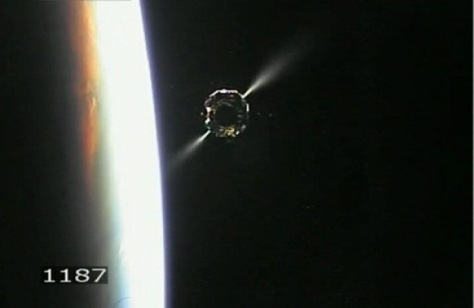
    The next surprise was the on-board cameras that were reminiscent of the space shuttle launches. As the launch vehicle cleared the launch pad and the vehicle slowly moved out of the visible range, the transmission quickly switched to the on board camera view. An animation along side showed the status. The four strap-ons separated followed by the separation of the first stage. The camera then switched to show the payload, Chang’e 3 in what appeared to be gold foil similar to what I’ve seen on Indian spacecrafts. As the second stage separated the camera switched to a view just above the twin nozzled third stage of the vehicle. An animation explained the position of the spacecraft and how the three ships in the Pacific were in constant communication with the spacecraft. It even showed the third stage lit up when the engines were burning and off when the stage was coasting in space. The view suddenly changed to the one on top of the third stage and under the Chang’e 3.

    What came next were stunning visuals of the Earth’s horizon on the left and just as beautifully the spacecraft separated. It was accompanied with a lot of dust particles that rained like confetti celebrating the separation. We also saw stunning visuals of the attitude control thrusts.

    The sunlight reflected off the spacecrafts gold foil making it look like an extremely bright object. Slowly the camera panned towards the Earth. It seems the stage was moved 90 degrees so that the top of the third stage pointed Earth. As the visual of Earth lingered strangely CCTV News went off air for me. I took that as a signal for me to head off to bed.

    On Twitter I heard news of the solar panel deployment and the announcement of the successful completion of the Long March 3B’s launch campaign. Placed on a direct trajectory to the Moon, the orbiter and lander and rover will reach the Moon on December 6 and the lander will make a soft landing on the Sinius Iridium on December 14.

    Congratulations, China and Godspeed! Chang’e 3!!

  • Journalists get a peek at the Mars Orbiter Mission

    Journalists from India (AFAIK) got a peek into the Mars Orbiter Mission spacecraft on Wednesday. The PTI copy was meticulous but dry. Pallava Bagla at NDTV still insists on calling it Mangalyaan. The other interesting pieces appeared in The Hindu and The Times of India respectively. Might also be worth looking at the links to see pictures of the spacecraft. I wish ISRO put up some pics as well so that poor bloggers like me sitting at home can post them on the blog without having to worry about copyright violations.

    The Mars Orbiter Mission, as ISRO calls it, has come through a rather demanding timeline in terms of space projects to enable it to launch during the October-November 2013 launch window that has opened up to Mars as it closes on its opposition to Earth.  At the previous such opportunity in 2011, the Russians launched the long pending Phobos-Grunt mission to Mars. China piggybacked on the mission with its own small spacecraft the YH-1.

    India also hopes to send a relatively small spacecraft to Mars. The Orbiter will launch on ISRO’s dependable rocket, PSLV using extended strap-ons. The launch itself will be set against the dramatic backdrop of the North-Eastern monsoon and the beginning of the cyclone season in the Bay of Bengal.

    As per press reports, the spacecraft will move to Sriharikota from the ISRO Satellite Center on September 27. This will be after a “national review” which is to be held on September 19. The spacecraft will be integrated on the PSLV-C25, being currently assembled at the Satish Dhawan Space Center, Sriharikota. This PSLV-XL will have slightly larger strap-on motors. The spacecraft will fly from Sriharikota and will use the help of two civilians ships in the south Pacific ocean en-route to the red planet. The spacecraft will take one year to reach Mars. In September 2014, the spacecraft will perform the critical Mars orbit injection maneuver. The first signals from the spacecraft will be received by the NASA Deep Space Network at Canberra, Australia.

    As we prepare, September will be a month of action for ISRO. As it works on the spacecraft to ensure that it is space-worthy, two civilian ships will be sent to the south Pacific ocean on September 15, 2013 from Visakhapatnam. These will help during the phase after launch and whilst the spacecraft will be headed to Mars.

    This page maintained by NASA lists mission failures of the Mission to Mars is a good indicator on why it is a good idea to leave no gaps in mission planning to Mars. Spacecrafts have wide open areas for failure – reaching Earth orbit, the coast to Mars, reaching Mars orbit and perhaps even whilst the orbiter is in orbit. One can but hope.

    Here’s wishing India’s Mars Orbiter Mission Godspeed on its journey to Mars.

  • CryptoParty in Mumbai

    The Free Software Movement Maharashtra in association with the Software Freedom Law Centre organised a Cryptoparty in Mumbai yesterday. The event was scheduled between 10 AM and 1 PM.

    Having organised Wikipedia meetups in the city, I understand how difficult it is to get a good venue for the event. But, an event could be considered useless if it’s not timed properly. Most people perhaps with the exception of IT firms work on Saturdays. So, I do not understand why the timings were kept so. Also, perhaps a time little more to the evening say like 4 PM to 7 PM or even 3 PM to 6 PM, would make it a possibility for people to leave early to work to attend the event.

    One of the reports from the event is here.

  • How Chembur’s Changed

    It has been a little over nine months since I returned from my old workplace in Bharuch, Gujarat. In this time, I’ve been lazy enough to not go out for my evening stroll through Chembur. Today, I finally made the time. I am totally amazed at the ongoing change in what was once a lazy eastern suburb of Mumbai.

    Walking out of Chheda Nagar, I see concrete and steel rise up into the air, the beginning of the Santacruz – Chembur Link Road. The project was scheduled to open in 2008 and recent reports suggest that it will not be open even in 2013. The World Bank funded project that is being built to enhance East to West connectivity has also marred some of the stunning views of sunsets and the visual observation of the planet Venus that I was offered on my evening walks. But, as the board says, Thank you for putting up with this inconvenience now to enjoy a better tomorrow.

    The Sky Walks are the next treat. The concept conceived by the Mumbai Metropolitan Region Development Authority (MMRDA) in 2007 as a way of de-congesting the area near the railway stations has been built over old shady roads that were my walking ground in days of college. It has also made me change my decade old walking path. To it’s credit, it’s not as shoddily designed and is built over a route that commuters are used to and helps them avoid going down and climbing up a flight of stairs each.

    The old BEST bus stand at Ambedkar Garden now has a commercial complex consisting of shops at the ground level and houses hospitals and coaching classes at the upper levels. It now becomes easier for kids stressed out at coaching classes to visit the doctor, I guess. The bus goes beyond this structure at the back of which the pass counters and conductors rest places have been built.

    The Central Avenue Road that stretches from the Chembur Railway Station to Diamond Garden on the Sion – Panvel Highway. This road, once a road sided with shade trees and independence era bungalows on both sides of the road, are now lined with high rises and buildings which houses several banks that have opened branches here.

    On the return road through Ahobila Mutt, Sandu Garden, Chembur Head Post Office down to the market, things almost remain the same. Here too, there are some changes. The hall where my first year birthday party was held stands torn down. The hall, my father jokes, would not have seen any event more important than my birthday party. Through the gap one can see the Monorail station coming up. Usually I was able to see the Fine Arts Society, where I gained training in carnatic vocal music as a kid. As I go to the base of the Chembur market bridge I see a skeleton of the Sky walk that would connect the monorail station to the railway station.

    As I walk to the corner store at Amar Mahal to grab a Coke, I am thankful for something remaining the same in the past decade. I do not believe that humans are built to witness this speed or scale of change around us. I think we need these things – parks, buildings and corner stores that are permanent so that we can sit, observe and contemplate on the fast changes that have been transforming Chembur. Whether for good or bad, now, only time will tell.

  • Re-use the Old Launch Pad?

    While ISRO is developing the GSLV Programme and making continuous improvements to its workhorse, the PSLV, one is left wondering at the state of rocketry in India, considered as a nation that made several bold experiments in rocketry. I just thought it would be a nice gesture to all the odd experimental rocketeers if ISRO would allow the use of the Old Launch Pad for experimental rocketry.

    The Old Launch Pad is at the southern tip of the Sriharikota High Altitude Range (SHAR), now called the Satish Dhawan Space Center. It was used for the launch of the SLV-3 and the ASLV programmes. Now-a-days it seems to be used for launching higher end sounding rocket, if I understand correctly.

    [The post had an image from The Hindu on the first SLV-3 launch from the old launch pad. Insert here if you can find it.]

    Opening a place to experiment would be a great gesture on the part of ISRO, which wants to encourage both universities and industry to participate in the Indian space programme. Without industry, it would not be able to outsource the construction of the PSLV. The industry would be more inspired if they could be more than just contractors to ISRO. One never knows what might have arisen out of a rocket industry growing in India. Perhaps an Indian company may have succeeded in developing a GSLV alternative? I do not think it is too late. As ISRO moves towards human rating its launch vehicles, there is possibility for developing industrial capability in launch vehicle technologies. Such capabilities can not only be used for launching payloads into orbit but also launching interplanetary exploration probes and landing vehicles which use rockets. It might also prove helpful in dual use technolgies providing missile capabilities to DRDO.

    For university students, challenges exist in rocket technologies that are getting developed for terrestrial exploration and interplanetary applications. It could mean trying out new fuel combinations, new rockets for Earth and space or even building high quality materials in the university lab.

  • Transit to Work

    The BEST bus came to a stop. He climbed the steps looking at the rivets that seem to hold the rickety red colour bus together. He did not feel like going to work. He was forcing himself to do it. With measured steps he climbed in.

    As he showed his pass to the bus conductor who checked it on his device to verify that the pass was valid he moved on to an empty seat. He sat next to an elderly gentleman who wore a half shirt and trousers. Sitting down he wondered about the day ahead. He remembered the work that was due today and the large pending folder. He wasn’t stressed about it like he used to be since he now worked in a public sector bank. However, his experience in the private sector always made him uncomfortable about keeping work pending. It seemed like he was adjusting to the new work culture rather slowly.

    He was brought back to the present when the bus hit a pothole. Half the passengers in the back seats were tossed up. A few cursed in various languages. He just smiled.

    Slowly, the bus got more crowded and the crowd started pushing into him. The elderly gentleman wanted to get off at the next stop. He stood up and began moving through the crowd towards the exit. Some people grumbled as they made way for him. The bus was licensed to have only 20 standees. It said so in English, Hindi and Marathi along the gangway of the bus but it always carried more than that number at peak hours.

    A little while later, it started to rain. The glass shutters were pulled down to stop the rain from getting in. He was sitting next to the window.

  • How the City Moves

    I watched Parag Khanna’s TED talk recently. This gave me a new way of thinking about how Mumbai has been changing recently.

    A slew of infrastructure projects now seek to connect Mumbai East to West. These include to some extent the Monorail, the Link Roads and the Metro. These connecting roads passing through the slums, the old industrial belt and through hills are getting widened.

    Mumbai is tilting on its axis – which was exceedingly North to South from the suburbs to the city. With the move of bulk of the government institutions and private offices to the Bandra Kurla Complex and to the western suburbs, the tilt seems to be getting more clearer. The middle class which worked in the town are now moving to the western suburbs. The local railway lines and the road infrastructure has not been built to take this tilt yet. Hence the traffic jams in the western suburbs and the link roads. The tilt is interesting because in the central suburbs are vast amount of industries and the thriving unofficial economy of the city that keeps the North South link oiled. It will be interesting to see what happens to these in the days to come.